Rest
Historical document, translated for reference. It reflects medical knowledge of the 1920s–30s and is not medical advice.
Summary
This 1930s Soviet medical article examines rest as a concept opposed to work, discussing its physiological basis, historical development under capitalism, and implementation in socialist construction. It emphasizes rest as essential for reproducing labor force while critiquing capitalist exploitation of workers' rest time.
Encyclopedia article (1928–1936)
REST, a concept usually opposed to work and labor, denoting a state of inactivity, repose, or such activities (occupations, games, entertainment, sports) that contribute to the restoration of energy expended in professional labor and to the satisfaction of physical, intellectual, and social needs. The opposition of rest to work and labor is reflected in the etymology of the word rest (ot-dykh)-to catch one's breath, to recover after heavy labor. The origin of this word is rooted in the history of slave labor and exploitation. The main purpose of R.-the reproduction of labor power. Practical measures in the organization of R. should naturally be based on the results of theoretical research on issues related to fatigue (see) and R. However, in this area, theory lags far behind practice, and in fact we still know very little about what happens in the nervous, muscular, and other systems of the body during fatigue and in the recovery period. As is known, fatigue manifests as a decrease in functional capacity of the entire organism and of individual systems and organs. If work is interrupted, then after a certain period of time-varying in different cases-the functional capacity of the body is restored, and during this period, blood pressure, pulse rate, pulmonary ventilation, oxygen consumption, and carbon dioxide output usually return to their original state, in one order or another. Apparently, during not too heavy work, both processes-fatigue and recovery-proceed simultaneously. In physiology, "unfortunately, oversimplified views on fatigue as a process of some kind of self-poisoning of the body by lactic acid and similar products still prevail. This self-poisoning is eliminated through the partial combustion of lactic acid into carbonic acid and its partial resynthesis into hexosephosphoric acid. Such a concept leads to the idea that the best means of restoring strength is rest-repose, doing nothing. In reality, the question is more complex, and fatigue is connected not only with lactic acid (if it is connected with it at all), but is determined by changes in the nervous and other systems. A change in the type of work, sports, and physical culture during R. often act much more strongly than lying in bed at a rest home; this circumstance, as well as the powerful restorative effect of physical therapeutic agents on a fatigued organism, does not at all fit with the mechanistic theory of fatigue as a result of self-poisoning by lactic acid. Generally speaking, the opposition of R. to labor and the ignoring of social factors that have a tremendous tonic effect on the working organism are completely not justified by the data available to modern psychophysiology of labor. Rest in capitalist society. The study of the history of the development of various forms of R., as they took shape in different historical epochs depending on the level of development of productive forces and production relations, awaits its researcher. As for the question of R. in connection with the history of the working class, this question has been addressed in the works of Engels and Marx. Particularly vivid are the pages devoted by Engels in his book "The Condition of the Working Class in England" to the appalling working conditions of the English proletariat, which reduced man to the level of a working beast, taking away from the worker all his time, barely leaving him time to move in the fresh air and enjoy nature, not to mention spiritual activity. Marx in "Capital" (Vol. I, Part III, Ch. 8), speaking of the struggle of the working class for a normal working day with the insatiable thirst for surplus labor among factory owners, speaks as follows about the limits of the working day and the worker's need for R.: "Man can expend during the course of a day, the natural duration of which is 24 hours, only a certain quantity of life force..." During a certain part of the day, this force must rest, sleep; during another part of the day, man must satisfy other physical needs-eat, maintain cleanliness, dress, etc. Beyond these purely physical limits, the extension of the working day encounters moral limits. The worker needs time to satisfy intellectual and social needs, the scope and quantity of which are determined by the general state of culture." "But," continues Marx, "in its boundless and blind striving for surplus labor, capital overthrows not only moral but also purely physical maximum limits of the working day. It usurps the time necessary for the growth, development, and healthy maintenance of the body. It steals the time necessary for the absorption of fresh air and sunlight. It curtails dinner time and includes it in the production process itself, so that food is given to the worker as a mere means of production... The healthy sleep necessary for the renewal and refreshment of life force, capital reduces to as many hours of stupor as are undoubtedly necessary to revive an utterly exhausted organism. Thus it is not the normal maintenance of labor power that determines the limits of the working day here, but, conversely, the striving for the greatest possible daily expenditure of labor power... sets limits for the worker's rest." The past decades have in no way softened the greed of capital, about which Marx and Engels wrote. The classic characterization given by the founders of Marxism to the capitalistic, penal-labor conditions, is to an even greater extent applicable to the working conditions in the metropolises and especially in the colonies of capitalist countries and in our era-the era of imperialism and proletarian revolution. In the conditions of capitalist production known to us, even the R. of the worker, turned into an appendage of the machine, is a form of exploitation and suppression of the working class. Pushing the worker into the tavern, poisoning him and his family with the poison of cultural and moral decay through the newspaper, theater, cinema, drawing the teenage worker into bourgeois sports and tourist organizations, the bourgeoisie has turned worker R. into one of the forms of distracting the masses from class struggle, from active political life, turning it into one of the instruments of its influence on the working people and mass propaganda for 'civil peace'. The monstrous consequences of the universal world crisis of recent years, which shook the foundations of the world capitalist economy, have deprived the proletariat of its gains in the field of labor and social legislation. Capitalist unemployment has subjected tens of millions of proletarians to horrors of poverty and extinction. The fascist policy of financial recovery at the expense of the working class has caused a catastrophic reduction in social, cultural, preventive, and medical institutions, including the network of hospitals, sanatoriums, and rest homes. Thus, the mortally wounded by the universal crisis and agonizing capitalism of our day not only takes away from the proletariat its right to health-restoring R., but deprives millions of proletarians even of the right to forced labor. Rest in the construction of socialism. The great proletarian revolution has raised over one-sixth of the globe the banner of liberated labor. Worker R. has naturally become one of the fundamental problems of socialist construction. The quantity and, above all, the quality of this R.-a powerful lever for influencing the improvement of labor, for increasing productive forces, for the growth of creative enthusiasm of the masses. The quality and quantity of R. of the worker in the Soviet state are fundamentally different from those of the worker in capitalist society. If in capitalist countries the life of the worker begins when forced, exhausting labor ends, then in the USSR R. is not opposed to labor. Complementing each other, they represent that dialectical unity in which the growth of labor productivity, by raising the level of material and cultural-domestic position of the working class and the peasantry, creates the prerequisites for expanding the base of cultural rest for the working masses, and the health-restoring, activating R. in turn enormously increases labor productivity, i.e., 'in the last analysis, the most important, the most essential thing for the victory of the new social order' (Lenin). The giant successes of socialist construction have made it possible to increase the leisure time of the working masses by limiting the working day (currently 7 hours in almost all branches of production), introducing breaks every 5-6 days for 42-48 hours, and for heavy and harmful professions even up to 60 hours, R. when working only 4 hours-40 minutes (e.g., among iron rollers) and by providing an annual decree-based vacation of up to 1 month. At the same time, Soviet labor legislation provides for special working time conditions for teenage workers, as well as for working women during pregnancy, childbirth, and breastfeeding, creating unprecedentedly favorable working conditions in history for the working youth and the working woman.
Socialist forms of labor—shock work and socialist emulation, advanced by the working class—change the worker himself, his attitude toward labor, and overturn previous notions of psychophysiological norms, thereby regularly discovering (as evidenced by world records, numerous worker brigades in various sectors of our construction) new sources of additional energy that are released in the masses by social impulses of free, creative labor under the heroic struggle for the pace of socialist construction. Under the influence of the new laws of the transitional period, concepts of labor 'norms' customary in capitalist society undergo a profound quantitative and qualitative transformation. Hence, the obvious necessity at this stage of socialist construction to approach the entire problem of R. 'in a new way' both in terms of social orientation and in relation to content. For this, the real material and technical prerequisites have already been laid and are being laid daily in the course of implementing our five-year plan. On the basis of the socialist transformation of labor, daily life, and culture, within the framework of the broad system of socio-cultural and health measures of the Soviet state, unprecedentedly favorable conditions are being created for workers to use their leisure time to restore strength, replenish knowledge, and satisfy their social and intellectual needs. At the same time, the widespread conception of R. as rest, inactivity, and laziness is fundamentally changing (and will continue to change more and more). The very content of the word 'rest', commonly understood even today in the historical sense mentioned above, is becoming obsolete through the entire course of our construction. Not rest, idleness, and laziness with their inactivating, demagnetizing influence, not plant-like 'vegetative' rest (eating, sleeping, and admiring nature), taken in isolation from current political tasks and the new socio-creative interests that have arisen in the masses, should constitute the content of R. in the country building socialism. A system of properly organized R. should activate and strengthen the will to work and correctly combine entertainment, games, engaging physical (especially militarized) and mental activities with the expansion of political, industrial-technical, and general cultural horizons. Only in this case will mass R. meet the tasks of improving the health and cultural-living conditions of the working class. Proceeding from this understanding, it is necessary to declare a decisive struggle against the biologization of R., which in practice leads to the separation of mass R. from the political tasks of socialist construction. This does not mean, of course, in the slightest degree, the need for the complete abolition of R.-rest, which is extremely important and should be widely used in individual cases (e.g., for elderly people, in cases of overwork, etc.), but by no means should it become a general rule, as is often the case. It is necessary to overcome the underestimation of the health-improving role of various forms of active, effective, dynamic R., among which, by their fundamental significance and positive influence on the psycho-physical tone of the resting person, labor processes should be placed in one of the first positions. The beneficial refreshing, invigorating influence of switching from one type of activity to another is well-known and has been experimentally verified in many cases. The alternation of mental labor with physical labor from time to time has a beneficial effect on overall work capacity. The beneficial influence of so-called corrective physical exercises, resp. labor processes (hence labor therapy), based on exercising those muscle groups that function in the opposite sense than the muscles that bear the main burden of everyday work for workers of a given profession, is also known. Thus, as we see, labor in various quantitative and qualitative combinations is a restoring, health-improving, and even therapeutic factor. It is also necessary to note the other side of the question, which has the deepest principled-political significance from the point of view of the relationship between R. and labor in socialist society. 'Labor,' says Engels, 'is the first basic condition of human existence... Labor created man himself' ('The Role of Labor in the Process of Humanizing the Ape'). Within the framework of capitalist economy, being a source of suffering, diseases, and degeneration of the masses, labor turns under the conditions of socialist construction into a conditio sine qua non of the health improvement of the masses, becoming a powerful source of beauty and the joy of life. Labor becomes 'a matter of honor, a matter of glory, a matter of valor and heroism.' The practice of our construction provides many confirmations of the correctness of this position. It is sufficient to recall the enthusiasm of advanced workers who joyfully dedicated their R. to free labor at numerous Saturday workdays, the significance of which Lenin noted in the article 'The Great Initiation.' It is sufficient to point to the experience of tens of thousands of young workers who combine their desire to know the new world being built with practical help to collective farms, with the dissemination of new forms of socialist labor, with the study of the earth's depths, with the exchange of experience between city and countryside, which has a huge revolutionary role. In these and many other examples, we have advanced models of the connection between R. and labor at the present stage. We must learn to see in these models a prototype of labor in communist society at its highest phase of development. As the classless socialist society on its path of development toward communism will increasingly subjugate the forces of nature to its rule and increase the productivity of human labor, with this will come the reduction of working time, the reduction of time necessary for social labor. Along with this, free creative labor 'itself will become the first need of life' (Marx) and will increasingly fill a person's leisure time. This will be facilitated by the blurring of the boundaries between physical and mental labor, prepared by the entire course of socialist construction (in particular, polytechnical education), which will open up boundless possibilities for workers to switch from one type of activity to another and, through the beautiful harmonious combination of free creative R. and labor, will raise this human activity to a new, higher stage. Then creative labor will become R. and rest will be in free labor. Thus one can imagine the dialectical synthesis of labor and R. in the developed communist society, without attempting at present to determine concretely the forms of their relationship in communist life. Our achievements. The conquests of the October Revolution found their vivid expression in the broadest system of socio-cultural measures, which provided the working class and working peasantry with unprecedented opportunities to use their leisure time to satisfy physical, intellectual, and social needs. The enormous improvement compared to the pre-revolutionary state of the housing and living conditions of the worker, the tremendous growth of theaters, cinema, radio broadcasting, the universally developed network of factory-club clubs, red corners, village reading rooms, etc.; the organization of parks for rest and culture and the construction of Houses of Culture in Leningrad, Moscow, and many other proletarian cities; the broadest development of physical culture and proletarian tourism, the developed network of rest homes, sanatoriums, pioneer camps, etc.; and finally the enormous development of resorts—all these represent the most important elements on which worker rest in the USSR is built. In the years of the revolution, millions of proletarians have restored their strength in well-equipped rest homes located in industrial suburbs, in healthy dacha areas, and at various resorts. According to data from the All-Union Central Council of Trade Unions, for just one year—1931, the year of the unfolding world crisis, accompanied for tens of millions of workers in capitalist countries by the horrors of unemployment, hunger, poverty, and severe deprivation—more than 1 million people passed through the network of rest homes in the USSR, enjoying free R. and treatment at the expense of special funds. In capitalist countries, as is known, workers have no free R. In Germany, for example, only a few workers manage to get a place in institutions of the type of a poor rest home at a reduced rate. It goes without saying that under the conditions of the modern capitalist crisis, due to the mass closure of rest homes, sanatoriums, etc., not only millions of unemployed but also those proletarians whom capitalism threatens with hunger every hour cannot even dream of this 'privileged' R. In light of these comparisons, the historical decision of the government of the RSFSR of November 13, 1931, is particularly noteworthy, which ensures the broadest development of the material and technical base and gives the directive to introduce mass physical culture into labor, daily life, and school both in the city and in the countryside. Main shortcomings. Despite the successes and achievements of which we have the right to be proud before the countries of the capitalist world, the development of mass worker R. is extremely lagging in quantitative and especially in qualitative terms compared to the growing needs of workers and the working masses.
The network of institutions for worker Rest consists mainly of stationary rest homes, adapted to serve workers during maternity leaves. At the same time, despite all their unquestionable achievements, rest homes in their organization and routine have not yet been rebuilt to meet the new tasks of increasing labor productivity, industrial-technical propaganda, cultural service, etc. With the enormous development of proletarian tourism and great successes of this most important form of rest for the masses, the tourist movement also lags extremely, both in volume and especially in the extremely low sanitary condition of routes and bases and the system of tourist service. The questions of Rest for the worker at the workplace, Rest on the day off, Rest for the working mother, the teenage worker, and the working family remain almost unresolved to this day. Meanwhile, there is no doubt that with new forms of labor and the increasing role of women and teenage workers in production, these very questions constitute the main link in the problem of worker Rest at the present stage. It must be stated that worker Rest—the most important area of socialist daily life and culture—still remains in the shadows, although in recent times there has been a significant growth of interest and, associated with this, but as yet clearly insufficient progress in the development of theoretical and practical work in the field of worker Rest. There is insufficient planning in the development of work on the organization of Rest. There are no accepted standards and types of construction. The latter is not based on the principles of mass character, hygiene, ease of implementation, and first and foremost, cheapness of construction. The questions of a regime that activates and increases the capacity for Rest have not been developed; there are insufficient scientific guidelines for different ages, by industry, etc. The achievements of modern technology from capitalist countries are not being applied to proletarian Rest. There is a lack of scientific and practical personnel. Major Marxist-methodologists and serious scientific-technical forces have not been involved in the development of these questions; their consideration has not been brought into the broad working audience. There is almost no literature; there is no generalization and evaluation based on Marxist-Leninian theory of the experience accumulated on site, etc. However, the shift that has emerged in recent times marks a new stage not only in the quantitative development but also in the qualitative approach to the questions of worker Rest. The fundamental feature of this new stage is that in the course of socialist construction, the prerequisites have been created to transfer worker Rest, for which special conditions were created mainly in the system of stationary-type rest homes, from this base to a much broader basis—into the urban economy, into daily life, and into labor, thereby raising worker Rest to a higher level. At this stage of its development, the system of worker Rest should cover all aspects of worker leisure in daily life, in production, and in study, on the day off and during maternity leave, and in content this system of Rest should 1) ensure that workers, along with the free choice of various healthy entertainments and engaging activities, are brought into contact with proletarian culture and with the foremost examples of art (theater, music, cinema, etc.), and at the same time 2) provide cultural and political mass activities aimed at the maximum use of worker Rest for the purposes of socialist construction and proletarian defense (political education, technical propaganda, militarization, mass political campaigns, etc.). The system of worker Rest should be maximally provided for both in worker housing and in factories, plants, rabfaks (workers' faculties), and higher technical and higher educational institutions by organizing appropriate institutions (open-air clubs, physical culture sites, swimming pools, solariums, showers, etc.), designed for the widest application of physical culture and the use of the health-giving influence of natural forces—sun, air, and water—in leisure hours. In this system, a special role should belong to parks of culture and rest as bases for various forms of Rest and near (suburban) tourism. The Rest regime should be built on the following basic requirements: 1) organization of Rest, combining the interests of the individual in the collective with the requirements of collective Rest as its basic form; 2) complete freedom of choice of activities, entertainments, labor processes, no elements of compulsion; 3) rational alternation of activating influences and measured rest, differentiated according to profession, age, sex, and physical condition; 4) rational dosage of the use of physical factors, especially the sun; 5) removal from indoors in summer and winter into the fresh air in accordance with climatic conditions (the principle of maximum aeration). The most important organizing role in mass Rest should belong to worker clubs, which as yet lag extremely far behind the requirements made of them in this respect. The entire club network with its entire system of cultural-daily life organization (in barracks, housing associations, worker settlements), with shop red corners in production, with the huge contingent of workers and women drawn into the work of cultural councils, from which the main cadres of organizers of mass Rest should be recruited, should be turned to this task. The basic forms of worker Rest should be a) Rest at the workplace, b) Rest in study during various breaks, c) Rest in daily life—in worker settlements, barracks in new construction areas, worker settlements, state farms and collective farms, in green areas near settlements, etc. As for the above-mentioned types and for maternity leave, the most important form of Rest for the main mass of workers should be tourism, both long-distance and especially near, suburban, which has the broadest prospects for its development as the most health-giving, hardening, and militarizing form of Rest. For the greatest use of the healing forces of nature in the interests of worker Rest, the health resorts and spas (seaside, mountain, steppe, forest climate stations) should be widely developed as the most effective bases for stationary-type Rest and as bases for tourism, transit and terminal points of tourist routes. Along with designing special experimental institutions built on the use of the advanced achievements of science and technology requiring the erection of special structures, the basic principle of the system of mass worker Rest should be the maximum simplicity and cheapness of all its measures and devices and their organic inclusion in the corresponding elements of socialist daily life (housing, squares, cinema, clubs, suburban cottage areas, etc.). Therefore, boldly designing new types of worker Rest institutions that stand at the level of the grand tasks and prospects of socialist construction, it is necessary to wage an uncompromising struggle against the 'leftist' tendency toward palaces and giant rest bases, which in practice leads to an underestimation of the most accessible simplest forms of Rest for the millions of urban and rural workers. Rest at the workplace. This type of Rest, otherwise called micro-rest, represents the least studied chapter. The forms of this Rest: during the dinner break, during breaks caused by the technological process (e.g. in the galosh workshop on the conveyor, a 10-minute break every hour), or during breaks introduced specially for Rest. It is especially important to provide cultural and hygienic conditions for Rest for the broad layer of worker-activists who often spend a large part of their leisure time at the plant. It is necessary to create such an atmosphere that these workers do not waste their strength during the break between shifts and public work, pushing in dirty, smoky rooms, lying on damp ground, etc. The simplest measures in plants do not require special expenditures. On the territory of the plant, it is necessary to organize a site for various open-air games, a physical therapy site with a shower installation, with a shelter from rain and sun, with lounges for the elderly and tired, with benches, etc., to ensure various forms of Rest (dynamic, quiet) and activities in the open air. It is extremely important to have appropriate organization of shop clubs, Rest rooms in canteens, etc., with the main requirement being an abundance of light and clean air with the transfer, wherever and whenever possible, of all club activities to the open air. The decree of the government of the RSFSR of June 13, 1931 obligates the provision in the construction of industrial enterprises of 'rooms for conducting physical exercises during the working day (break), and in harmful production, special rooms must be set aside for this purpose (using them simultaneously as red corners), while in harmless shops the area in the shop itself can be used; water-skiing stations, as well as land plots on the territory of the enterprise'. In recent times, at a number of enterprises (in Moscow—Elektroprom, Trehgornaya Manufactory, Goslabormediz, etc.), the so-called 'physical culture pause' has been introduced on an experimental basis, which is a specially introduced ten-minute break during which workers, under the guidance of an instructor, engage in physical culture exercises. According to preliminary data from the Institute of Physical Culture (Moscow), this experiment gives very encouraging results.
The results of numerous experiments conducted in Western Europe (especially in Germany, England) and in the USA are very indicative in this regard. Thus, Herbst (Robert Herbst) presents data on the results of applying ten-minute physical culture breaks (Pauseturnen) for telephone operators at the Berlin telephone station after 4-5 hours of work. Fatigue, particularly that increasing after lunch, almost completely disappeared, and the telephone operators returned to work refreshed. The author also presents data on the reduction in temporary disability after the introduction of breaks. At the same time, he notes that the result cannot be attributed entirely to gymnastic exercises. Vernon, Bedford, and Warner believe that the increase in labor productivity through breaks depends on the type of work. 'In production processes,' write the authors, 'that are entirely or to a large extent dependent on human labor, the influence of fatigue is so reduced by rest breaks that the increase in working capacity covers the loss of time and the overall daily productivity increases. In the same processes, which require little manual labor and are mainly performed by machine, labor productivity does not increase.' Wyatt and Ongden investigated what influence the worker's conduct during breaks has on increasing labor productivity. Vernon presents numerous data (from experience in enterprises in England and the USA) on various methods of applying breaks of different durations with a study of the influence of these breaks on the labor productivity of workers. All the author's data speak to the benefits of breaks for Rest. At the same time, he emphasizes that short breaks for Rest after short periods of work gave significantly better results than long breaks after long periods of work. 'In one factory, workers produced 16 items per hour when they had working time at their discretion. After establishing a 10-minute break after every 25 minutes of work, they began to produce 18 items per hour; when they began to rest for 3 minutes after every 17 minutes of work, productivity rose to 22, and when a 2-minute Rest after 10 minutes of work was established, the workers began to produce 25 pieces per hour.' There can be no doubt that both the cited researchers and many other authors of similar works fulfilled the 'social order' of the bourgeoisie with regard to the 'scientific' justification of the sweatshop system of labor, known as capitalist rationalization. This must be kept in mind when evaluating and accounting for the materials presented from the standpoint of the requirements of socialist construction. One of the most important tasks of Soviet science—a task not yet resolved—is to find such combinations of labor and Rest in different sequences of their alternation that, along with the highest labor productivity, would ensure the most beneficial influence on the worker. Rest in the workplace represents the most important link in the problem of worker Rest. Corresponding measures should be included in the unified cultural-domestic plans of factories. Experience shows the lively interest of the working masses in organizing healthy worker Rest. A vivid example can be the fact of the selection from the active workforce of 'friends of worker rest' (factory Goslabormediz). The guiding


м^^ I
ArlJJrlHrlJJWrfWrt««*ri

<?
4 Figure 2. Plan of a rest base (in section): 1-assembly hall; 2-premises for daily stay of day workers; 3-sleeping quarters; 4-sleeping quarters and gymnasium.
LUillllLQ
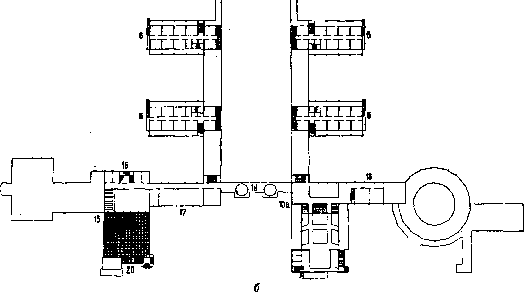
Fig. 3. Plan of a rest home: a-first floor; b-second floor; 1-vestibule with service premises; 2-living room; 3-washing rooms with showers; 4-prophylactic; 5-premises for periodic exhibitions; 6-sleeping pavilions, united by covered galleries; 7-premises for daily stay of day workers; 8-physical culture hall, open in summer, closed in winter; 9-foyer; 10-assembly hall; 10a-balcony of the hall; 11-dining room; 12-open summer courtyard; 13-kitchen; 14-internal green courtyard; 15-gallery; 16-terrace; 17-library and rooms for quiet activities; 18-lecture hall; 19-rooms for noisy games and activities; 20-open passage; 21-terrace.
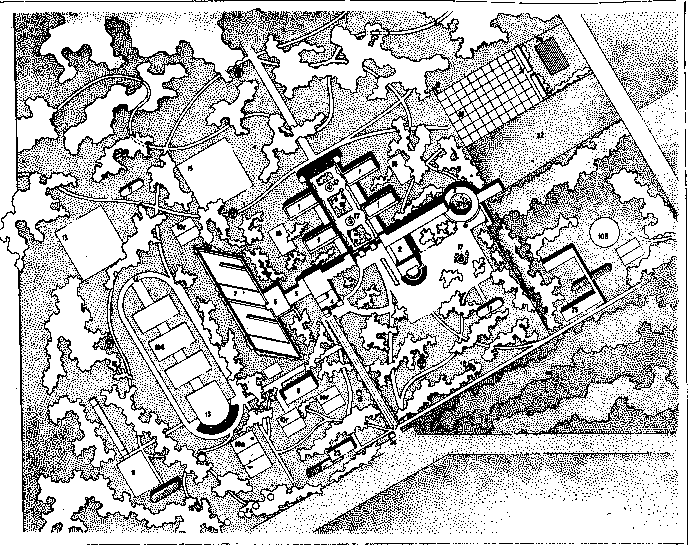
and the initiative role in the organization of R. and the utilization of the activity of the masses must lie with the health posts. The decision on this was made at the Congress of Health Posts in March 1932 (Moscow). Rest for students (in their studies), first of all in technical schools, workers' faculties, higher technical schools, and higher educational institutions, has special significance both from the point of view of mass health improvement and from the point of view of the interests of 'production' (study). Speaking about the importance of strengthening in youth their cheerfulness and life forces, V. I. Lenin pointed out (Clara Zetkin, 'Lenin and the Working Woman') that youth need: 'healthy sports, gymnastics, swimming, traveling, physical exercises of all kinds, versatility of intellectual interests, a healthy body, a healthy spirit'. In this direction the system of R. for student youth must be built, being in the highest degree linked both with study and with the combat tasks of building socialism. The decree of the Council of People's Commissars of the RSFSR of 13/XI-1931, cited above, establishes the mandatory nature of 'in the construction of new buildings for educational institutions of all types except primary schools, to provide for the installation of halls for physical exercises with auxiliary premises for mass activities, as well as to allocate land plots with physical culture grounds on them'. In the construction of buildings for primary schools, provision must be made for the possibility of conducting physical exercises in educational or auxiliary premises (classrooms, corridors) by adapting them. Tourism, excursions, sports and physical culture have received enormous, but still completely insufficient dissemination in the life of the school. For the development of a system of measures for the introduction into the everyday life of educational institutions of activating R., an experimental base has been organized by the Central Institute of Balneology in the Mechanical Engineering Institute and in the former Mining Academy (Moscow), where various forms of the R. regime are studied for summer and winter both during short breaks between classes and on the day off. Rest in everyday life. In his report at the June plenum of the Central Committee of the VKP(b) on the reconstruction of urban economy, Comrade Kaganovich said: 'We have entered the period of socialism. This means that, completing the construction of the foundation of the socialist economy and developing the industrialization of the country in every way, we must now on a broad front carry out work on the reconstruction of the material-living and cultural conditions of life of workers and the working masses on a socialist basis'. The decisions of the 17th All-Union Party Conference defined the paths for carrying out not only acute current measures, but also broad, historically important tasks of socialist reconstruction, revealed in the grand perspective of the plan of the second five-year plan. Organization of everyday leisure. Measures for the organization of everyday leisure must be built in accordance with the peculiarities of local conditions with the maximum utilization of all possibilities, however primitive they may be. At the same time, special attention must be paid to such forms of organization of R. that would be most accessible to the working masses and would ensure the widest coverage of the free time of workers. In industrial centers and in workers' settlements of new construction, the most important base for mass R. should consist of measures for improvement, carrying out of green plantings, putting in order of squares, use of suburban green areas, etc. According to the resolution of the Council of People's Commissars of 13/XI-1931, 'in the course of communal construction, construction of swimming pools with auxiliary premises at large city bathhouses, swimming pools, beaches and public showers must be provided. In the construction of clubs, houses of social and physical culture, structures for physical exercises, auxiliary premises, land plots with physical culture grounds on them, water-skiing stations, etc., must be provided'. Next to workers' dwellings, areas for games, sports, sun-air baths with the simplest equipment should be organized. Unified cultural-everyday plans at factories (e.g. at the Verkhneisetsky) provide for 1932 the development of a broad system of R. in factory settlements both for adults and for teenagers with the involvement of instructors, etc., for this purpose. The organization right there of kindergartens and nurseries (together with the installation of laundries) frees the working woman and her leisure time. With extremely small funds required for carrying out the simplest measures for R. in everyday life, it is here that the most important, and sometimes decisive role, as experience shows, is played by the initiative of local organizations, the mobilization of the self-activity of the masses and internal resources. Rest of the day off must be built on a widely developed network of R. in everyday life so that the worker and his family can culturally spend their leisure time right next to their housing. However, there is no doubt that in the problem of R. of the day off, special bases, parks of rest and culture and mass suburban tourism should play a major role. Bases for R. of the day off can be designed for organized daily, 24-hour and 40-48-hour R. for summer and year-round operation. Depending on the nature of their purpose, they can vary in their forms. The simplest adaptation of suburban green areas near worker centers requires the allocation of forest plots with convenient communication routes, maintaining cleanliness and order on these routes and areas, equipping them with benches, shelters for protection from bad weather, supplying boiled water, mobile and food stalls, etc. Bases for R., where the worker has the opportunity to spend the entire day off with an overnight stay, located near worker housing, in a dry, elevated, if possible forested area, must be equipped with at least primitive, but all necessary installations for cultural and health-improving R.: 1) sanitary-cultural and health-improving complex-pass of the simplest type, solariums, river beach, physical culture grounds, lavatories; 2) cultural complex-reading rooms, corners for club games (checkers, chess), for political enlightenment work, technical training, exhibitions, consultations, open stage, cinema; 3) complex of R. and public catering: premises for R. with hammocks, couches, kitchen, dining room, etc. At the bases, children's corners must be created for serving preschool and school-age children arriving with parents. The corners must have specially equipped areas for games and activities, etc. All the listed installations and structures must be of the lightest type in the form of awnings, verandas from local building materials. For summer, the installation of tents should be widely used. The Central Institute of Balneology (Moscow) has developed a design for an experimental base with a capacity of 500 people per day of rest for one-day and 24-hour visitors for the whole year. The base is designed to serve a large enterprise with 15,000-20,000 workers and provides for a quite cultural and hygienic environment corresponding to the regime of activating dynamic R. (see design-art. 185-192). Parks of rest and culture - see Green plantings. Suburban tourism. In serving the broad masses of working people with properly organized worker R., tourism must play an enormous role. Unfortunately, tourism in our country is still completely insufficiently widespread. Questions of 'rest at the end of the week' (Weekend; Wochenenderuhe) have in recent years been the subject of great interest abroad. Types of special light inexpensive buildings have been developed, special exhibitions are organized, illustrated publications are published. A special industry of portable equipment has grown, etc. All this is not intended for the working mass, but for the bourgeoisie, bureaucracy and for satisfying the demands of private individualistic economy, petty-bourgeois, cozy bourgeois comfort. However, there are many achievements in organization and technique, in particular in creating a hygienic and convenient environment for travel and camp life, samples of which, especially in Germany, remain unsurpassed in ingenuity and cheapness. We need to transfer the best of these achievements to us, adapting them for serving the broad proletarian masses. 'We need to give in these parks the same conveniences as are given in European cities with that 'small' difference that there these conveniences are used by capitalists, and with us they will be used by proletarians-blacksmiths, turners, weavers, locomotive engineers, cobblers' (Kaganovich). We must set as a combat task the creation, to begin with, in large proletarian centers, of 1-2 routes to the nearest suburban forest areas, organize R. bases in them, make it possible in the near future for mass worker gatherings in conditions of minimally necessary conveniences and hygiene. For this, it is necessary to build pedestrian paths, good dust-free highways for automobiles and bicycles, hygienic inexpensive cafes, dining rooms, kiosks with refreshing drinks, verandas where one can take shelter from rain in summer, heated premises for winter tourism, organize ski, water stations, provide areas for children, etc. All this is extremely simple and should not present particular difficulties if one does not chase after capital structures and widely uses camp-type equipment.'
When designing suburban rest bases, it is necessary to keep in mind the possibility of applying certain therapeutic factors here for the numerous category of patients who, without any necessity, have been flooding our resorts to this day. Here, treatment for rheumatics, gout sufferers and other patients with mud or therapeutic peat, artificial mineral waters or various methods of physical therapy can be successfully applied. Such planning near cities and new climate stations and health resorts, along with powerful, well-equipped bases of Rest, has great advantages from the point of view of the most rational use of large capital investments. However, it must be based in planning not only on general sanitary considerations (e.g., isolation of tuberculosis patients), but also on a strict accounting of all the differences in requirements presented to Rest institutions—for the healthy and for treatment of the sick. It is on this very principle of comprehensive planning that the Green City near Moscow was planned (see). Rest in the form of a decree leave, as indicated, represents a form that has received the greatest prevalence in the USSR. Decree leaves for workers are provided in rest homes (see). Stationary homes, despite their undoubted achievements and the enormous positive work they have carried out, have ceased, due to the nature of their regime, to satisfy a significant portion of workers today. According to reports in 1931, the contingent of rest homes consists of 50-55% of workers under 30 years of age, who, according to their intellectual, physical and social needs, do not need the uniform, quickly tiring stay in a rest home, but tourism in all its diverse forms and types. Questions of organization, planning and scientific substantiation. 1. Organization and planning. The development of worker Rest as a synthetic problem, related to issues of labor, everyday life and culture, depends on the work of industry, municipal services, healthcare, cooperatives and many other organizations. It is necessary to combine scattered forces and resources and use them in a planned manner. It is necessary to create experimental bases, model institutions in factory enterprises, in state farms, MTS, collective farms. It requires the involvement of interested institutes, the Academy of Municipal Economy, etc., broad training of scientific and practical personnel, use of foreign experience, creation of a special journal, convocation of periodic scientific conferences—and as the main decisive condition—the mobilization around the work of organizing Rest of broad proletarian public opinion. Questions of organizing worker Rest have not yet found their final resolution. The first experience in combining all types of worker Rest is represented by the plan of the People's Commissariat of Health of the Ukrainian SSR for 1932. The project submitted to the government of Ukraine provides for the assignment of general leadership to the People's Commissariat of Health and the creation of special administrations in city councils of major industrial centers, which should manage the organization of mass worker Rest on a cost-accounting basis, attracting insurance funds, trade union organizations and others. In the Urals, regional organizations have decided to create special commissions—a regional one at the Urals Trade Union and district ones at district trade union councils. The All-Union scale planning of worker Rest is carried out by the USSR State Planning Committee. 2. Personnel for worker Rest. On the broadest basis of measures to ensure worker leisure in the USSR, significant cadres of organizers of rest homes, physical culture workers, and cultural workers have been trained. However, these cadres are completely insufficient in number and are not prepared for the tasks of implementing worker Rest in a new way. Hence the most important role of the accelerated training of scientific workers—methodologists and researchers in the field of the most effective forms of Rest and rational tourism and the formation of cadres of trained organizers and cultural workers. Work in this direction has only just begun. Questions of worker Rest and tourism are being introduced into teaching (a course at the department of balneology at the Institute for Advanced Medical Studies in Moscow), training of graduate students has begun, a system of courses for training and retraining various categories of workers has been designed. This work is still clearly insufficient and runs up against the weakness of the scientific base, lack of experienced teachers and manuals, and underestimation of the need for a new profile of workers in Rest and tourism. 3. Material and technical base. The prospects for the development of worker Rest and tourism raise with all acuteness the questions of material and technical equipment of all kinds: for mobile games, activities, visual aids, physical education equipment, tourist camping gear, sanitary-technical equipment for physiotherapy sites and other health-improving structures on Rest bases, etc. It is necessary to develop the most convenient, inexpensive and durable products and standards for their mass production. The development of mass production of the mentioned and many other items of construction, equipment and gear is one of the fundamental tasks in the plan of the second five-year period and must be taken into account by the corresponding branches of industry. 4. Scientific substantiation. The scientific development of questions of worker Rest has been entrusted by government bodies of the RSFSR to the Central Institute of Balneology (Moscow). In 1931, the Institute developed typical institutions for day-off Rest, basic provisions and tasks for the design of a day-off Rest base for the Park of Rest and Culture in Sverdlovsk, an expanded plan of health-improving measures according to the scheme of the general design of Sokolniki Park in Moscow, and a plan for organizing rest for higher technical educational institutions and others. At the same time, a number of works were carried out on studying the effectiveness of tourist trips under different conditions of their conduct. By a group of institute employees (Orlyuk, Nevraev, Model), the influence of day-off Rest on textile workers was studied. It turned out that the group of resters who systematically spent their days off in a rest home during a month showed a marked improvement in a number of indicators of the state of the nervous system, metabolism, blood composition, improvement of memory, attention, etc. A very significant growth compared to the control group was also obtained in the same group of resters in terms of the amount of output produced (among weavers of the Krasnokholmsk factory who rested 6 days during January, labor productivity increased by 7%, among weavers of the 'Osvobozhdeny trud' factory who used rest for 12 days off in January and February—by 10%). Scientific research work should unite scientific institutes on the theoretical development of fundamental problems, which are: study of the most effective forms of Rest in various conditions in the city and in the socialist sector of the countryside in connection with overcoming the opposition between city and village; the problem of collective Rest; labor processes as forms of Rest for various professional groups; the problem of alternating labor and Rest from the point of view of increasing labor productivity; the history of Rest in different epochs depending on production relations, etc. The development of the theory of socialist Rest should be carried out on the basis of Marxist-Leninist theory, in the struggle against all distortions. It should develop in an irreconcilable struggle against the right-opportunist underestimation of mass worker Rest, against apoliticism, against misunderstanding of the principles of mass character and collectivism in Rest as instruments of the socialist re-education of the masses. Along with this, it is necessary to give a decisive rebuff to left-wing attempts to turn worker Rest into a continuous switch to labor (identification of Rest and labor), to fill the worker's leisure time with continuous meetings. These attempts ultimately pose a threat to deprive the worker of a culturally activating Rest, to restrict 'the free play of his intellectual and physical forces' (Marx) and to detach worker Rest from the fundamental tasks of building socialism.
Related articles
Mentioned in
Cite this page
“Rest.” Soviet Medical Encyclopedia. English translation of Bolshaya Meditsinskaya Entsiklopediya, 1st ed. (Moscow, 1928–1936), ed. N. A. Semashko. https://sovietmedicalencyclopedia.pages.dev/article/rest/