Opisthotonus
Historical document, translated for reference. It reflects medical knowledge of the 1920s–30s and is not medical advice.
Summary
Opisthotonus is a severe spasm in which the head and heels are bent back and the body bows forward. It can result from organic nervous system diseases like meningitis or tetanus, or from psychological causes in hysteria.
Encyclopedia article (1928–1936)
Opisthotonus (from Greek opisthen- meaning backward and tonos meaning tension), a convulsive posture caused by combined tonic contractions of the extensors of the back, neck, and head; see illustration
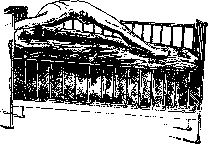
Opisthotonus during a major hysterical seizure (according to Charcot).
sometimes this is accompanied by extreme extension of the limbs, especially the lower ones (see illustration). In opisthotonus, the spine is raised and curved in an arch concave to the back; the patient rests on the bed with the head thrown back and the buttocks or heels, while the body hangs in the air. The origin of this phenomenon, judging from the results of experimental and clinical studies, is twofold. Sometimes, for example in poisoning of frogs with strychnine, opisthotonus represents a complex reflex act in response to external stimuli, even minimal and therefore difficult to detect. This type is characteristic of opisthotonus in humans in leptomeningitis and tetanus, where sometimes touching the patient, a slight noise already causes opisthotonus. On the other hand, removal of both hemispheres of the cerebellum in dogs and cats also causes opisthotonus. Probably the cerebellum has a depressing effect on the tone of the extensors; therefore, after removal of the cerebellum, their hypertonia occurs. Similarly, in humans, opisthotonus is sometimes observed with cerebellar tumors. From opisthotonus occurring in the aforementioned severe organic diseases of the nervous system, hysterical opisthotonus should be distinguished. In hysteria, opisthotonus is one of the phases of a major seizure ("arc de cercle en arriere", according to Charcot), has a psychogenic nature and is a reflection of the emotionally colored experiences of the patient. In recent years, hysterical opisthotonus occurs less frequently than in Charcot's time and does not reach such a severe degree.
m. neiding.
Related articles
Mentioned in
Cite this page
“Opisthotonus.” Soviet Medical Encyclopedia. English translation of Bolshaya Meditsinskaya Entsiklopediya, 1st ed. (Moscow, 1928–1936), ed. N. A. Semashko. https://sovietmedicalencyclopedia.pages.dev/article/opisthotonus/