Stalagmometry
Historical document, translated for reference. It reflects medical knowledge of the 1920s–30s and is not medical advice.
Summary
Stalagmometry is a method for measuring surface tension by counting the number of drops from a vertical capillary tube. It relies on Tate's law and is used to determine the surface tension of liquids like serum, bile acids, and blood.
Encyclopedia article (1928–1936)
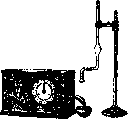
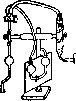
STALAGMOMETRY (from Greek stalagma-drop and metron-measure), or the drop method, is a method for measuring surface tension (see) of liquids by counting the number of drops into which a certain volume of liquid breaks when flowing from a vertical capillary tube called a stalagmometer. The method is based on Tate's law, which states that a drop forming on a horizontal circular surface detaches when its weight becomes equal to the product of the surface tension and the base of the drop. With the same area of detachment, the weight of the drop is proportional to the surface tension; therefore, with a decrease in the surface tension of the liquid, the number of drops flowing from a given volume of the tube increases, and vice versa. Although Tate's law is not absolutely correct, for practical purposes the proportionality can be considered almost absolute (Lohnstein, Livingstone-Morgan, etc.). Traube's stalagmometer "consists of a straight or bent at a right angle (see Dropper) (Fig. 1 and 2), precisely calibrated tube with an expansion between two marks applied on it indicating the volume of the given instrument. The lower end of the tube, from which the drops must detach, is smoothly ground. The instrument indicates its capacity and the number of drops of water flowing from it at t° 15°. The measurement is performed as follows: the test liquid (serum) is drawn into the instrument with a rubber bulb to the upper mark and fixed with a clamp in a vertical position. The liquid is allowed to flow drop by drop to the lower mark while counting them simultaneously. The counting of drops can also be performed automatically by means of an automatic counter proposed by the Gergardt firm. Each drop falling from the stalagmometer onto a special celluloid plate closes a circuit, which with the aid of an electromagnet moves a clockwork mechanism counting the number of drops that have flowed. Thanks to the graduation applied on the instrument, a reading accuracy of 0.05 drop is possible. Before use the apparatus must be thoroughly washed so that it does not contain any traces of fat. The same applies to the ground surface. It is necessary to ensure that the entire ground surface is completely wetted by the test liquid. The liquid column in the apparatus must not be interrupted by the slightest air bubbles. Non-observance of these conditions can lead to an erroneous determination of surface tension. The determination should also be carried out at a certain t°, since with an increase of t° by 5° the number of flowing drops increases (approximately one drop for every 100 drops of water). The number of drops flowing in a unit of time—in 1 minute—should not exceed 20. If a liquid is being investigated that flows with a greater number of drops in 1 minute, it is necessary to slightly close the upper opening of the apparatus with a finger. On the contrary, with a strongly slowed flow of drops, it is necessary to slightly press on the liquid column with a rubber bulb to accelerate the flow of the liquid. It is recommended to use different apparatuses for liquids of different viscosities. For blood it is more convenient to use a straight instrument. For regulating the speed of drop flow, Schemensky proposed connecting the upper opening of the stalagmometer with a wide test tube filled with liquid paraffin (Fig. 3). Through the stopper tightly closing this test tube, two glass capillaries are passed. One of them is immersed in the paraffin with one end, the other serves to connect the test tube with the stalagmometer by means of a rubber tube. Depending on whether we have a slowed or accelerated flow of drops, the paraffin capillary is correspondingly lowered or raised.
Figure 3. Schemensky's apparatus.
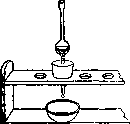
Czapek's stalagmometer consists of a bent glass tube having a diameter of 12 mm and ending in a Fleischel-Micher capillary. Water is poured into the tube up to the mark, and into the cup---the test liquid. The capillary is immersed in it by 1-1/2 mm. To the open limb drops of distilled water are added dropwise until the air in the closed limb under the pressure of the liquid column overcomes the surface tension of the test liquid in the cup and appears inside it. The amount of added water is a measure of the surface tension of the test liquid. The unit of surface tension of distilled water at a temperature of 16° equals 4.6-4.7 drops. Calculation. If we take the surface tension for water as 100, then for the test liquid it will be equal to =, x 100 (1), where Z is the number of drops of the test liquid, and Z0 is the number of drops of water in equal volumes. Since the liquid being investigated has a specific gravity differing from that of water, it is necessary to take this into account and introduce this factor into formula (1) and then we obtain: a = я x 100 x уд. в. (2) — the expression of surface tension in percentages relative to water. One can also express a in absolute units of surface tension of water relative to the surrounding medium, namely air. Since the surface tension of pure water in this case will be equal to 7.30 mg/mm, the expression a in mg/mm should be performed by the formula a= ~x x уд. вес x 7.30 mg/mm, or, if we take the surface tension of water as 75 dyn/cm (Iscovesco), then <т = -^ X уд. вес x 75 дин/ом. According to Traube, the surface tension of serum is lower than that of water and expressed in drops equals 109-112 drops at t° 15°. For clinical purposes it is quite sufficient to use the first or second formula when determining the surface tension of serum or other liquids. Rona and Michaelis (Rona, Michaelis) instead of Traube's slowly dripping stalagmometer
Steffa-
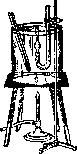
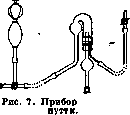
proposed a quickly dripping pipette, with a capacity of about 3 cm3; it ends at the bottom with a slightly narrowing point and possesses not very thin walls (Fig. 4 and 5). If it is desirable to work not at room temperature, but at a higher one, one can use Rona and Michaelis's pipette immersed in a water bath (Fig. 6), or the Steffa-Nutti apparatus (Fig. 7). Stalagmometry finds application in the clinic of liver diseases, for determining bile and fatty acids in urine and blood serum that lower surface tension. An increased content of inorganic salts raises the surface tension of the liquid. Stalagmometry also finds application in bacteriology and serology in the form of the meyostagmin reaction (see Ascoli meyostagmin reaction).
Related articles
Mentioned in
Cite this page
“Stalagmometry.” Soviet Medical Encyclopedia. English translation of Bolshaya Meditsinskaya Entsiklopediya, 1st ed. (Moscow, 1928–1936), ed. N. A. Semashko. https://sovietmedicalencyclopedia.pages.dev/article/stalagmometry/