Dropper
Historical document, translated for reference. It reflects medical knowledge of the 1920s–30s and is not medical advice.
Summary
This article from the 1928–1936 Soviet medical encyclopedia describes various types of laboratory and medical droppers, including stalagmometers, pipette-style droppers, and dropper-bottles. It also details the physical factors that influence drop size, such as liquid viscosity, surface tension, and the cleanliness of the dispensing orifice.
Encyclopedia article (1928–1936)
DROPPER, a device for measuring drops. The main types of droppers are as follows. 1. Traube stalagmometer (J. Traube; Fig. 1). Used only for precise work; the accuracy of readings is up to 0.003 cm3. 2. Droppers of the pipette type with rubber caps. Used most often for counting eye drops (Fig. 5). A dropper of this kind, but with the condition that the outer diameter of the orifice releasing the drop is equal to 3 mm, is accepted as the international standard drop-measure (Fig. 4). A standard drop-measure must, at 15°, yield drops of distilled water with an exact weight of 0.05 g each (Ph.U.I.). Similar pipettes are also ground into bottles; for more precise measuring, graduations in fractions of cubic centimeters are marked on them (Fig. 3). 3. Dropper-bottles are of two types: with an edge slightly drawn out in one place (bottles with a spout) or with a stem soldered to a ground-glass stopper (Fig. 2). 4. A glass rod bent at an angle can serve as a dropper, provided that there is a sufficient amount of liquid in the vial so that it is not necessary to tilt the vial too much.
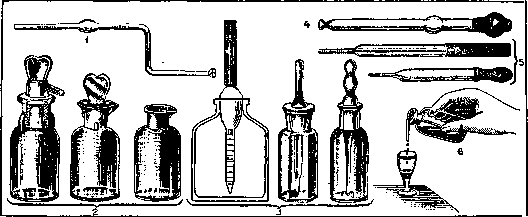
Porcelain clay is a product of the weathering of feldspar, a colloid possessing strong adsorption properties, a whitish earthy mass. It is insoluble in water but forms a homogeneous, plastic mass with it. For medical purposes, kaolin is used, pre-treated with weak HCl and then elutriated. Kaolin is used for clarifying wine, beer, etc. It serves as a mass for pills with silver nitrate and potassium permanganate. In cosmetics, kaolin is a component of powder, and in dusting powders thanks to (Fig. 6). The size of the drops depends on many conditions: first of all, on the physical properties of the liquid (specific gravity, cohesive force of particles, or viscosity, surface tension), then on the wetting of the glass by the liquid, and consequently also on the cleanliness of the glass at the point of drop formation. Even weightless traces of grease (e.g., due to accidental contact of the hand with the orifice) or dust are enough to significantly change the size of the drops. Evaporation of the solution at the site of drop formation also changes the conditions of drop formation; drops of different sizes are obtained depending on whether the orifice is wetted only inside or also outside. All these reasons make it necessary to consider dropper-pipettes ground into bottles as more accurate; dropper-bottles with a soldered stem are less accurate, and bottles with spouts and rods for counting drops are very inaccurate. Besides the listed reasons, the size of the drops depends on the shape of the cross-section of the drop-formation site, on the degree of filling of the dropper, on the temperature, and finally on accidental vibrations during the counting of drops. When wishing to receive medicine in a dropper-bottle, one notes in the prescription: D(etur) ad vitr(um) gutt(atorium);
Related articles
Mentioned in
Cite this page
“Dropper.” Soviet Medical Encyclopedia. English translation of Bolshaya Meditsinskaya Entsiklopediya, 1st ed. (Moscow, 1928–1936), ed. N. A. Semashko. https://sovietmedicalencyclopedia.pages.dev/article/dropper/