Dialysis
Historical document, translated for reference. It reflects medical knowledge of the 1920s–30s and is not medical advice.
Summary
Dialysis is the process of freeing colloids from crystalloid impurities through the diffusion of the latter through membranes impermeable to colloids. This method, developed by Graham, is used for separating colloids from crystalloids and for purifying colloidal solutions.
Encyclopedia article (1928–1936)
DIALYSIS, the freeing of colloids from crystalloid impurities through the diffusion of the latter through membranes impermeable to colloids. One of the most important differences between colloids and crystalloids, which led Graham to distinguish between these two groups, is their different behavior during both free diffusion (see) and especially during diffusion through membranes. Crystalloids pass freely through various animal or vegetable membranes (e.g., parchment, pig's bladder, fish swim bladder, etc.), while colloids are retained by them. Based on this, Graham proposed a convenient method for separating colloids and crystalloids. He called this method dialysis, and the apparatus used for it a dialyzer. Dialyzers. Graham's dialyzer consists of a cylindrical ring on the lower side of which a membrane of parchment or similar material is stretched and tightly tied. The ring with the liquid for dialysis floating on the surface of a vessel with distilled water (Fig. 1). If, for example, an aqueous solution of sugar and gum arabic is placed in the ring, the latter will be retained by the parchment, while the sugar will diffuse into the water. If the water is changed frequently enough, then through prolonged dialysis, practically all the sugar can be extracted from the mixture. At present, very diverse designs of dialyzers are used. Instead of natural membranes, artificial membranes are often used for them. Membranes made of collodion offer very great conveniences. First, according to the shape of the vessel on whose walls the collodium is deposited, they can be given any desired form. On the other hand, depending on the method of preparation, collodion membranes can be made more or less permeable. To prepare the membrane, collodium dissolved in a mixture of absolute alcohol and ether is usually used. The prepared membrane is dried in the air for a short time, then immersed in water. Longer drying makes the collodion membrane less permeable; the same result is achieved by using collodion solutions containing a higher percentage of ether, less alcohol. The original concept drew a sharp line between colloids and crystalloids; at present, gradual transitions between these two states of matter are known. Therefore, by carefully calibrating—by the indicated or other methods—the permeability of the membrane, it is possible not only to separate crystalloids from colloids, but in some cases even to fractionate the latter. Besides the material (which is most often collodion or parchment), the form of dialyzers is also subject to various modifications. To accelerate dialysis, it is necessary that the membrane (for a given amount of liquid) have the largest possible surface area and be washed as well as possible by new portions of clean water. In Kühne's dialyzer, it is a long U-shaped parchment intestine immersed in running distilled water (Fig. 2). The "star dialyzer" of Zsigmondy works especially quickly and economically. A cylindrical ring with a membrane (Fig. 3, B) stands in it on a base having radial partitions (A). Clean water enters through a tube in the center of the base, moves radially to the periphery, washing the membrane with a thin layer and flowing off at the edge.
Figure 2.
Figure 3. Star dialyzer: A - base; B - ring with membrane. Above - view of the base from above.
periphery of the dialyzer
Electrodialysis. The speed of dialysis, like ordinary diffusion, depends on the random molecular movements of the dissolved substances. It can be increased many times by the application of electrical forces. For this, on both sides of the semipermeable membranes surrounding the colloidal solution, two electrodes are placed and a significant potential difference is applied to them (Fig. 4; Pauli's electrodialyzer). Ions leave the central part of the apparatus, attracted to the opposite poles, and are washed out from the electrode spaces by running water. This method, representing a combination of dialysis and electrolysis, was introduced into science mainly through the work of Dhere, and then Pauli. In many cases, it gives very good and fast results, proving to be significantly more effective than ordinary dialysis. Of course, electrodialysis serves only for the purification of colloids from ions, not from non-electrolytes. A simple homemade apparatus for electrodialysis is described by Baer. Compensatory dialysis. Dialysis finds application not only for the purification of colloids from crystalloid impurities, but also for a more precise study of the latter. On the basis of only a chemical analysis of a colloidal solution, nothing can be said about the state in which the crystalloid substances contained in it are. For example, the calcium contained in the blood can be chemically (or adsorptionally) bound to serum proteins, can be in a freely diffusing state in the form of some undissociated organic compound, or can consist of free ions. Meanwhile, the state of the electrolyte in the solution (in particular the relative content of its colloidally bound, freely diffusing, and ionized fraction) has incomparably greater significance than its total content. It cannot be established by means of ordinary dialysis, just as it cannot be by chemical analysis. Indeed, crystalloids, especially electrolytes, usually form with colloids very unstable, easily decomposable compounds. When dialyzing blood serum, not only freely diffusing calcium will pass into the dialysate: its removal, disturbing the established equilibrium, will cause further decomposition of the colloidally bound calcium, which can gradually completely diffuse through the membrane. To resolve the question posed, Michaelis and Rona developed the method of compensatory dialysis. Its essence is that instead of distilled water, the colloidal solution is washed in the dialyzer with various concentrations of the substance being studied. For example, to solve the question of whether calcium in blood serum is bound (and to what extent) to serum proteins, blood serum is dialyzed against an isotonic salt solution to which various amounts of calcium salt are added. The calcium content will remain unchanged during dialysis only if the external solution has the same concentration of free lime salt as the serum. Only under this condition will the tendency of calcium to pass into the dialysate be osmotically compensated by its concentration in the latter. In this way, it was found that in the blood serum of horses, about 35% of calcium is bound by colloids. The same method was used to study the state of sugar and other substances in the blood. However, later research forced a re-examination of both the principle underlying compensatory dialysis and the results obtained by it. At first it seemed unquestionable and obvious that at diffusion equilibrium each diffusing substance must be in exactly the same concentration on both sides of the membrane. However, the research of Donnan showed that the presence of colloids (more precisely—colloidal electrolytes) affects the distribution of crystalloid ions on both sides of a membrane permeable to them. Some ions are retained in the colloidal solution, others are displaced in excess into the dialysate. Therefore, the concentration of the ion being studied in the dialysate is not always equal to the concentration of the same ion in the colloidal solution, and the figures obtained by means of compensatory dialysis therefore need to be recalculated (which is not always easy to do). The distribution of ions on both sides of the membrane (between the colloidal solution and the dialysate) received the name membrane equilibrium or Donnan equilibrium. Vivi-diffusion. In the interesting method of vivi-diffusion (Fig. 5), developed by Abel and his collaborators (Rowntree, Turner), dialysis was successfully applied for the isolation and quantitative study of cry
Figure 5. A - cut vessel; B - collodion tubes; B - inflow and outflow of washing liquid; Г - thermometer.
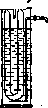


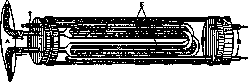
of colloids from the blood of a living organism. Blood (to which a little hirudin has been added to prevent clotting) is drawn from an artery by a cannula, passed through a series of collodion tubes immersed in a warm Ringer's solution, and returned to the bloodstream by a second cannula. Thus, while maintaining the normal course of blood circulation, blood can be passed through a collodion dialyzer for extended periods. Substances dissolved in the blood diffuse into the external Ringer's solution until equilibrium is reached (and in the case of crystalloid non-electrolytes, complete equilibrium) between their concentrations on both sides of the collodion wall. By comparing the dialyzate of blood from vessels entering and leaving an organ, one can judge the transformation of the substance under study in that organ. The same method has recently been applied for "blood washing" in humans (Haas; 1928). Blood, whose clotting has been prevented by heparin, passing through a collodion tube, is freed by dialysis of the toxic products contained in it and is then returned to the bloodstream.
D. Rubinstein.
Related articles
Mentioned in
Cite this page
“Dialysis.” Soviet Medical Encyclopedia. English translation of Bolshaya Meditsinskaya Entsiklopediya, 1st ed. (Moscow, 1928–1936), ed. N. A. Semashko. https://sovietmedicalencyclopedia.pages.dev/article/dialysis/