Desalinator
Historical document, translated for reference. It reflects medical knowledge of the 1920s–30s and is not medical advice.
Summary
This article describes the two primary methods for water desalination used in the early 20th century: distillation and electrolysis. It details the mechanical components of distillation units used on ships and in municipal water systems, as well as the electrolytic process for removing salts from water for industrial and laboratory use.
Encyclopedia article (1928–1936)
DESALINATOR, an apparatus used to obtain water with a lower salt content or completely free of salts from seawater. At the present time, two types of desalinators are used in practice: in some, desalination is achieved by boiling water (distillation), and in others, by electrolysis. Desalinators of the first type (Fig. 1) are installations that operate with the most rational use of the heat expended on heating and distilling the water. Apparatuses of this type are usually installed on warships. In Russia, such installations existed in Baku, Krasnovodsk, and Vladivostok for the desalination of seawater to supply municipal water systems before the construction of water pipelines from freshwater sources. Desalinators of the second type (Fig. 2), which use electrolysis processes, are electrolytic baths in which the electrodes are separated from the rest of the bath space by semipermeable porous partitions.
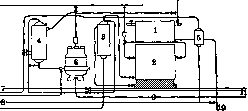

Figure 1. 1-evaporator; 2-cube with coils for preheating water; 3-condenser for the resulting drinking water; 4-second condenser; 5-filter (usually charcoal) for the final improvement of water properties; 6-pump; 7-pipe supplying water for washing; 8-pipe for drinking water; 9 and 10-pipes for water from the sea; 11-pipe for discharging cooling water.
The electrolysis is performed with direct current; the ions of the water salts are carried by the current to the anode and to the cathode; thus, an increase in salt concentration occurs in the water near the electrodes, while desalinated water is obtained in the middle of the bath between the semipermeable partitions. For practical purposes, installations are built having up to 70 such individual bath-cells; the water passes through them sequentially and is thus gradually freed from salts. To obtain water completely free of salts (distilled) from water with a dry residue of 200-600 mg per 1 liter, 10-30 kilowatt-hours per 1 m3 of water are required. Figure 2. A-anode; A-space where desalinated water is formed; K-cathode; P-semipermeable partitions. Such installations are built in Germany and are used on ocean liners to obtain drinking water from seawater, as well as in laboratories to obtain distilled water and, in individual cases, at enterprises needing particularly pure water (in the production of artificial silk, pharmaceutical preparations, etc.), to purify tap water to the necessary degree of purity, etc.
Related articles
Cite this page
“Desalinator.” Soviet Medical Encyclopedia. English translation of Bolshaya Meditsinskaya Entsiklopediya, 1st ed. (Moscow, 1928–1936), ed. N. A. Semashko. https://sovietmedicalencyclopedia.pages.dev/article/desalinator/