Deodorization
Historical document, translated for reference. It reflects medical knowledge of the 1920s–30s and is not medical advice.
Summary
Deodorization is the process of eliminating foul-smelling gaseous products of decomposition such as NH3, H2S, volatile fatty acids, methane, skatole, and others. This article describes various physical and chemical methods used in the 1930s to deodorize air, waste, water, corpses, and spoiled food products.
Encyclopedia article (1928–1936)
DEODORIZATION (from Latin de- negative particle and odor-smell), the destruction of foul-smelling gaseous products of decomposition-NH3 and its compounds, H2S, volatile fatty acids, methane, skatole, and others. Objects for deodorization include: spoiled air in rooms, excrement and their receptacles, certain types of domestic and industrial solid waste, wastewater, human and animal corpses, spoiled food products. Good ventilation, proper construction of latrines and receptacles for household waste, as well as cleanliness are the best means for combating malodors. Deficiencies in these measures necessitate the use of additional physical and chemical methods of deodorization. In places of public use (baths, barracks, lodging houses, meeting halls) and in the food industry (slaughterhouses, refrigerators) ozone (O3) is used in addition to ventilation for removing foul odors. It is introduced into rooms along with fresh air coming from ventilation systems (see illustration). Ozonization without ventilation should not be carried out in rooms where people are present.
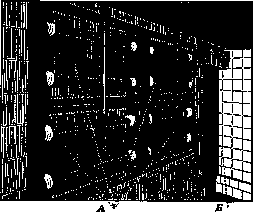
Ozonizing installation according to L. Kupffer. In the wall of the ventilation chamber (B), four gridded ozonizers (A) are embedded. When high-voltage currents are discharged in the ozonizers, a portion of the filtered air passing through the chamber is ozonized. Each ozonizer can operate independently, which allows regulation of the amount of O3 formed.
The concentration of O3 in rooms should not be brought above 0.05-0.10 mg per 1 m3 of air. At higher concentrations, irritation of mucous membranes and general intoxication are observed. For deodorization of excrement, cesspools and refuse pits, and solid waste, the following are used: 1) Iron vitriol (FeSO4) in amounts of 12-15 g per 1 liter of excrement or about 2 kg per 1 m3 of a cesspool after its cleaning. 2) Copper vitriol (CuSO4) in amounts of 7-8 g per 1 liter of excrement in the form of a 5% aqueous solution, it acts similarly to FeSO4 but is weaker. 3) Zinc chloride (ZnCl2) in a 5% aqueous solution in amounts of 75-100 g per 1 liter of excrement. 4) Bleaching powder [CaCl2 + CaOCl2 + Ca(OH)2] with an active chlorine content of at least 25%. 10-16 g are required per 1 liter of excrement. 4-20% solutions are used. For deodorization of sewer and other wastewater, 1 part of chlorinated lime milk (20%) is added to 200 parts of water. Bleaching lime forms compounds with NH3 and its derivatives and other products of decomposition. 5) Formaldehyde. Formalin forms odorless compounds with NH3 and its derivatives. It deodorizes excrement well. Often used for deodorization of corpses. For this purpose, with a syringe, about 2-2.5 liters of a mixture consisting of 2 parts formalin (35%) and 1 part denatured alcohol is injected into the large veins, the cavities of the abdomen, chest, mouth, nostrils, ears, into the eyeballs, and into the muscles. 6) Potassium permanganate (KMnO4). A strong deodorant, but due to its high cost finds only limited application. KMnO4 is used during disinfection by boiling of feces and other secretions to prevent the development of malodor, for washing rancid meat, etc. 7) Coal and wood tar, especially in combination with alkalis (e.g., Nentsky's liquid-1 part tar, 1 part NaOH and 18 parts water), with petroleum (in equal parts-5% solutions) and its derivatives or with chrome alkalis (chrome tar) are used for deodorization of solid waste, garbage cans, and dumps. The sanitary value of these preparations is increased by the fact that they have repellant properties for insects and rodents, do not reduce the agricultural value of waste for field fertilization, and have little effect on the processes of natural mineralization. 8) Substances that strongly absorb excrement and malodorous gases also find wide application for deodorization purposes-peat, charcoal, and earth (especially chernozem) in the form of dried, powdered, granular mass. They are poured in large quantities into toilets and cesspools until a thick layer is formed. Lit.-see lit. to article Disinfection. Ya. Levinson.
Related articles
Mentioned in
Cite this page
“Deodorization.” Soviet Medical Encyclopedia. English translation of Bolshaya Meditsinskaya Entsiklopediya, 1st ed. (Moscow, 1928–1936), ed. N. A. Semashko. https://sovietmedicalencyclopedia.pages.dev/article/deodorization/