Electrical Insulators
Historical document, translated for reference. It reflects medical knowledge of the 1920s–30s and is not medical advice.
Summary
This article from the 1928–1936 Soviet Medical Encyclopedia discusses the principles of electrical insulators, materials used for scientific and medical applications such as high-voltage X-ray equipment, and methods to prevent moisture and ion interference.
Encyclopedia article (1928–1936)
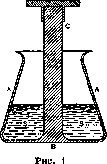
ELECTRICAL INSULATORS, devices or substances that insulate electricity. An electrically charged body loses its charge while in the air or gases, and the charge is dissipated either through the supports or through the air. The dissipation of the charge is generally slow when certain substances are used as materials for supports. Recent research shows that electrical insulators can be made sufficiently perfect for practical purposes. If a high degree of insulation is not required, it is sufficient to use supports made of ebonite, which is a good insulator, for the devices one wishes to insulate. Sealing wax and certain grades of glass insulate well, and the insulation must be designed so that moisture does not settle on the insulators; therefore, Mascart proposed a special shape for glass insulators, shown in Fig. 1. Mascart's insulators consist of a glass vessel AA having the appearance indicated in the figure; the vessel AA, representing a type of flask, has a column BC emerging from the middle of the bottom, and at the top of this column is placed a plate C, on which the insulated object is placed. To prevent moisture from settling on the column BC, concentrated sulfuric acid SS is poured into the vessel AA, which absorbs the moisture inside the vessel. A very good insulator is a quartz plate, followed by sulfur and amber, which are used in cases where the highest degree of insulation is required, with sulfur insulators being among the best and most convenient insulators.
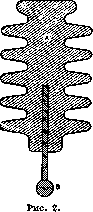
Where such perfect insulation is not required—which can be obtained with amber, quartz, or sulfur insulators used for scientific research and certain electrostatic experiments—porcelain and glass insulators are used, having various shapes and employed constantly for insulating high-voltage wires in X-ray work. These insulators consist of porcelain masses A (Fig. 2); rods B are fastened at their ends, to which the insulated conductors are connected. To make the surface of the insulator larger, the insulator is given a shape whose cross-section is indicated in Fig. 2, so that the surface is increased many times. If the insulator is in the open air, then to eliminate the influence of rain, the insulator is often given the shape of a bell (Fig. 3), with the insulated object located on a rod connected to the inner part of the insulator. Rain falling on the insulator flows down the side surfaces and thus leaves the inner part of the insulator dry. For low-voltage currents used in
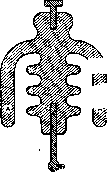
Figure 3.
ordinary galvanization, there is no need for the insulation mentioned above, and ebonite and even wood—which is completely unsuitable for high-voltage installations—serve as sufficient insulators. The insulating capacity of air is inversely dependent on the number of ions in the air, and the elimination of these ions by filtration through layers of cotton wool on which the ions are deposited increases the insulating capacity of air, which is sometimes utilized in science and technology. P. Lazarev.
Related articles
Cite this page
“Electrical Insulators.” Soviet Medical Encyclopedia. English translation of Bolshaya Meditsinskaya Entsiklopediya, 1st ed. (Moscow, 1928–1936), ed. N. A. Semashko. https://sovietmedicalencyclopedia.pages.dev/article/electrical-insulators/