Mercury Quartz Lamp
Historical document, translated for reference. It reflects medical knowledge of the 1920s–30s and is not medical advice.
Summary
This article describes the construction and operation of the mercury quartz lamp, a device that emits a strong ultraviolet spectrum. It details the historical development from glass to quartz tubes, the types of lamps available, and their specific applications in medicine.
Encyclopedia article (1928–1936)
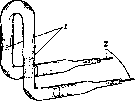
MERCURY QUARTZ LAMP consists mainly of an evacuated quartz tube, the ends of which terminate on both sides in expansions filled with mercury; metallic electrodes immersed in the latter are connected to a source of current (Fig. 1). The first mercury lamps, manufactured by Arons in 1892, had a glass tube. Subsequently, it was possible to melt mountain crystal and make a transparent mercury-quartz burner from it. The mercury-vapor arc formed in it gives a line spectrum composed of individual lines, especially numerous in the ultraviolet part of the spectrum. Practically, it can be considered that the spectrum of emission of a mercury lamp does not contain infrared and red rays. Thanks to this, the light of such a lamp differs greatly from sunlight. Under the light of a mercury lamp, all objects, especially red ones, completely change their color. The quartz tube passes all visible rays, as well as ultraviolet rays with a wavelength up to 180-150 nm. Fig. 1. Longitudinal section of a mercury-quartz burner.
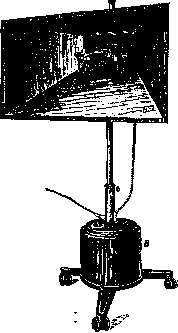
Previous glass lamps, little transparent to ultraviolet rays, passed only a small amount of them and that with a wavelength only up to 330-320 nm; subsequently, mercury lamps made of uviol glass were released, passing a greater amount of ultraviolet rays with a wavelength up to 280 nm. Quartz lamps are more refractory than glass ones and withstand greater load; the increasing pressure of mercury vapors in the burner at the same time leads to an increase in the intensity of ultraviolet radiation. Compared with sunlight, the radiation of a mercury-quartz lamp contains a significantly larger amount of ultraviolet rays and at the same time with a shorter wavelength (in sunlight the shortest ultraviolet rays have a wavelength of 289 nm) (Fig. 2). At present, mercury-quartz lamps are produced in various models. The most common is the Bach lamp (see Bach mercury-quartz lamp). A significant distribution also has a lamp according to the model of Prof. Jesionek, convenient for conducting group lighting. This lamp has a special reflector in the form of a truncated quadrangular pyramid mounted on a stand, the base of which faces the patient. The reflecting surface of the reflector is made of magnalium (an alloy of aluminum and magnesium), which reflects a significant part of the incident ultraviolet rays, thanks to which the amount of ultraviolet rays falling on the patient increases.
Fig. 3. Mercury-quartz lamp of the Jesionek type for alternating current: A-burner; B-reflector; C-transformer.
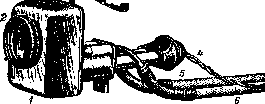
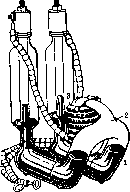
Less frequently at present is the mercury-quartz lamp according to Prof. Cromeier, which dermatologists, dentists, etc. use in cases where only small surfaces are irradiated, but usually in this case they strive to obtain a strong reaction from the irradiated skin or mucous membrane. This lamp has water cooling; thanks to this, it is possible to intensify the action by directly pressing the lamp against the area of skin being treated (Fig. 4 and 5). All these lamps are manufactured for operation on both direct and alternating current. In the latter case, a special self-igniting three-pole mercury-quartz burner is required, in addition, a special transformer with a choke coil and rheostats is necessary; such an installation acts on the principle of a mercury rectifier. Direct current lamps are equipped only with rheostats. Until recently, we used exclusively imported burners; at present, in the USSR, mercury-quartz burners and the necessary fittings for them are already manufactured (with the exception of Cromeier lamps).
The current consumption when using a mercury-quartz lamp is extremely small. In recent years, new models of mercury-quartz lamps have been released, which ignite automatically without tilting the burner and pouring mercury. They have not yet gained significant distribution (Fig. 6). Mercury-quartz lamps are widely used at present in medicine, especially in cases where it is necessary to obtain an intensive action of ultraviolet rays, primarily rays with a shorter wavelength, i.e., such as are not contained in either sunlight or the emission of carbon-arc or incandescent lamps. Treatment with mercury-quartz lamps is applied in extrapulmonary tuberculosis, especially tuberculosis of the skin; in rickets; in poorly healing fractures; in the treatment of purulent and long non-healing wounds and ulcers; in the treatment of a number of skin diseases (impetigo, furunculosis, scaly lichen, some forms of eczema, etc.); as a method of treatment for erysipelas; further in general debility after an infectious disease, in the treatment of neuralgias, etc. For more details on indications and contraindications, as well as on the methodology of application and dosage, see Light Therapy. On luminescent analysis in filtered ultraviolet illumination, see Wood's rays.

Related articles
Cite this page
“Mercury Quartz Lamp.” Soviet Medical Encyclopedia. English translation of Bolshaya Meditsinskaya Entsiklopediya, 1st ed. (Moscow, 1928–1936), ed. N. A. Semashko. https://sovietmedicalencyclopedia.pages.dev/article/mercury-quartz-lamp/