Piezoelectricity
Historical document, translated for reference. It reflects medical knowledge of the 1920s–30s and is not medical advice.
Summary
This article from the 1928–1936 Soviet Medical Encyclopedia explains piezoelectricity as the electrical polarization of crystals under pressure or tension, first observed by Haüy in 1817. It discusses polar axes in crystals like tourmaline and quartz, the inverse piezoelectric effect, and early applications including ultrasonic waves and use in radiotelegraphy.
Encyclopedia article (1928–1936)
PIEZOELECTRICITY (from the Greek piezo - I press), the electrification of crystals under the action of pressure or tension. The phenomena of piezoelectricity, discovered by Haüy in 1817, are observed in their most simple and clear form in crystals possessing hemimorphism, that is, having an axis of symmetry with an unequal arrangement of faces and edges at its ends. An example is the tourmaline crystal shown in Fig. 1, which represents in schematic form a triangular prism terminating at the top and bottom with two triangular pyramids. The axis of symmetry, shown by the dashed line in Fig. 1, passes through the vertices of both pyramids parallel to the edges of the prism. The hemimorphism of this crystal is seen from the fact that the edges of the lower pyramid intersect the edges of the prism, whereas the edges of the upper pyramid intersect the faces of the prism midway between its edges. Such a crystal axis is called a polar axis. If a plate perpendicular to this axis is cut from the crystal and compressed along the axis, one of the surfaces of the plate becomes positively electrified and the other negative. Upon tension, the signs of the charges are reversed. There can be several such polar axes in crystals. In particular, in quartz crystals, which have the shape of a hexagonal prism, the prism axis is not a polar axis. Such axes in quartz are the three axes A1A1, A2A2,


Figure 1.
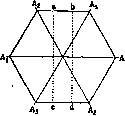
Figure 2. A3A3, perpendicular to the opposing edges of the prism (Fig. 2). The plate abcd, cut perpendicularly to A1A1, becomes electrified on the surfaces ac and bd upon pressure on these surfaces. A charge on these same surfaces, but of opposite sign, can also be obtained by applying pressure to the faces ab and cd. Conversely, if a crystal is electrified, that is, placed in an electric field, the crystal contracts or expands. If the electric field in which the crystal is placed changes periodically, the crystal enters into vibrational motion; by creating an electric field with a rapidly alternating electric current and placing a quartz plate (the so-called piezo-quartz) in the field, Wood obtained extremely energetic sound waves from the oscillating plate, the period of which lies beyond the limit of hearing of the human ear (ultrasonic waves). These waves possess a strong physiological action. At present, they are also used to measure sea depth by means of their reflection from the seabed and for recording instantaneous forces, for example, during explosions. Piezo-quartz, oscillating in an electric field, is also used in radiotelegraphy.
A. Mlodzievsky.
Related articles
Mentioned in
Cite this page
“Piezoelectricity.” Soviet Medical Encyclopedia. English translation of Bolshaya Meditsinskaya Entsiklopediya, 1st ed. (Moscow, 1928–1936), ed. N. A. Semashko. https://sovietmedicalencyclopedia.pages.dev/article/piezoelectricity/