Aspirators
Historical document, translated for reference. It reflects medical knowledge of the 1920s–30s and is not medical advice.
Summary
Aspirators are devices for removing fluids from body cavities using air vacuum, primarily used in clinical settings for diagnostic and therapeutic purposes, especially for draining pleural effusions. The article describes various types of aspirators including those used for pleural drainage and urological treatments, along with their mechanisms and applications.
Encyclopedia article (1928–1936)
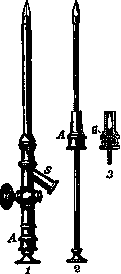
ASPIRATORS (from Latin aspirare - to inhale), apparatus for removing fluids from body cavities by means of air vacuum. They are used in clinical practice for diagnostic and therapeutic purposes, mainly for removing exudates and transudates from the pleural cavity. During a diagnostic puncture, aspiration is usually performed with a 5-10 cubic centimeter syringe with a long and sufficiently thick needle to avoid its breakage and to obtain viscous fluids, for example, pus. For draining large quantities of liquid, a trocar is most frequently used, for example, Stintzing's (see Figure 1), with a rubber tube about 0.5 cm in diameter and about 1 m long. The trocar is inserted into the intercostal space, and the rubber tube fitted to it, previously filled with sterile water, is lowered into a measuring cylinder. A siphon is created, and the negative pressure in it will correspond to the column of liquid in the tube equal to the distance from the chest to the floor (see Figure 2). This method of aspiration, besides the simplicity of the instruments, is the safest, as the pleural cavity remains under constant negative pressure. A significant disadvantage of other A. is the fluctuating pressure, which particularly applies to the apparatus of D. Delefaue (Dieulafoy).
In Furbinger's apparatus, aspiration is done by mouth; in Bunsen's apparatus, air is rarefied by water flowing from one vessel to another. Some use a water-jet pump with a manometer. In practice, Potent's aspirator (the latest model by Stintzing - see Figure 3) is most commonly used. In it, with the help of a pump
B. Egorov.
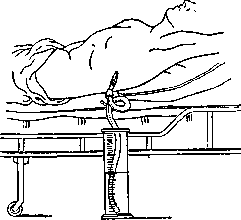
Figure 2.
or a rubber bulb, air is rarefied in the measuring flask, into which liquid begins to flow as soon as communication is established between a body cavity and the interior of the flask by means of a trocar puncture.
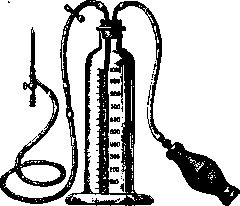
Figure 3. Apparatus of Stintzing. Aspirator of Bronner, an apparatus for treating chronic gonorrheal urethritis by passive hyperemia. Bronner's A. consists of a straight hollow bougie with numerous openings, equipped with a rubber bulb for creating air vacuum in the bougie; when the bulb is compressed, the bougie,
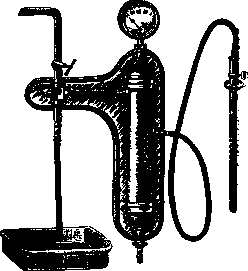
Figure 4. Aspirator of Bronner.
introduced into the urethra, resembles a large number of small dry cups acting on the urethral mucosa. Subsequently, to regulate the degree of vacuum, the bougie of Bronner's aspirator was, instead of a bulb, connected to a water pump equipped with a manometer (see Figure 4).
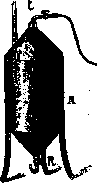
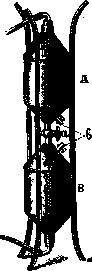
Figure 5.
Figure 6. If valve L and the valve at tube t are opened, water will flow out of A, and gas will enter in its place through tube t; the volume of water flowing out will indicate the volume of gas that entered A. By means of valve R, the rate of water outflow and gas inflow can be regulated. Similarly, an ordinary laboratory glass bottle with a drain cock (tubulus) placed at the bottom can be used; for this purpose, the bottle is filled with water, a tight plug with a glass tube is inserted into the bottle's neck, and the latter is connected to the place from which gas needs to be drawn. Such A. suffer from the disadvantage that, without interrupting operation, through them one can draw a volume of gas equal to the capacity of the apparatus, but no more. The so-called double-return A. is much more convenient, operating on the same principle but allowing to draw any amount of gas with a certain amount of water (see Figure 6). It consists of two vessels A and B of equal volume, located one above the other and soldered to three iron legs. Vessels A and B communicate with each other by means of valve a, which can regulate the rate of water flow from them. Into the conical ends of both vessels, at equal distances from valve a, two side valves b are inserted. When water flows from vessel A to B, the side valve in A is closed, but in B it is open for the displaced air to escape (the lower opening of vessel B is tightly closed at this time). A plug with a bent tube leading gas is inserted into the upper vessel A. When =54 / all the water has transferred from A to B, valve a and the lower side valve b are closed, the entire apparatus is turned 180°, the lower opening is tightly closed, and the upper one is again connected to the place from which gas is being suctioned. For the next gas suction, the side valve b in A (it is now lower) and the valve a connecting both vessels are opened. The calculation of the amount of gas drawn is performed by multiplying the number of vessels emptied of water by their volume. Mendeleev recommends as the simplest, long-acting and easily assembled aspirator shown in Figure 7. It represents a tube AB wide at the top and long and narrow at the bottom. The lower opening should not be larger than the thickness of a feather. A tight plug with two openings is inserted into the neck A. Through one opening, tube FG drawing gas is inserted; through the other-funnel C. Water is poured into funnel C from the water supply cock D. The lower opening of funnel C should be smaller than the lower opening of tube B. As a result, less water will flow from the funnel than can flow out of tube B, and therefore columns of water will alternate with columns of gas in tube hB, and gas will be carried away with water. For this reason, the diameter of tube hB should not be large-otherwise water will flow down the walls without carrying gas with it. It is necessary during the operation of this apparatus to ensure that there is always a layer of liquid in funnel C, otherwise air will enter the apparatus through the funnel opening. A significant disadvantage of this aspirator is the inability to account for the amount of gas drawn. If accounting is necessary, a gas meter-gas meters, rheometers-should be connected to the apparatus (to tube ?). It is much more convenient to use special glass or metal water-jet pumps, similar in design principle to the last apparatus. For aspiration purposes, electric vacuum cleaners can also be used. These apparatus also require the attachment of gas meters if accounting for the drawn gas is necessary.
f. pudyagin.
Related articles
Mentioned in
Cite this page
“Aspirators.” Soviet Medical Encyclopedia. English translation of Bolshaya Meditsinskaya Entsiklopediya, 1st ed. (Moscow, 1928–1936), ed. N. A. Semashko. https://sovietmedicalencyclopedia.pages.dev/article/aspirators/