Evacuation
Historical document, translated for reference. It reflects medical knowledge of the 1920s–30s and is not medical advice.
Summary
This historical article from the 1928–1936 Soviet Great Medical Encyclopedia details the principles and organization of sanitary evacuation during wartime and mass disasters. It covers the medical service hierarchy, transportation methods, triage, and the establishment of evacuation stages and hospital bases.
Encyclopedia article (1928–1936)
EVACUATION (from Latin evacuatio - removal, emptying). By sanitary evacuation is meant the removal of contingents requiring treatment, with their simultaneous placement in conditions most favorable for the earliest recovery and restoration of working capacity. Sanitary evacuation constitutes a complex system of measures for gathering the evacuated, providing them with initial medical aid, preparing them for transport, sorting, rendering medical aid en route, and placing them in special medical institutions. Sanitary evacuation is used in all cases when treatment on the spot proves impossible for one reason or another. This happens most often during mass casualties, during war and natural disasters (earthquakes, floods, famine, etc.). In wartime, sanitary evacuation pursues two goals: 1) the removal from active troops of the wounded, those affected by chemical warfare agents, and the sick, who restrict the maneuverability of military units and formations; 2) the restoration of the combat capability of the evacuees by organizing their most rational treatment in combination with the process of removal. The provision of initial medical aid, determination of indications for sanitary evacuation, gathering of evacuees, and their preparation for transport are the duty of the medical service of military units in the army. The removal of evacuees from the forward area and the provision of qualified medical aid to them, as a rule, is carried out by the medical service of military formations (divisions), while the placement of the wounded and sick for special treatment in stationary medical institutions of the army rear and the interior region is usually entrusted to the sanitary service of large military formations (armies, fronts, and military districts). Evacuees use various types of sanitary transport (see Sanitary transport) and pass along their way through a series of intermediate medical institutions where they are provided with medical aid, sorting is performed, and rest is granted. Such medical institutions or groups of them (hospital bases) are called stages of sanitary evacuation, and sanitary evacuation itself is identified by some authors with the so-called stage treatment. Stages of sanitary evacuation as a rule are usually located in places of transfer from one type of transport to another. In addition, stages of sanitary evacuation have to be deployed along evacuation routes of considerable length to provide medical aid and treatment to contingents unable to withstand prolonged transportation. The segment of the evacuation route between the stages of sanitary evacuation with the transport servicing it is called the link of sanitary evacuation. Since the removal of evacuees by each stage of sanitary evacuation is carried out "towards oneself," sanitary transport vehicles operating in a given link of sanitary evacuation are attached to the rear stage of sanitary evacuation and are sent forward for work. The route of sanitary evacuation with all sanitary means located on it, leading to the rear from any military formation, is called the axis of sanitary evacuation of this formation. The equipment of sanitary evacuation axes is carried out along evacuation directions, differing among themselves in the intensity of the flow of evacuees. Evacuation routes and directions by type of communication means are divided into dirt, railway, water, and air. Dirt roads of sanitary evacuation provided for sanitary evacuation may coincide with roads intended for the delivery of supplies to the troops or are allocated separately. In this case, to ensure unilateral movement, which has significant advantages with an intensive flow of transport vehicles, empty sanitary transport moves along the supply routes, and empties freed from cargo return to the rear along roads designated for sanitary evacuation. Even greater convenience for the movement of transport columns is created by the allocation of parallel roads for horse-drawn, automobile, and tractor traction transports, which differ in various movement speeds and require different roadbed construction. The coincidence of evacuation routes with the return routes of returning empty military (non-sanitary) transports makes it possible to use the latter for transporting the wounded and sick evacuated to the rear. However, practical difficulties in adapting such empty returns for transporting severely wounded people who need special rest, as well as the mismatch of cargo transport return points with the stages of sanitary evacuation, compel the sanitary service to have its own special sanitary transport in its organizational system. Modern regulations of the Workers' and Peasants' Red Army resolve the issue of the organized use of return empty cargo transport for sanitary evacuation purposes by allocating two streams of evacuees along dirt roads: a) the severely wounded and sick are transported from forward medical aid points to that stage of sanitary evacuation where they can most likely be provided with the required medical aid and treatment appropriate to their health—on sanitary carts and automobiles; b) the slightly wounded and sick, sent from forward medical aid points to the area of transshipment of property brought up to the troops from the columns of one supply link to the transport of another link—by return empty transport. Such places (areas) of transshipment are called exchange points (division exchange points, corps exchange points) and differ by type of cargo (artillery, transport). Points for gathering the slightly wounded are deployed at division exchange points, and field evacuation reception stations at corps exchange points, where medical aid is provided to the slightly wounded evacuated by return empty cargo transports, and short-term rest and nutrition are also provided. Return empty railway freight cars are included in temporary sanitary trains and are more easily adapted for transporting evacuees. The greatest difficulties in evacuation are presented by the task of ensuring the approximation of qualified medical aid to the evacuees in accordance with the type and nature of the lesion or disease. Unlike the transportation of cargo and the organization of the transportation of healthy people, in the composition of evacuated contingents we have very different groups, the state of which is subject to sharp fluctuations during the transportation process, in accordance with which the attitude towards these groups also constantly changes. Sanitary evacuation must be accompanied by sorting at each stage, which leads to a constant change in evacuation groupings. The latter, in turn, must provide for: a) the method of transportation (sitting, lying, walking); b) the type of transport (sanitary two-wheeler, sanitary automobile, sanitary airplane, unadapted cargo transport cart, etc.); c) the destination (address) of the transport (to which stage, to which medical institution directed) and d) the urgency of transport. The combat situation, the availability of transport resources, and the capacity of the stages of sanitary evacuation have a significant impact on the evacuation grouping. Under the real threat of enemy combat assets, the indications for leaving in place and the volume of medical aid at the stages of sanitary evacuation are significantly reduced. The organization of the evacuation apparatus and its management require the greatest operational efficiency, anticipation of various kinds of possibilities, and the availability of reserve funds to parry any contingencies. The distribution of medical evacuation means can be more or less stable only in the interior region, on the territory of military districts of the country's rear, where hospital bases consisting of medical institutions of various specialties are deployed in large populated areas according to a pre-planned plan. According to modern views (Schickele, 1934), at least 60% of all beds available to the army evacuation apparatus must be concentrated here. Each internal district, depending on the network of communication routes, is expediently divided into sectors (regions) with the unification of hospital bases and separate hospitals located in such a sector under the management of the head of the district or distribution evacuation point (Fig. 1). Hospitals located in one populated area on the territory of the internal military district are part of the local evacuation point. Within evacuation points, the bed apparatus can be grouped into two large groups: a) therapeutic, consisting of hospitals for the treatment of the sick, those affected by chemical warfare agents, and the contagious, and b) surgical—for the treatment of the wounded and the sick with diseases of the eyes, ear, throat, and nose. Separate hospitals included in or assigned to a particular evacuation point can be located at some distance from the main hospital base as branches. Each district evacuation point must have special hospitals or departments for the treatment of fractures, bone tuberculosis, skin-venereal, nervous, psychiatric, cardiac, and dental diseases, as well as for X-ray therapy. Urological, jaw departments and hospitals, for special bone surgery and for surgical tuberculosis, as well as sanatoriums, may not be allocated in every district evacuation point, but serve several regions, since the deployment of hospital units with a capacity of less than 200 beds turns out to be uneconomical. In frontline, army, and military hospitals, only the slightly sick and wounded are detained until complete recovery in the presence of free places. In addition, the severely wounded and sick who do not withstand transportation at all settle on evacuation beds. The percentage of wounded and sick, detained...
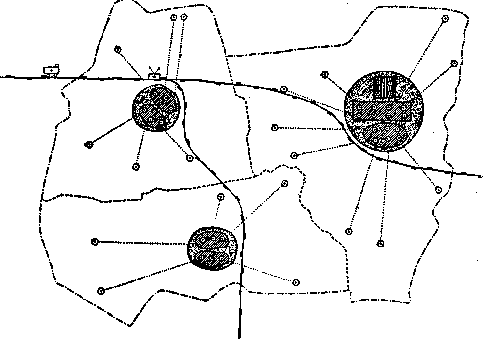
e. g., y. Conventional signs: boundaries of the internal district, boundaries of a region (sector), railroad, sanitary train, distributors of the regional evacuation point, local evacuation point, group of surgical hospitals, group of therapeutic hospitals, group of special hospitals of regional (district) significance, group of special hospitals of interregional significance, individual hospitals assigned to the evacuation point. Figure 1. Scheme of sanitary evacuation and hospitalization in the internal region. EVIPAN of those accommodated on evacuation beds depends primarily on the combat situation; the largest number is evacuated during periods of intense combat, when the troop and army stages of sanitary evacuation are forced to pass through themselves such a quantity of evacuees within a single 24-hour period that it frequently exceeds the capacity of their bed apparatus. On average, at least 60% of the wounded and sick are evacuated to the internal region (Toubert). The total number of evacuees in wartime is calculated in the millions; thus, from the beginning of the World War until October 1, 1916, about 4,000,000 people were evacuated in the Russian army; the number of admissions to hospitals during 4 years of war in the French army reaches 9,000,000, and in the German army it equals 10,080,470 people. The "rhythm" of evacuation is shown in the diagram (Fig. 2), from which it can be seen that the largest number of evacuees falls on the summer months, when military operations were more intense. The ratio of evacuated wounded and sick is given in the diagram (Fig. 3), relating to one of the distribution evacuation points. This diagram shows that at the beginning of the war, combat casualties predominated in the Russian army, while towards the end, the loss due to illness increased. The unevenness of the flow of evacuees in qualitative and quantitative terms is most pronounced in the troop and army regions, where the load on both the transport and bed apparatus is subject to constant and sharp fluctuations. To be able to provide transport and beds for the flow of evacuees to the rear under all conditions, it is necessary to have a powerful reserve of flexible and maneuverable means distributed along individual evacuation directions. Communication is hampered, and in individual directions may be completely disrupted by enemy air operations. To monitor the condition of evacuees en route at intermediate in thousand, 800
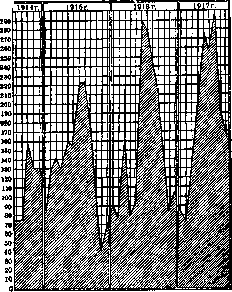
my in the World War of 1914-1917 by months. with the stages of sanitary evacuation and a smoothly operating "reporting service" based on constant (dispatch) accounting of the state and work of the entire evacuation apparatus plays an exceptionally important role in directing sanitary evacuation. In conditions of modern warfare, sanitary evacuation sharply ) ieur o 5g. 1 191WG 1917g. -|Ш-=5-=г=»B5==31в=- =2»55=;«й;-==г>;;=» 4- i -|- Oo 11» > t ф- £» _ ... __Lj- ioo -X- ь 44- £. их ____i / l j -3-iI ' t __l± . , Ж __L_\_____j T_ I-iv-4-j--t:ii: l-Ж* -I-I* ::> i г ,' i Й J V L ,„ 4- l Рк- X %- J' t 4 „L 15^y-'$/ i-H I^ t Л „-/-11--У- _ x "J И У /E o-----.-------------------------~i. У "=T^ x- Figure 3. Arrival of evacuees at the Moscow distribution evacuation point in the World War of 1914-1917. stations, control and evacuation points are opened with a small number of beds to accommodate those unable to withstand further transportation. The entire organization and deployment of sanitary and evacuation work is built according to a plan. The basis for drawing up the evacuation plan is preliminary calculations of the number of expected casualties, data on lines of communication, and areas in which stages of sanitary evacuation can be opened. In accordance with these calculations, hospital, transport, and other sanitary means are distributed, and the necessary reserve of these means is created at the disposal of senior sanitary commanders. The evacuation plan indicates the deadlines for deploying the stages of sanitary evacuation, the scope of medical work for each of them, and simultaneously outlines assumptions about sanitary and evacuation maneuvers depending on the tasks assigned to the troops provided for in medical and evacuation terms. The mass nature of contingents requiring treatment in wartime makes the doctrine of sanitary evacuation one of the most important sections of sanitary tactics (see).
B. Leonardov. EVIPAN, N-methyl-C-C-cyclohexenyl-methyl-barbituric acid, a white crystalline tasteless powder with a melting point of 143-150°. Sparingly soluble in water. A hypnotic drug possessing an extremely rapid, deep, but short-lived action. Well tolerated by the stomach and produces no side effects. Due to the short duration of the effect, it is almost never used. Of all the greater importance is the sodium salt of Evipan—evipan-sodium—as an agent for general anesthesia. Weese and Scharpff noted in an experiment on an animal the onset of anesthesia already during the injection of 25 mg per 1 kg of body weight. The hypnotic and narcotic doses lie very close, while the lethal dose is 4 times greater than the narcotic dose. In humans, intravenous administration of a freshly prepared 10% solution of evipan-sodium produces deep sleep in about 30 seconds, passing without a period of excitation into complete anesthesia (after 1-3 minutes), lasting 15-25 minutes. Recommended dosage: up to 50 kg of the patient's weight—7 cm3, for every subsequent 5 kg—0.3-0.5 cm3 more, but not more than 10 cm3 in total. Most authors point out the necessity of individual dosage depending on the state of the patient's strength and the reaction to the drug. It should be administered very slowly, at a rate of approx. 15 seconds for each cm3, and no more than necessary to achieve complete anesthesia occurring during the injection itself. With such administration, already after 3 cm3, deep sleep ensues, which can be used as basal anesthesia or preliminary before ether or chloroform anesthesia, as well as before local anesthesia (Frigyesi). Already 50-60 seconds after the start of the injection, the corneal reflex disappears, breathing becomes deeper and slower, the pulse quickens by 10-30 beats per minute, and blood pressure drops by 5-20 mm. After 15 minutes, corneal reflexes return; after 20-25 minutes, response to a call returns. Among side effects, at the beginning of falling asleep, small tonic twitches of the entire body and extremities are frequently noted. Sometimes at the beginning of deep anesthesia, strong twitches are observed. Upon awakening, there is complete amnesia, mild headache, and vomiting in 5%. Rapid administration leads to collapse. Out of over 100,000 cases of evipan anesthesia described in the literature, 29 deaths have been published. To a significant extent, they can be attributed to overdose and too rapid administration, but in some cases, such as in Weese (Redman, death case with 4 cm3 of evipan-sodium), it falls on the drug itself. In view of the fact that the drug is decomposed by the liver during evipan anesthesia, mild jaundice was observed in a small percentage of cases. A contraindication to its use is liver disease. Evipan is also poorly tolerated by patients with bronchial asthma (paralysis of the respiratory center) and with a tendency to collapse (instability of the autonomic nervous system).
Related articles
Mentioned in
Cite this page
“Evacuation.” Soviet Medical Encyclopedia. English translation of Bolshaya Meditsinskaya Entsiklopediya, 1st ed. (Moscow, 1928–1936), ed. N. A. Semashko. https://sovietmedicalencyclopedia.pages.dev/article/evacuation/