Morbidity
Historical document, translated for reference. It reflects medical knowledge of the 1920s–30s and is not medical advice.
Summary
This article from the 1930s Soviet medical encyclopedia distinguishes between morbidity (new disease cases) and prevalence (existing disease cases), explaining statistical methods for tracking disease incidence in populations.
Encyclopedia article (1928–1936)
MORBIDITY, a term understood as accounting for new, previously unregistered diseases in the population (or in its individual groups) and indicating the movement of phenomena, in contrast to terms such as prevalence (see), pathological involvement, which speak of the state of the phenomenon, i.e., the state of public health at a given time. Until recently, there was no strict distinction between the terms morbidity and 'prevalence'; in the classical works of the founders of Russian sanitary statistics (E. A. Osipov, P. I. Kurkin) and in the works of almost all Russian sanitary statisticians, the terms morbidity and prevalence are used as equivalent. However, the modern era, which has created new forms of medical care for the population (therapeutic-prophylactic 'dispensarization') and has extremely expanded the field of sanitary-statistical research, has given a new topic - the determination of 'pathological involvement' of the population - and urgently requires a precise distinction between these concepts. This distinction was proposed by S. M. Bogoslovsky (report 'Scheme of sanitary-statistical research in the Union of SSRs', approved at a meeting of physician-statisticians, 1927).- In the study of morbidity, there are two sharply defined directions that have developed on the historical basis of the development of medical care organization for the population: a) Russian, representing the result of the development of public medical care organization (zemstvo in pre-revolutionary Russia and Soviet in the present time) and putting at the head of the study the 'general morbidity' of the population based on its seeking medical help; b) the West European direction, according to the scheme of which, as stated by Prinzing, the main sources of morbidity statistics are: 1) statistics of causes of death, giving information on diseases ending in fatal outcomes (the accuracy of such statistics will be the greater the more extensive the sectional control has been carried out, i.e., the coverage of corpses by autopsies); 2) hospital statistics, providing materials that differ in the comparative accuracy of diagnoses of diseases, their course, danger to life, complications, duration, etc.; 3) statistics of infectious diseases, which is legally mandatory for physicians in many states, sometimes for a wide list of diseases; 4) statistics of diseases of individual population groups (army, fleet, etc., or special unions and societies - hospital insurance funds). The most important significance is attached to the observations of insurance funds, which relate to large groups of the population and extend to all diseases affecting capacity to work. However, when representatives of West European science became acquainted (with the work of P. I. Kurkin in the journal 'Archiv fur soz. Hygiene u. Demogr.') with the content of Russian sanitary-statistical research, a trend formed among them (its representative is the demographer E. Roesle) in favor of establishing the study of general morbidity by the broad method. This opinion of Roesle is currently being submitted for discussion to the Statistical Council of experts at the League of Nations. The general mass morbidity includes all forms of diseases affecting a given population; when dealing with diseases selected on one basis or another, they speak of special types of morbidity: epidemic morbidity, morbidity from social diseases, professional morbidity, etc.; the purpose of studying morbidity is to determine the sanitary condition of the population; morbidity, determined with possible accuracy and for a sufficient period of time, is considered the most essential and decisive criterion of the state of public health (E. A. Osipov). Morbidity is studied by the statistical method. The unit of research here is each new, previously unregistered disease, for which the patient seeks medical help. Each such disease must be registered on a 'statistical card of diseases' established for this purpose; these disease cards (they are also called outpatient cards) are the material for the statistical processing and characterization of morbidity in numerical terms. To determine the form of the disease and designate it with a scientific, precise term according to nomenclature can of course only be done by a physician; therefore, it is accepted that statistical research of morbidity is based only on observations confirmed by physicians. Observations by feldsher personnel are processed only within the framework of so-called reporting (on their activities). Furthermore, since only those cases of diseases for which the sick seek help from the treating physician can be registered, then from the entire mass of diseases affecting the population, only a part of them, registered by physicians, naturally falls into the field of observation; thus, when studying general morbidity, one actually deals only with 'detected' morbidity, or with 'help-seeking' behavior, but not with 'actual' morbidity. With the development of medical care for the population, with its increased accessibility and improved quality, with the increase in the population's awareness of the value of health, the number of registered cases of disease of course constantly increases, thanks to which 'detected' morbidity increasingly approaches 'actual' (so-called 'exhausted' morbidity). The growth in the number of requests for medical help over time is visible from the following example (Moscow province): for 1898-1902, the help-seeking ('detected' morbidity) was expressed here by the figure 635.6 per 1,000 population, in 1906-1908 - 759.3, and in 1926 - 1,116.8. Thus, morbidity is actually judged by 'help-seeking' behavior and its components, although some diseases remain unregistered for various reasons (distance from medical institutions, occupation, non-seriousness of the disease, distrust of medical help, etc.). Despite this, researchers accept that on the basis of these medical observations, thanks to the accumulation of huge masses of them, one can judge the composition and character of 'actual' morbidity. This is how the creators of morbidity statistics in Russia viewed this matter. Only the modern era, which has established in the USSR a new type of medical care - namely 'therapeutic-prophylactic' care, which is a synthesis of therapeutic care and the sanitary care established during the zemstvo period - opens up the prospect of studying 'exhausted' morbidity, at least for certain population groups taken under so-called dispensary observation (see Dispensarization). This new direction in the organization of medical care requires new forms of registration of medical observations, namely those that would make it possible to account in chronological order for each person in the observed group all individual cases of diseases affecting him during a known period of time. Since this group of persons is under constant medical observation, the registration of diseases in this case is fully exhaustive, and thus statistics has the possibility in the future to study already 'exhausted', 'actual' morbidity in a precisely defined mass of people. Since the material for the study of morbidity consists of observations by physicians who treat patients seeking medical help, it follows that the registration of these medical observations must have a proper statistical setup, that this registration should be imposed as a general state obligation on all treating physicians; that it should be 'accurate, complete, systematic and uniform', i.e., that observations should be recorded at the moment the patient seeks help, that information should be entered in full on the registration form and in precise expressions without the inclusion of inaccurate and hypothetical dates and definitions, that such registration should be carried out consistently, without omissions and in a uniform form. Hence the need for establishing a unified form and rules of registration, which must be applied by all physicians registering diseases. Such 'General Rules and Forms of Registration' have now been published by the Central Sanitary-Statistical Commission of the People's Commissariat of Health of the RSFSR and are mandatory for all physicians of the Republic. The best and most convenient system for registering diseases for the purpose of studying morbidity is the recording of information about observed diseases on cards, i.e., the so-called 'card system' of registration - that system which, in the subsequent processing of the material, allows it to be most easily and conveniently grouped in any direction, guarantees greater accuracy of calculations and speeds them up, since cards can be distributed for counting among several persons. Of course, a card for registering diseases, as a form of mass accounting, must be brief; it should contain only the most essential questions. The card adopted by the Central Sanitary-Statistical Commission of the People's Commissariat of Health of the RSFSR contains the following questions: Sex... Male, Female, Primary, Repeat... County (city)... Outpatient clinic... Year... month... day... 1. Surname... First name... Patronymic... 2. Age (years... months...) 3. Nationality... 4. Where lives: county... city... volost__ village__factory, courtyard (barracks)... other places... transient, etc.... when arrived... 5. What does: occupation, position... detailed profession... student (-ess)... school. 6. Where works: at home, at the f-ry (factory), in a workshop, on the silk road... Name of the factory (plant, etc.)... Department of the factory, shop, etc___ 7. How long sick... 8. Disease...
The doctor's signature... The main element of registration in this case is the disease; hence the necessity of using a single, universally accepted nomenclature of diseases. At present, we have adopted the international nomenclature, approved by the International Statistical Congress of 1920 in Paris. In order that in subsequent statistical processing of records of disease forms they can be assigned to certain groups and sections, a single, firmly established classification of diseases is necessary: this ensures the comparability of the materials being processed, and makes it possible during summarization to aggregate similar forms of diseases. "Disease" is the result of the effect on man of an extremely complex combination of the most diverse factors. It can be broken down into the following major categories. A. Factors of an internal order (inherent in the human organism itself-heredity, sex, age, race, physical development, etc.). B. External factors: 1) natural conditions-general biological and 2) conditions arising from the fact of man's "sociality": a) socio-domestic and b) professional. To study morbidity means to identify its causes, strength, character and thus to identify the pathogenic influence of the factors mentioned above on public health. Diseases show a kind of selective ability with respect to sex, age, seasons of the year, as well as with respect to different localities, social groups of the population. Some diseases (e.g., those related to sexual life) show the greatest predominance in women, others (e.g., trauma) predominate in men; each of the age periods is distinguished by its characteristic morbidity structure; morbidity develops differently in professional groups of the population. For example, data on the morbidity of the population of the Moscow province and the city of Moscow in 1926 are provided (see tables and diagrams).
The study of morbidity includes determining its strength and character for the entire population of a given locality as a whole, for each sex and separate age groups, for individual months of the year, etc. Subsequently, when the general morbidity of the territory (province, region, city, etc.) has been determined, the investigation proceeds to separate social and professional groups. Of course, the basic groupings of material in these studies must be uniform-otherwise the comparability of the processed data disappears. The generally accepted age grouping contains the following three age scales, differing in the degree of detail of age subdivisions.
0-12 mos. 0-12 mos. 1-4 yrs. 1-4 yrs. 5-9 yrs. 5-9 yrs. 10-14 yrs. 10-14 yrs. 15-19 yrs. 15-19 yrs. 20-29 yrs. 20-24 yrs. 30-39 yrs. 25-29 yrs. 40-49 yrs. 30-34 yrs. 50-59 yrs. 35-39 yrs. 60 yrs. and over 40-44 yrs. 45-49 yrs. 60-69 yrs. 70-79 yrs. 80 yrs. and over 0-12 mos. 1-4 yrs. 5-9 yrs. 10-14 yrs. 15-19 yrs. 20-39 yrs. 40-59 yrs. 60 yrs. and over
In the study of morbidity, a) determination of the structure (composition) of morbidity and b) its strength and character are distinguished. The first is obtained when the share of participation of individual disease forms or their groups in the total mass of diseases for a given period is established; in other words, when extensive ratios (to the total number of diseases, taken as 100, per 1,000, etc.) are used. The strength (or height) of morbidity is determined when ratios of the number of cases of Disease A are used.
A. Absolute numbers men B. Ratios per 1,000 of each sex Moscow province city of Moscow women Moscow province Section I. Epidemic and infectious diseases. Including: Group 1. Epidemic diseases Group 2. Infectious but non-epidemic diseases Section II. General diseases. Including: Group 1. New growths Group 2. General nutritional disorders, metabolism and internal secretion Group 3. Chronic poisoning Section III. Diseases of the nervous system and sense organs. Including: Group 1. Diseases of the nervous system Group 2. Diseases of the organs of vision Group 3. Diseases of the organs of hearing Section IV. Diseases of the circulatory organs Section V. Diseases of the respiratory organs Section VI. Diseases of the digestive organs
210,834; 217,686 238,279 39,768 I56,835 160,625 57,061 55,856 6,825 8,893 47,976 2,034 41,817 69,704 35,389 43,253 3,710 199,184 39,095 134,621 127,611 130 230,523; 184,894 71,766 121,200 37,567 Section VII. Diseases of the genitourinary organs. Including: Group 1. Diseases of the urinary organs Group 2. Diseases of the male sexual organs Group 3. Diseases of the female sexual organs 274,845' 304,698 .930; 11,443 5,301 3,689 70,426 77,482 37,000 82,597' city of Moscow Moscow province 143,433 44,584 80,130 7,360 72,503 262 |197,978 69,516 94,454 34,008 49,835 298,070 180,3 146,3 34,0 48,5 41,0 1,7 35,8 59,6 30,3 32,9 124,6 235,2
Section VIII. Diseases of pregnancy and the puerperium Section IX. Diseases of the skin and subcutaneous tissue Section X. Diseases of bones, joints and muscles Section XI. Developmental defects Section XII. Diseases of the newborn Section XIII. Senile debility Section XIV. Diseases from external causes Section XV. Diseases undefined and inaccurately designated Total....... Population according to the 1926 census........ 46,125 1,646 6,385
Section II General diseases Section VII Diseases of the genitourinary organs Section IV Diseases of the organs of circulation Other diseases Figure 1. Morbidity of the population of the city of Moscow in 1926 by age (per 1,000 persons of each age group).
1706.5 1800 I I 1~Г~T I; 81,5 10 4,0 ~ : 8»,c -:- №130,oJ" 271,8 Section VI Diseases of the digestive organs Section I Epidemic and infectious diseases Section IX Diseases of the skin and subcutaneous tissue Section III Diseases of the nervous system and sense organs Section V Diseases of the respiratory organs Section II General diseases Section VII Diseases of genitourinary organs 77? Section IV Diseases of the organs of circulation Sections XIII,XI,XII,XIV,XV and XVI Other diseases Section XIV Diseases from external causes 400- ш 5mJ!T| |:,;18fto;!; 27,7 62,4 ч x!7в,0й E144.5E й 69,4 568,5 ~ГЙТ~ ; 2»,2 , HSS.4 Л jjpgfe !#И KF"RJtJ 24,8 да i 'i'i'i1 56,9 70,0 .-. щ iis,5 и 114,3 399,8 B?! ШШ1 «_
O
P"
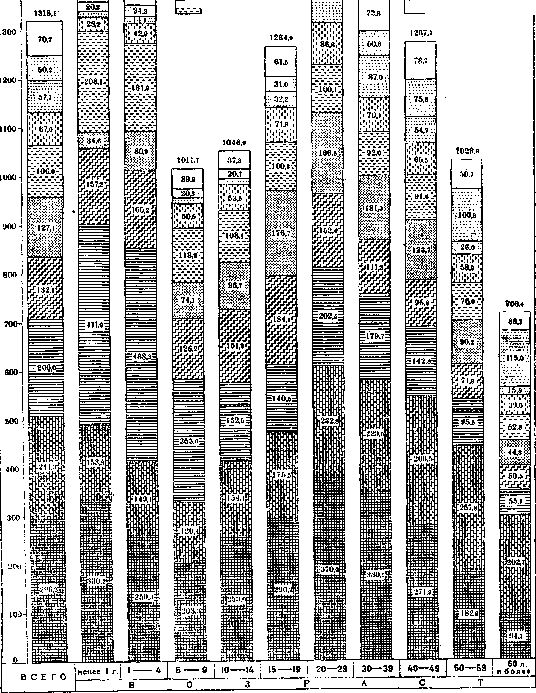
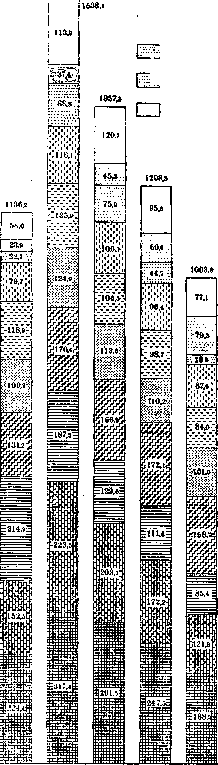
Fig. 2. Morbidity of the population of the Moscow province in 1926 by age (per 1,000 of each age group). The intensity of morbidity is determined by the ratio of the number of diseases to the number of population (taken as 100, 1,000, etc.) in which they arose (intensive relations); the nature of morbidity is determined by the ratio of individual disease forms (groups of them, etc.) to the number of population. Maps of 'new diseases' of the population of a particular locality are developed in their mass for determining 'continuous', mass morbidity; in partial development, not all card material is used, but a certain, sufficiently large part of it, capable of reflecting the structure of morbidity on certain bases—then they speak of 'selective' research (see Selective method). At present, the question of selective research of morbidity seriously occupies the minds of sanitary statisticians in the USSR in view of the fact that for many local sanitary-statistical centers of the Union, continuous research of morbidity is beyond their capabilities. The XI All-Union Congress of Bacteriologists, Epidemiologists and Sanitary Physicians in the spring of 1928, considering the question of applying the selective method in processing materials on population morbidity, decided: '1) The basic method for studying the general morbidity of the population is recognized, as before, the continuous development of the relevant card material; due to its difficulty, it cannot be carried out annually, but is carried out periodically, every 5-10 years, and as much as possible in the years of general demographic censuses. 2) The carrying out of at least one-time continuous research of population morbidity is accepted as an important condition for the correct organization of reduced research of morbidity in the future. 3) Reduced research concerns only the moment of development, but does not affect the moment of registration; the general system of registration of all medical observations on statistical cards according to accepted rules is preserved'. At present, it is recommended to apply the selective method on a mechanical principle for developing materials on morbidity of the urban population, while for rural localities—to begin the development of materials from point settlements (i.e., those settlements where there is a medical facility), assuming that the latter will provide a sufficiently large amount of material; where possible according to the conditions of the collected material, in determining the morbidity of the rural population, to carry out the same method of mechanical selective research as for the urban population. The statistical study of general morbidity was first begun in Russia by E. A. Osipov. In 1875, he presented to the Moscow Provincial Sanitary Commission the 'Program for sanitary research of the province'; it established the systematic regular registration of all forms of diseases observed by zemstvo doctors; by adopting this program, a new branch of statistical research of the population was organized, namely—statistics of morbidity. The study of general morbidity in the period 1880-90 is characterized as 'the general, continuous and continuous determination of mass morbidity of the population' according to a single program for all localities and in the same volume from year to year. The system of studying general morbidity, laid down by Osipov, had no precedents anywhere before that time. The analysis of collected materials on morbidity for 1876-1885 made it possible to draw a number of conclusions of capital importance. In the subsequent years up to 1908, the analysis of materials on general morbidity was carried out by Osipov's successor—P. I. Kurkin. By 1909, when a large amount of information had accumulated on statistics of general morbidity, the provincial sanitary organization recognized it as timely, in view of the enormous importance for the province of the question of professional morbidity, to begin the study of the latter. The study of general morbidity in other localities of Russia followed the pattern of the Moscow province. A further development and deepening of the research is the study of morbidity of the individual, family, group of families, etc.: here the unit of research is no longer 'case of disease', as is the case in mass statistics of morbidity, but 'individual', suffering during his life path from various forms of diseases. This study is based on observations collected by means of the so-called 'individual-family' registration, conducted in medical facilities. Individual cards relating to one family are collected into a family envelope; in addition to general questions, the individual card also contains notes about the anamnesis, heredity, family diseases, changes in family status, occupation, place of residence, outcome of the disease, etc. In these cards, clinical material is collected, which enables the physician to follow the course of the disease during repeated visits to the patient, to capture the connection between individual diseases of the same person, between diseases of members of the same family, to capture their hereditary transmission, etc. However, this is still the statistics of the future, which to this time is in its initial stage. In view of the important significance that contagious-epidemic diseases have in the life of the population, current statistics of epidemic morbidity from the very beginning was singled out into a separate department. Although the basic method for accounting for acute infectious diseases is their registration on general statistical cards (as for all diseases in general), nevertheless for organizational and practical purposes the need for special, emergency registration of the main acute infectious forms on 'emergency notification' cards—for cities, and in the form of 'weekly current reports'—for villages—is recognized. The study of morbidity from social diseases (tuberculosis, syphilis, etc.) requires special, more complex forms of statistical registration (dispensary statistics). However, for general accounting of morbidity from these diseases, simplified mass registration forms (statistical card of diseases) can be used; complex dispensary registration of tuberculosis, venereal diseases, etc. cannot exhaust the general accounting of these diseases. The statistical study of 'professional morbidity' and 'pathological susceptibility' is the most complex. At the basis of the method of studying them lies the position established by Bogoslovsky more than 20 years ago that the unit of research here should be taken as 'detailed profession', i.e., that primary element into which labor is broken down under its modern division. The method of research consists of the following moments: a) identification of the general morbidity of the entire population of a given locality (as a scale for comparisons), b) establishing the professional inherent to each detailed profession (compiling sanitary characteristics of these professions), c) compiling (on the basis of these characteristics) groupings of detailed professions according to the similarity of professional inherent to them, d) sanitary research of those enterprises, professional morbidity and pathological susceptibility of workers with which is being researched, e) detailed research of socio-domestic conditions (the entire way of life) of the studied groups of workers, f) research of the state of physical development and health of workers upon their admission to a given enterprise and subsequent periodic research of them during their stay on it, g) research of morbidity of these workers for the time between their periodic examinations. In the system of statistical records necessary for studying professional morbidity and pathological susceptibility, the basic form is the 'Personal Sanitary Journal' proposed by Bogoslovsky with inserted sheets into it. It contains general statistical data, general status and anamnesis, clinical status, laboratory researches, diagnosis by organs (conclusion of the physician, measures of medical-social assistance, etc.). The journal is designed for a series of periodically repeated medical examinations. Observations about diseases that occurred between periodic examinations are entered on the 'sheet of current observations' inserted into the journal. A special additional sheet to the sanitary journal contains data on the 'research of social and professional conditions of the worker' (individual working conditions, housing, means of subsistence, nutrition, other domestic conditions, general conclusion). In Western Europe, statistics of general morbidity of the population does not exist, because there was no basis there—the public organization of medical assistance to the population, on which this statistics is built and continues to be built in the USSR. Western European morbidity statistics concerns only individual groups of the population (insured, army, navy, etc.); it operates mainly with data from sick funds, dealing only with diseases proceeding with loss of working capacity; taking them into account, it also takes into account 'days of illness'—the duration of the disease, which our statistics of general morbidity, based on the registration of all diseases, cannot do. The introduction of social insurance gave rise in the USSR to statistics of morbidity with loss of working capacity.

M., 1912; Osipov E., Statistics of morbidity of the population in the Moscow province for 1878-82, M., 1890; he same, Program for sanitary research of the Moscow province, adopted by the Moscow Provincial Zemstvo Sanitary Commission (Review of the twenty-five-year activity of Moscow zemstvo for 1865-1890, M., 1892); Rules of medical-sanitary registration, issues 1-1, M., 1927-28; Prinzing F., Methods of sanitary statistics with additions by P. Kurkin and P. Kuvinshnikov, M., 1925; Social hygiene, edited by A. Mol'kov, M., 1927; Yakovenko E., Medical statistics, M.-L., 1924.
Related articles
Mentioned in
Cite this page
“Morbidity.” Soviet Medical Encyclopedia. English translation of Bolshaya Meditsinskaya Entsiklopediya, 1st ed. (Moscow, 1928–1936), ed. N. A. Semashko. https://sovietmedicalencyclopedia.pages.dev/article/morbidity/