Ambulatory
Historical document, translated for reference. It reflects medical knowledge of the 1920s–30s and is not medical advice.
Summary
The article traces the historical development of ambulatory clinics in Russia from the 17th century through the Soviet period, describing their organization, staffing, and evolution from mobile units to established healthcare facilities.
Encyclopedia article (1928–1936)
AMBULATORY (from Latin ambulare - to walk), a medical institution for providing assistance to outpatients. Judging by the root of the word, ambulatories probably had a mobile character at their inception, moving from place to place; for example, the French ambulance was a military infirmary that followed the troops right to the battlefield (they were introduced into the French army in 1597). It is interesting to note that even at the time of the establishment of zemstvo institutions, ambulatories also initially had a mobile character: doctors (or paramedics of independent paramedic stations), in addition to their main station, also had mobile stations. The history of the emergence of ambulatorries in Russia, or rather the provision of assistance to outpatients, appears as follows. With the reorganization of the Apothecary Order at the beginning of the 17th century, the first secular ambulatorries with doctors (foreigners and Russians) and paramedics began to appear. During this period - the end of the 18th century and the first half of the 19th century - ambulatorries existed only at hospitals; in rural areas there were no ambulatorries, except in areas subordinate to "domains" or the "Administration of State Property", where there were paramedics (one for 1-3 volosts). Landowners rarely maintained paramedics either. Among factory workers, ambulatorries existed only in the mining department of Perm province and in the gold mines of Siberia; on other factories in European Russia, medical personnel was extremely rare (the law on the mandatory provision of premises for hospitals at factories was first published only in 1866). With the introduction of zemstvo institutions (1864), the zemstvo inherited 351 ambulatorries from the "Order of Public Charity" (32 in provincial and 319 in county cities). From this time, the construction of zemstvo and urban medical networks began. During the organization of urban and zemstvo institutions, large cities emerged as independent units in medical terms and opened their own ambulatorries; railways, the reformed army, factories and plants also began to build their own independent medicine, opening their own ambulatorries. By 1890, in zemstvo provinces there were already 1,068 ambulatorries attached to hospitals, 414 independent ambulatorries, and 2,896 paramedic-obstetric ambulatory stations, with this increase being due to the opening of rural medical stations (in provincial cities there remained 32 ambulatorries, in county cities - 325, the remaining ambulatorries - all in rural areas). As of July 1, 1913, according to the data of the Raynov Commission, there were 2,517 medical districts (according to the Commission for checking statistical data under the People's Commissariat of Health - 2,732) and almost as many independent paramedic stations in the entire territory of the RSFSR. With the October Revolution, the Soviet period of healthcare begins. As of January 1, 1926, there were already 4,251 medical districts in rural areas in the USSR, and for each such district there were only 0.8 independent paramedic ambulatory stations. The number of ambulatorries by individual republics (as calculated on January 1, 1926) is as follows: RSFSR - 5,852, Ukrainian SSR - 1,907, Byelorussian SSR - 239, Georgian SSR - 127, Armenian SSR - 24, Azerbaijan - 61, Turkmenistan - 20 and Uzbekistan - 163, for a total of 8,393 ambulatorries.* For the RSFSR, it is possible to give a more detailed distribution of ambulatorries (see table): railways have such "reception rooms" in almost all ambulatorries. In a small rural ambulatory, the entire staff usually consists of 4 people: 1 doctor, 2 middle-level medical personnel (1 in the dressing room, 1 in the pharmacy) and 1 attendant. The All-Union Congress of District Physicians in Moscow in 1925 spoke out in favor of the need to have 2 doctors in each district. Currently, a number of provinces in the USSR are already introducing second positions for district physicians, thereby facilitating the work of the ambulatory. Such a rural ambulatory, according to the congress's plan, should have two doctors, a minimum of 3 middle-level personnel (1 in the dressing room, 1 in the pharmacy and 1 for patronage) and 1 attendant. In developed ambulatorries, the staff is correspondingly even larger. Thus, in Moscow, in 32 hospital ambulatorries and 99 non-hospital ambulatorries, 1,323 doctors work (of which 325 are dentists), which gives an average of 10 doctors per ambulatory. According to the latest regulation on working hours in medical-sanitary institutions, approved by the People's Commissariat of Labor of the USSR on October 4, 1927, under No. 307, medical and dental doctors in outpatient reception in ambulatorries, special offices, polyclinics, dispensaries, consultations, etc. must work 5 hours with continuous work; feldshers conducting independent outpatient reception are also included in this group. Middle-level personnel work 6 hours, and service personnel - 8 hours. By the Collegium of the People's Commissariat of Health, approved on December 21, 1923, and agreed with the People's Commissariat of Labor on March 26, 1924, the following labor norms for medical personnel in ambulatorries were established: 1) in general, non-specialized ambulatorries - 1 doctor per 40-45 visits; 2) in specialized ambulatorries (therapeutic and surgical) - 1 doctor per 35-40 visits; 3) in ambulatorries for nervous patients - 1 doctor per 30 visits; 4) in ambulatorries for gynecological, eye and ear patients - 1 doctor per 30 visits; 5) in ambulatorries for venereal and skin patients - 1 doctor per 40 visits; 6) in children's ambulatorries - 1 doctor per 35 visits; 7) in dental ambulatorries - 1 doctor per 18 visits; in children's dental ambulatorries - 1 doctor per 14 visits; for dental technicians, the monthly production norm is set at 196 production units. The pharmacy staff at ambulatorries is calculated as follows: for every 100 outpatient visits - 1 assistant; for each assistant - 1 helper worker; for two assistants - 1 prescription controller; for 500 and more outpatient visits - 1 defect-laboratory assistant. The amount of middle-level personnel in ambulatorries is determined by the number of actually functioning medical offices (1 middle-level personnel per medical office, with a full working day). The basic principles of Soviet healthcare organization - accessibility and free qualified medical care for the working population, prevention of diseases and participation of the working population itself in the construction of healthcare - are also the basis of the activities of modern ambulatorries. The accessibility of ambulatorries is already evident from the numerical indicators of visits to ambulatorries: in the RSFSR there are 1.2-1.6 visits per resident, and in the Moscow province even 1.9-2.3 visits. To implement the principle of "accessibility", when developing the ambulatory network, a number of factors are taken into account: population size, its social composition, density in a given territory, topographical features, living conditions of the population, epidemicity, actual outpatient attendance of the entire population and its individual groups, etc. In accordance with the second principle of Soviet medicine, the ambulatory is tasked with conducting work, in addition to providing medical care, also on the prevention of diseases (prophylaxis). Health Commissions for Labor and Living Conditions (see) are organized at ambulatorries. On the basis of studying the socio-hygienic conditions of labor and life of the working masses and with the help of the population itself, which participates in these commissions, necessary health measures are developed and implemented. Modern ambulatorries, in their orientation and activities, are beginning to approach the activities of a dispensary (see) and not only carry out medical measures, but also study working conditions, organize physical examinations of workers, gradually take them under their dispensary observation and organize the population around them.
Ambulatories also carry out educational work, both within their walls through exhibitions and conversations with patients, and outside the ambulatory through appearances by the medical personnel working there.
Ambulatories. The design and equipment of an ambulatory. The rationality of an ambulatory's design comes down to the closest possible contact with the mass of the population served (location of the ambulatory), to the most rapid and isolated (by diseases) service of incoming patients (plan of the ambulatory), and to the most complete satisfaction of the needs of this particular group of population (the question of special preliminary survey of the area when organizing an ambulatory).- Plan of the ambulatory building. The program of each particular ambulatory, as a defined link in the general network of health care institutions, determines also the plan of the building-its design and layout. All rooms of each ambulatory are divided into three groups-rooms for waiting patients, treatment rooms, and office rooms.-Rooms of the ambulatory for patients. Statistics of the area provide information on the number of patients who annually apply to the ambulatory. The flow of daily numbers (daily capacity of the ambulatory) is usually uneven within different hours of the day. In urban conditions, with daytime service, the highest attendance is observed from 11 a.m. to 1 p.m. (up to 50% of the entire 8-hour daily number). In rural ambulatories, up to 90% of the daily number of patients come from surrounding villages from early morning. In ambulatories in workers' districts, the influx is connected with the time before the start and after the end of factory work. Depending on this, the waiting hall should be calculated for the number of simultaneously present patients: in the first case, based on 25-30% of the daily mass, in the second-80-100%, in the third-40-50%. The convenience of work in the ambulatory requires proximity of the waiting patient
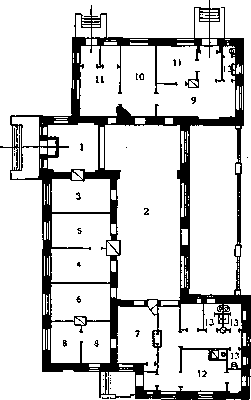
Rural ambulatory for 120 daily visits: 1-vestibule-dressing room; 2-waiting room with registration; 3 and 4-doctor's office; 5-dressing room; 6-laboratory; 7 and 8-pharmacy; 9-children's waiting room; 10-children's doctor's office; 11-children's and general isolation rooms; 12-watchman; 13-restroom.
to his doctor's office; therefore, the main plan should be a large waiting hall surrounded by treatment offices. With a capacity of the ambulatory of more than 200 daily visits or if it has special departments, it is necessary to further divide the ambulatory into autonomous groups and even with separate entrances. The groups are connected by common treatment auxiliary institutions and, if possible, a common registration room. The layout of the building should ensure a free path for the patient (entrance hall-dressing room-registration-waiting room-doctor's office and back), avoiding counter-currents. In large ambulatories, its separate groups and more independent treatment-auxiliary institutions can be located on different floors, taking into account the difficulty of climbing stairs for certain categories of patients.-Treatment rooms of the ambulatory: these include doctors' offices by specialty, dressing rooms, pharmacy, operating rooms, procedure rooms, a ward for 1-2 beds in the latter two rooms, X-ray room, etc. Doctors' reception offices should be easily accessible for the corresponding category of patients, but at the same time isolated from the noisy waiting room by a solid wall and, if possible, a double door. In the office, it is desirable to allocate in its entrance part a room for undressing the patient, with the possibility of easy cleaning of the floor and walls. In large urban ambulatories, as additional parts, there may also be rooms for water-electro-light therapy with a separate entrance for returning patients, an isolation room for temporary placement of infectious patients before being sent to a hospital, rooms for the control commission doctors, for the sanitary doctor, for the laboratory, etc. Office rooms of the ambulatory are determined by its size and FUNCTIONS.
Related articles
Mentioned in
Cite this page
“Ambulatory.” Soviet Medical Encyclopedia. English translation of Bolshaya Meditsinskaya Entsiklopediya, 1st ed. (Moscow, 1928–1936), ed. N. A. Semashko. https://sovietmedicalencyclopedia.pages.dev/article/ambulatory/