Polyclinic
Historical document, translated for reference. It reflects medical knowledge of the 1920s–30s and is not medical advice.
Summary
This article from the 1928–1936 Great Medical Encyclopedia describes the organization, structure, staffing norms, and functions of polyclinics in the Soviet Union as major ambulatory healthcare facilities.
Encyclopedia article (1928–1936)
POLYCLINIC (from Greek polis - city), a medical institution whose task is to provide the population with qualified outpatient medical care in a number of specialties, mostly in all major ones, and including, in addition to a number of offices for corresponding specialties, an X-ray room, a clinical diagnostic laboratory, various physiotherapy installations, etc., to ensure the high quality of the provided medical care. The designation of polyclinic in cities is usually assigned to the most powerful specialized dispensaries with 1,000 and more visits per day, but often special dispensaries with a smaller patient load and even lacking the specified technical equipment are also called polyclinics, although it would be more correct to simply call such outpatient-type institutions specialized dispensaries. The name polyclinic is often incorrectly assigned to dispensaries providing qualified care in a single specialty, e.g., there are eye polyclinics, children's polyclinics, dental polyclinics, etc. The layout and equipment of polyclinic offices mostly correspond to the special tasks of these offices, e.g., specially equipped obstetrical-gynecological, surgical, eye, etc. Medical consultations in polyclinics are usually conducted by qualified specialists. With an average load of 10-11 thousand visits per year per 1 medical consultation, a corresponding norm for patient intake has been established for each specialty. The working day is established as follows: for physicians - 5 hours, and for dentists - 5 hours 30 minutes (Resolution of the People's Commissariat of Health of the RSFSR of March 5, 1933, "Na fronte zdravookhraneniya" [On the Healthcare Front], no. 7-8, 1933). Table 1 gives the approximate norms established by the People's Commissariat of Health of the RSFSR for various types of polyclinics. Table 1. Workload norms for polyclinics with 1,000 and more visits. Specialty: Workload per physician without assistant / with 1 assistant / with 2 assistants per hour / full working day. Therapist: 5.0, 30 / 6.2, 37 / -, -. Surgeon: 6.0, 36 / -, -. Otolaryngologist: 4.5, 27 / 5.5, 33 / -, -. Pediatrician: 6.0, 36 / -, -. Ophthalmologist: 4.5, 27 / -, -. Neurologist: 6.3, 40 / -, -. Dermatovenereologist: 5.5, 45 / -, -. Dentist: -, - / 3.6*, 22 / 7.5, 44. Gynecologist: 6.5, 60 / -, -. Obstetrician-gynecologist in women's consultations: a) for pregnant women: 7.5, 55 / -, -; b) for contraceptives: -, - / 20**, 41 / -, -. * As a rule, a surgeon must work without an assistant. ** Usually does not work without an assistant. Workload with 0.5 assistant. Norm for daily dental reception: for general oral sanitation - 8 persons. Reception of children - 16 persons. General norm of dental reception - 20 persons per day. Norm for a dental technician - 45 dentures per month. 288 The polyclinic also has on its staff a certain number of middle-level medical personnel for maintaining appropriate records and executing physicians' orders - injections, dressings, etc. Middle-level medical personnel are attached to certain offices for their permanent service, e.g., to the obstetrical-gynecological, surgical, eye, dental, physiotherapy departments, etc. In many polyclinics, the staff includes social care sisters or visiting nurse-investigators, who, "according to the appointment and instructions of physicians, conduct social and domestic investigations of the living conditions of the respective patients." It is necessary to have 1 nurse-investigator per 400 visits to the polyclinic. Polyclinics that are most powerfully equipped technically, located in the center of a city or district, and usually possessing all types of highly qualified outpatient care to serve not only the respective contingents of the district attached to them, but also other districts that do not have appropriate types of highly qualified care or have them to an insufficient degree, are called central polyclinics, in contrast to district ones, which exclusively serve the territory of a definite district or a part of the latter and are usually less equipped with special installations. If there are several polyclinics in a district, one of them, the best equipped and provided with the most qualified medical forces in all types of medical outpatient care, or at least in all main types (with the inclusion of those that are absent in other district dispensaries due to the insignificance of attendance in the corresponding specialty or due to the lack of appropriate specialists), is called the central polyclinic of the corresponding district. Usually, the home-care medical station is also located in the central polyclinic. In large cities and in district polyclinics, there are home-care stations. In many cities, a first-aid station or post is usually located in central polyclinics. Polyclinics are usually arranged in such a way that offices for various specialties are located along the sides of a large waiting hall, which is also connected with the registration desk. The following premises must be provided in a polyclinic (see drawing on pages 239-240): a vestibule, a cloakroom for patients and medical staff, a waiting room and registration desk, rooms for all special offices with appropriate consideration of the number of visits, separate dressing rooms for men and women, 1-2 treatment rooms, an operating room with corresponding parts - pre-operating, sterilization, and supply rooms (in small polyclinics - of a simplified type), toilets for patients and medical staff (for the latter also a shower room), an office for the head physician, 1-2 rooms for physicians (for staying before and after appointments and in intervals), rooms for middle-level and junior staff and watchmen, isolation rooms for temporary isolation of patients suspected of having infections with a separate toilet, special rooms for exercising the functions of medical control and labor expertise, special premises for the clinical diagnostic laboratory, X-ray, physiotherapeutic procedures (physiotherapy department), administrative and economic premises, rooms for meeting the scientific and cultural needs of the polyclinic (red corner, conference hall, lecture hall), and premises for public organizations. Premises for serving children, tuberculosis, and dermatovenereological patients are usually separated in the polyclinic building into an autonomous group with a separate entrance and separate registration. The polyclinic must also have rooms with 1-2 beds - a temporary hospital for accommodating severely ill patients who have appeared for an appointment and are subject to transfer to a hospital. A pharmacy space with an dispensing room, accounting room, supply room, and basement is often provided at the polyclinic. Depending on the projected volume of work of the polyclinic, its technical capacity, and throughput, the number of rooms for special offices and departments and their sizes are determined. In a number of polyclinics, special premises are also set aside for the sanitary organization of the corresponding district. Usually, a polyclinic has a central registration desk serving all departments and offices of the polyclinic; a card registration system is used with a single numbering and one card for the entire polyclinic. In a number of large polyclinics, there is a separate registration desk by departments, but even in this case, centralized processing of registration materials takes place. The polyclinic reports on issued medical certificates to the health post of the corresponding enterprise so that the health post can take necessary measures to combat the morbidity detected by the polyclinic at the given enterprise and report to the administration of the corresponding workshops. The polyclinic, in turn, receives corresponding information from the health post about the state of health of the contingents served by it who are employed at the given enterprise, since these data are initially concentrated at the health post. The polyclinic also receives necessary data from hospitals about the state of health of patients referred by the polyclinic to hospitals, as well as about the upcoming discharge of such patients to ensure their further systematic observation by the polyclinic. A number of polyclinics also have a pharmacy, especially in polyclinics in rural districts. In cities, medicines prescribed by polyclinic physicians are dispensed for the convenience of visitors and patients from the nearest pharmacy. Many polyclinics receive patients on a prosthetic engineering order; 92 - sanitary-hygienic laboratory; 93 - biochemical laboratory; 94 - sampling; 95 - reception of analyses; 96 - clinical analyses; 97 - washing and drying room; 98 - serology; 99 - hematology; 100 - autoclave; 101 - supply room; 102 - experimental animals.
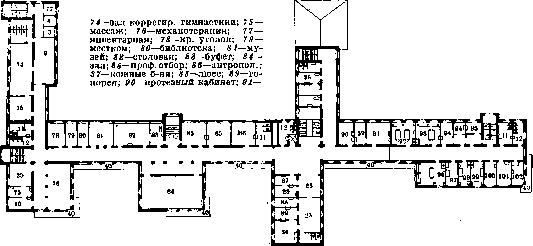
THIRD FLOOR: 36 - treatment room; 37 - manipulation room; 38 - lobby; 39 - medical chancellery; 40 - balcony; 41 - wrapping room; 42 - baths and shower room; 43 - heat therapy; 44 - high-frequency current room; 45 - low-frequency current room; 46 - quartz lamp room; 47 - X-ray therapy; 48 - control room; 49 - head of department; 50 - X-ray photographs; 51 - photography; 52 - X-ray fluoroscopy; 53 - dentist; 54 - ear, nose, throat; 55 - ophthalmologist; 56 - extraction room; 57 - therapeutist; 58 - otolaryngologist; 59 - surgeon; 60 - pediatrician; 61 - special room; 62 - operating room; 63 - sterilization room; 64 - pre-operating room; 65 - gynecologist; 66 - urologist; 67 - legal consultation; 68 - obstetrician; 69 - bone tuberculosis; 70 - children's room; 71 - tuberculosis; 72 - pneumothorax; 73 - plaster room.
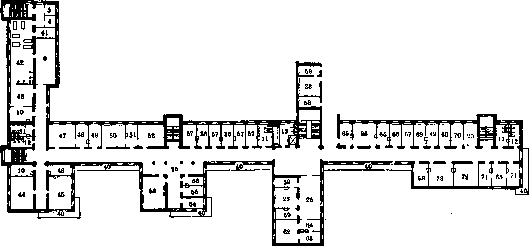
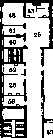
SECOND FLOOR: 1 - duty room; 2 - warming room; 3 - utility storeroom; 4 - linen room; 5 - drying room; 6 - mud therapy; 7 - sweating room; 8 - relaxation hall; 9 - dressing room; 10 - physician's office; 11 - men's restroom; 12 - women's restroom; 13 - cloakroom; 14 - porter's lodge; 15 - staff cloakroom; 16 - gown room; 17 - shower room; 18 - assistant head's office; 19 - accounting department; FIRST FLOOR:
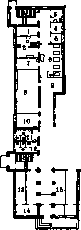
20 - supply manager's office; 21 - pediatrician; 22 - preparatory room; 23 - dressing room; 24 - staff room; 25 - waiting room; 26 - ward; 27 - sanitary nurses; 28 - sanitary physician; 29 - medical statistics; 30 - chief physician; 31 - pedologist; 32 - weighing room; 33 - nursery room; 34 - examination room; 35 - registration desk.
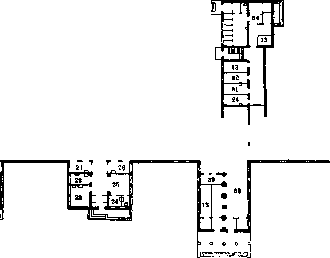
FIRST FLOOR
I, II, III, IV, V, VI, VII, VIII, IX, X

Standard construction project of the People's Commissariat of Health. Polyclinic for 15,000 visitors. Based on preliminary applications from outpatient clinics, first-aid stations (health posts) at enterprises, home-visit doctors, etc. The order of admission, registration forms, and reporting in polyclinics are regulated by special rules issued by the People's Commissariat of Health. Regarding the order of admission, priority (first-priority admission) is granted to insured population groups, but among the latter, groups of industrial workers—shock workers—are usually singled out for preferential service. A polyclinic constitutes the basic unit of a single dispensary, working in close contact with all its other parts—special dispensaries, consultations, etc. In polyclinics with a rational organization of medical care, dispensary methods of work are widely applied, implying not only the provision of systematic qualified medical care, but also constant monitoring of the state of health of the working contingents attached to the polyclinic and participation in carrying out preventive and sanitary measures in everyday life and at work. In rural areas, the name of polyclinic is assigned to special outpatient clinics with a smaller medical admission rate than in cities, if they have admissions in basic specialties and possess the necessary special equipment (X-ray, laboratory, etc.). Rural polyclinics are organized predominantly in district centers at the locations of the largest district hospitals, which have several medical specialists and serve the collective farms, state farms, and certain rural localities assigned to them with qualified medical care; rural polyclinics operate on the same principles as urban ones, applying the same methods of dispensary work, with the only difference that in rural polyclinics not located in district centers, admissions are usually conducted in basic specialties—therapy, surgery, obstetrics-gynecology, and often skin and venereal diseases, whereas special admissions in neuropathology, otolaryngology, ophthalmology, pediatrics, etc., are usually organized at polyclinics of rural district centers. In addition, due to the shortage of medical specialists in rural areas, admission norms here are significantly higher than in urban polyclinics. In areas with a high prevalence of eye and skin-venereal diseases, admissions in the relevant specialty must be organized in the polyclinics of the given area. A rural polyclinic serves state farm workers and collective farmers in order of priority. A rural polyclinic, which constitutes the basic unit of a rural medical district reorganizing its work along the lines of a single dispensary, is in most cases the organizing center for carrying out preventive and sanitary work in the given district, according to the instructions and under the guidance of the respective district health department. When deploying a polyclinic with a certain number of admissions in individual specialties, account is taken of the size and density of the population of the respective city district or rural region, the remoteness of individual districts from one another (distance to the nearest polyclinic), the social, occupational, age, and sex composition of the population, the size and nature of the manufacturing and industrial enterprises to be served, labor and living conditions and general sanitary conditions in the points included in the service of the respective polyclinics, the revealed morbidity and application of the population for medical care, the most frequently encountered diseases in the given district, the above-mentioned norms of medical admission, and the ratio of admissions in individual specialties. The latter is presented according to the data of the People's Commissariat of Health of the RSFSR as follows: for therapy—32% of visits, for surgery—14%, for nervous diseases and psychiatry—7%, for obstetrics-gynecology—7%, for children's diseases—10%, for eye diseases—5%, for ear, throat, and nose—6%, for tuberculosis—4%, for skin-venereal and urological diseases—5%, for dental diseases—10%, total—100%. In general, it is desirable that the radius of the district served by a polyclinic does not exceed 1.5 km. A polyclinic with admissions in all basic specialties can be rationally organized to serve the insured given the presence of 3,000–5,000 insured persons concentrated in one district. An especially important indicator when organizing a polyclinic network is the number of visits per 1 resident and 1 insured person per year: per 1 resident in urban and industrial centers of the RSFSR, there was an average of 9.7 visits in 1932, and this attendance indicator fluctuated in different regions within the range of 8.5–15.9 depending on the above-mentioned conditions affecting polyclinic attendance: Leningrad Oblast—9.0, Leningrad city—15.9, Moscow Oblast—13.2, Moscow city—14.7, Ivanovo Industrial Oblast—10.4, Ural Oblast—7.3, North Caucasus—9.6, West Siberia—8.5. Per 1 resident in the autonomous republics, there was an average of 7.6 visits per year, with the indicator in Crimea equaling 12.0, and in Yakutia—9.8. The number of visits per year per 1 insured person is significantly higher than the average number of visits per 1 resident; thus, for example, in Moscow in 1931 there were 20 visits per 1 actively insured person, in Leningrad—22, in Leningrad Oblast—21. Over all recent years, in connection with the rise in the cultural level of the working population, the improvement in the quality of rendered medical care, its approximation to the population, and the widespread application of dispensary service methods, the attendance coefficient in polyclinics has been growing steadily. To establish proper ties with the working population being served, labor and living improvement commissions for workers, the so-called KOTIBs, are organized at polyclinics, consisting of polyclinic doctors, representatives of factory committees of the largest enterprises, the mutual aid insurance fund of the served district, and members of the Soviet of Workers', Peasants', and Red Army Deputies attached to the polyclinic. The polyclinic KOTIB hears reports on the work of the polyclinic, examines its work plan and budget, discusses measures to improve its activities and eliminate existing shortcomings, hears reports from enterprise representatives on workers' wishes regarding the organization of medical care, and makes decisions on the procedure for distributing various types of therapeutic and prophylactic care (places in sanatoriums, diet dining rooms, rest homes, etc.). History. Polyclinics are undoubtedly a conquest of Soviet medicine, since in pre-revolutionary years polyclinics numbered in the units, and even then only in the largest cities. In 1912–1914, out of 224 cities for which data on medical care were compiled by Zhbankov, 107 cities did not even have independent outpatient clinics, and in the overwhelming majority of the remaining cities, general admissions were conducted, and only in some of the largest cities (Moscow, Leningrad) in some outpatient clinics where Duma doctors conducted general admissions, admissions of specialists in some basic specialties were also organized; at the same time, special admissions were little accessible to the population due to the extremely limited time of special admissions and the insufficient number of specialists invited by the Duma. Polyclinics in the above-mentioned sense did not exist at all in pre-revolutionary years, even at the largest manufacturing and industrial enterprises, whereas in 1932 in the RSFSR alone there are 22,500 medical admission slots, an enormous part of which falls on specialist admissions in polyclinics. (For the history of the development of polyclinics, see also Outpatient Clinic, Outpatient Care, Public Health). Polyclinics in capitalist countries in the overwhelming majority of cases are privately owned enterprises providing specialized medical care for a corresponding fee. In almost all capitalist countries, the majority of polyclinics provide care in one single specialty: there are separate polyclinics for internal diseases, surgery, ear, throat, and nose, dental diseases, women's diseases, children's diseases, etc. Communal polyclinics are very rare. In England, France, Germany, and America, polyclinics exist at large hospitals and university clinics. In Germany, in some cities, insurance funds have organized well-equipped polyclinics, but the latter have the right to provide care only to family members of the insured, but not to the insured themselves. Doctors have achieved a ban on polyclinics providing medical care to the insured, as well as a complete ban on further organization, as they feared a reduction in their private practice and a decrease in home visits from insurance fund members. In connection with the crisis of the capitalist economy in foreign countries, many polyclinics are closing or sharply reducing admissions in various specialties, whereas in the USSR, in connection with the general upswing and continuous growth of the national economy, a steady rapid growth in the number of polyclinics is observed. (See also Outpatient Clinic, Outpatient Care, Dispensary, Dispensarization, Public Health).
Related articles
Mentioned in
Cite this page
“Polyclinic.” Soviet Medical Encyclopedia. English translation of Bolshaya Meditsinskaya Entsiklopediya, 1st ed. (Moscow, 1928–1936), ed. N. A. Semashko. https://sovietmedicalencyclopedia.pages.dev/article/polyclinic/