Ambulatory Care
Historical document, translated for reference. It reflects medical knowledge of the 1920s–30s and is not medical advice.
Summary
Ambulatory care is a fundamental form of medical assistance provided to outpatients. The article details its organization in the Soviet Union, contrasting it with Western European approaches and describing its development as part of the unified Soviet healthcare system.
Encyclopedia article (1928–1936)
AMBULATORY CARE, one of the basic forms of medical assistance to the population, consists in serving outpatients. This form of assistance is widespread in all states, since most diseases do not require stationary, hospital, or even home treatment, and the main mass of patients is able to come to the doctor themselves, without requiring the attachment of a doctor to the patient. The organization, forms, and principles of organization of ambulatory care differ sharply in different countries and states. First of all, the organization of ambulatory care differs depending on who organizes it: the state, departments, public organizations, self-government bodies, insurance organizations (hospital funds), philanthropic organizations, or private individuals—private practicing physicians or their collectives, as entrepreneurs in the field of providing medical assistance to the population. This is one of the basic principles determining the character and state-public value of ambulatory care. The principle of organization of ambulatory care in the prerevolutionary period (before 1917) differed sharply in Russia and Western Europe. In Russia, due to the existence of zemstvo medicine, the principles and type of 'public' medicine predominated, and consequently, also public ambulatory care, organized mainly by zemstvo and urban self-government bodies. In Western Europe, the type of private ambulatory care predominated, organized by private practicing physicians and philanthropic organizations; in Germany, in addition, by hospital insurance funds and occasionally by municipal and departmental organizations. In prerevolutionary Russia, even during the zemstvo period, ambulatory care passed through its evolutionary stages in an organizational sense—not only quantitatively but also qualitatively—from the system of traveling physicians to a network of ambulatory points and specialized outpatient clinics in cities. With the growth and development of ambulatory care, the tasks of ambulatory points expanded and deepened: ambulatory points were assigned functions not only of first medical aid but also functions of 'observation points' for the health status of the population, points for observation of infectious diseases, sanitary-educational institutions, points of connection between physicians and the population. Ambulatory care received especially great development in the USSR, as soon as Soviet medicine, after the end of the civil war, entered the period of its reconstructive construction. In recent years, there is a steadily progressive growth of ambulatory care both quantitatively (in terms of the size of the network and the number of visits) and qualitatively, organizationally. At present, the foundations of the organization of ambulatory care in the Soviet Union are built on the following principles: 1) Ambulatory care is an organic and basic link in the unified Soviet medicine; 2) the organization of ambulatory care is a function of state and public health authorities from the center to the periphery (People's Commissariat of Health, provincial, district, gubernatorial, and uyezd health departments); 3) ambulatory care must be universally accessible, qualified, maximally close to the population, and free; 4) the organization of ambulatory care must provide for the special requests and conditions of cities, villages, industrial centers, the insured population, the interests of national minorities, and the population of remote areas; 5) the tasks of ambulatory points must include a) medical assistance, as qualified as possible, especially in cities and industrial centers; b) strict statistical accounting and registration of patients; c) possible preventive activities with the application, as much as possible, of the principles of dispensarization (see Dispensarization); d) observation of infectious diseases by linking with the corresponding sanitary authorities; e) extensive sanitary-educational work; f) organization of the population's self-activity around ambulatory points (commissions for improving labor and living conditions); g) scientific research work; h) coordination of the work of ambulatory points with other medical-sanitary organizations.—Ambulatory care everywhere is the basic organizational form of medical assistance to the population. Statistics show that 96 people out of 100 who fall ill use ambulatory care first of all; this determines how important significance should be attached to this form of assistance in an organizational sense. Ambulatory care is organized in two basic forms—general and specialized polyclinic. The first, predominantly, takes place in villages, the second—in cities and industrial centers, places of concentration of workers. A special achievement of Soviet medicine is that in cities and industrial centers, specialized ambulatory care is now connected and accompanied by a system of dispensarization of special population groups. A new organizational form, a new achievement in the organization of ambulatory care, must be considered the introduction of the principle of 'ambulatory associations' (the experience and practice of Moscow)—a system of organization of ambulatory care, under which a district distribution of ambulatory care is created, maximally close to the population and coordinated with all other types of medical-sanitary assistance. Such associations now exist in Moscow and some other large centers. They represent a system of medical care over a small radius, in its gradual development from a first aid point to a highly qualified clinic. When organizing associations in Moscow in 1923, there were 27 outpatient clinics. In 1924, all outpatient clinics and home care organizations were grouped into 26 ambulatory associations around 26 central specialized outpatient clinics (13 at hospitals, 13 outside hospitals). At the head of each association stands a managing physician, who cares for the correct organization of assistance within the association (ambulatory care, home care, emergency care). Associations are an organized center where practical issues within the association are outlined and discussed, together with the sanitary organization, regarding the organization of medical affairs, anti-epidemic struggle and struggle with social diseases, issues of studying professional harmfulness in enterprises and a number of other issues raised by the life and activity of the association; in addition, the association is the initial sanitary-statistical base where all information about general, epidemic, social, and professional morbidity is collected from institutions included in the association. Dispensarization in Moscow is carried out through physicians of ambulatory associations. As an example of the construction of an association, one can cite the Tver Ambulatory Association (in Moscow). It is located in the center of the city, occupies an area of 2.85 sq. km and covers 150,000 population. The number of industrial enterprises here is small, there are many Soviet institutions in the association. The association includes three large municipal outpatient clinics with a total number of treating physicians 32-72, one dental outpatient clinic with 13 physicians and 15 treatment points (at enterprises—6, at Soviet institutions—5, in theaters—2, in educational institutions—2). There are 3 home care points, where 16 physicians work. In 1926, in 36 institutions, 11,011 sanitary journals were compiled (for workers and employees 10,104 and for adolescents 907).
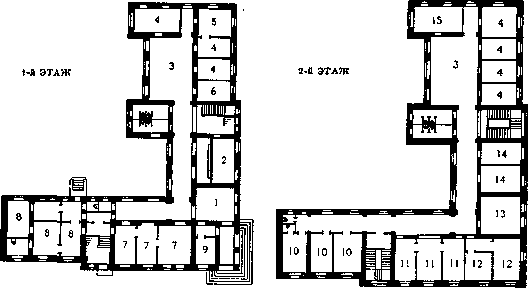
Outpatient clinic in an industrial area for 300 daily visits: 1-vestibule-dressing room; 2-registration; 3-waiting room; 4-physician's office; 5-dressing room; 6-personnel; 7-pharmacy; 8-pediatric department; 9-isolation ward; 10-venereal department; 11-dispensary; 12-office; 13-radiology; 14-electro-light therapy; 15-laboratory.
The area of organization of ambulatory care now comprises a large number of complex issues requiring special study. Among these issues are: 1) compilation of a network of ambulatory points in villages and cities—general and specialized, 2) development of plans and types of buildings for ambulatory points, 3) development of coefficients of utilization and attendance of various population groups (rural, urban, insured, etc.), depending on the radius and special types of morbidity, 4) organization of special types of ambulatory care, 5) internal work schedule of ambulatory points, 6) organization of sanitary-educational work at ambulatory points, 7) organization of connection of ambulatory points with the population (commissions for improving labor and living conditions), 8) scientific development of individual issues and materials of ambulatory care, etc. The modern organization and development of ambulatory care in the USSR is regulated by a series of legislative acts, decrees, mandatory resolutions, normative schemes, issued by the People's Commissariats of Health of the Union republics.
m. gran.
Related articles
Mentioned in
Cite this page
“Ambulatory Care.” Soviet Medical Encyclopedia. English translation of Bolshaya Meditsinskaya Entsiklopediya, 1st ed. (Moscow, 1928–1936), ed. N. A. Semashko. https://sovietmedicalencyclopedia.pages.dev/article/ambulatory-care/