Solarium
Historical document, translated for reference. It reflects medical knowledge of the 1920s–30s and is not medical advice.
Summary
A solarium is a designated area for receiving sun baths, which are simultaneously air baths. The article details proper construction, location, equipment, and scientific measurement of solariums for therapeutic purposes.
Encyclopedia article (1928–1936)
SOLARIUM (from Latin sol-sun), a place for receiving sun baths; more correctly aerosolarium, since every sun bath is simultaneously also an air bath. During a sun bath, in addition to direct sun rays, diffused solar radiation is also used. - The area for a solarium should be accessible to direct sun rays and should face south or southeast. An aerosolarium should be located at a considerable distance from houses, from noisy and dusty roads, from factory buildings where there may be constant air pollution with dust, smoke, harmful gases, etc. The solarium area should be protected from strong winds, but at the same time, care must be taken to ensure good ventilation of the solarium. High, solid fences around solarium areas that hinder free air movement are impractical. For fencing, green hedges or low fences (1½-2 meters), covered with dense vegetation, can be used. Removable shields, installed depending on the direction and strength of the wind, can also be used. If necessary due to external conditions, a solid fence should not be higher than 2 m. It is recommended to paint it white. - Solariums can be set up on terraces, on flat roofs, but it is best to arrange them in an area among greenery, on the shore of the sea, lake or river, as well as in the mountains. When setting up a solarium on a flat roof, extremely unfavorable conditions sometimes arise due to the proximity of heating iron roofs and concrete areas. When they heat up, especially with insufficient wind, hot air currents are formed, which partially give the sun bath the properties of a hot dry air bath, which is not always well tolerated by patients. The arrangement of solarium areas on turf clearings without dust, especially with daily watering, is preferable. High grass is undesirable to avoid excessive moisture. With proper planning, the area should have a slight slope ensuring rapid drainage of rainwater. The presence of a large body of water (sea, lake, river) has a cooling effect and, along with sea breezes, significantly moderates overheating. Therefore, conducting sun baths on a sandy sea or river beach is especially convenient, with patients located near the shoreline. It is therefore also advisable to take sun baths in boats, on jetties extending into the sea, etc. Solariums should be equipped with special wooden couches with soft padding (thin mattresses or straw mats) covered with a sheet. Large common platforms are not rational. In sanatoriums for patients with bone and joint tuberculosis, sun baths are taken on beds that are wheeled from the room to the terrace. Taking sun baths directly on the ground is not recommended; an exception is allowed in warm weather on a sandy sea or river beach; in this case, a sheet is also placed underneath. To protect the head from direct sun rays, shields made of wood or dense fabric should be installed on the couches. Part of the solarium area should be shaded. For this purpose, wooden canopies or canvas awnings are installed. Their height from the ground on the side facing the sun is about 2-2.5 m, on the opposite side - 2.5-3.5 m. In windy weather, the sides can be closed with removable wooden shields or canvas. The shaded part of the area can sometimes be large shady trees. The shaded area is allocated for undressing patients, waiting and resting; a place for medical observation is also arranged in the shade. For bedridden patients, brought on beds or special stretchers from rooms, it should be possible to easily move the beds into the shade and back into the sun. The shaded area should have enough couches for resting and lying in the shade (air baths). Staying in the shade is also used to prepare for sun baths, for rest, as well as for alternating sun baths and air baths, which makes it possible to conduct sun baths for patients who cannot tolerate prolonged continuous exposure to the sun. - The solarium should be supplied with water for subsequent (after sun baths) rubdowns, douches, showers; swimming (in the sea, river, etc.) is desirable. Showers are sun-heated or with special water heating to 25°. There should also be water for drinking and for moistening compresses for the head and heart. A modern aerosolarium should be equipped with a series of instruments for determining the intensity of direct and diffused solar radiation, for measuring air temperature, humidity and air speed. The assessment of a sun bath based only on radiation is completely insufficient. It must be taken into account that with the same amount of solar radiation, both overheating or significant cooling of the body is possible depending on the humidity of the air, its temperature and speed of movement, i.e., the effective temperature must be taken into account. In the absence of appropriate instruments in practical work, it should be remembered that profuse sweating in some patients taking sun baths indicates overheating, and the appearance of so-called goose skin indicates overcooling. In both cases, the sun-air or air bath should be stopped. - The intensity of solar radiation is determined by the number of small calories in 1 minute per 1 cm² of surface. The most intense sun baths are from 11 to 1 o'clock in the day, when there is a quantitative maximum of radiation with the highest content of ultraviolet rays. In the morning and evening hours, not only the overall intensity of radiation decreases, but to a large extent also the amount of ultraviolet rays. In Yevpatoria, for example, sun baths begin in the morning hours with radiation of at least 0.55 small calories in 1 minute per 1 cm² of horizontal surface, while at noon the intensity of radiation reaches 1.1-1.25 small calories. Thus, for a patient to receive the same amount of solar energy at different times, a sun bath of different duration is required. To avoid overheating of patients, sun baths are prescribed already in the early hours (see also Heliotherapy). The intensity of solar radiation is measured with actinometers (see Actinometry). The best-equipped solariums under scientific control are in Yalta at the State Institute of Medical Climatology, in Yevpatoria and in Sochi. In Yevpatoria on the beach there is a central actinometric station, which through the radio center gives signals to nine organized solariums on the sea shore, indicating the time during which a 'portion' of solar energy equal to 3 small calories falls on 1 cm² of horizontal surface. Accordingly, the next number is raised on semaphores, indicating how many 'portions' of 3 small calories have been received.
G. Varshaver. Rotating solarium (solarium tournant) was proposed by Dr. Saidman (J. Saidman, Paris). It is based on the perpendicular direction of radiation to the patient's body, which achieves greater penetration of rays deep into the skin. This method differs significantly from the one accepted in heliotherapy, where rays often penetrate the epidermis at an oblique angle. At such an angle and moreover changing depending on the height of the sun, according to Saidman, the rays are absorbed mainly by the superficial layers of the skin and the amount of energy decreases the lower the sun sinks to the horizon. When using perpendicular rays, the amount of energy increases significantly, the dose received by the patient almost no longer depends on the height of the sun. With the help of a spectroscope, Saidman showed that perpendicular rays reach the maximum depth possible for a given wavelength and absorbability of skin tissue cells. The exposure time required to obtain solar erythema is significantly reduced with the perpendicular method and in most patients, pigmentation hardly develops. Brody at the II International Congress of Actinology (in Copenhagen) in 1932 confirmed Saidman's observations. For local therapy, to enhance the effect of solar radiation, concentrators are used. Dosage is carried out by two methods: 1) physical - for measuring radiation - and 2) biological - for determining skin sensitivity. Saidman establishes doses for individual patients using a sensitometric method based on determining the individual sensitivity of each patient before the start of treatment. The rotating solarium consists of a stationary tower and a movable platform (fig.).
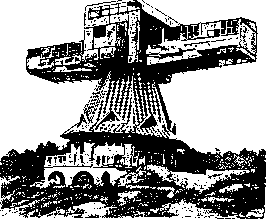
The tower consists of two floors, in which are located a laboratory for the study of skin sensitivity, a cabinet for deep roentgenotherapy, and an elevator. At the top of the tower, at a height of 16 m, is placed the support of the rotating part, weighing approximately 80 tons. In the center is located the distribution cabinet, equipped with measuring instruments and other devices, in which the assistant is located. On both sides of the central cabin (distribution cabinet) are two wings of the solarium, each divided into five cabins for patients. Special glass filters transmit various segments of the spectrum. Inside the cabin is a bed with a vertical lever, making it possible to change its position in connection with the change in the height of the sun and allowing at the same time to move heavy devices for concentrating and filtering the rays. The solarium is also equipped with artificial light (electric) apparatuses for enhancing the therapeutic action of the sun's rays (polymetallic arc, apparatus for infrared rays) or for replacing them on cloudy days. The indications for this method are the same as for ordinary heliotherapy and actinotherapy. The difference lies in the more rapid achievement of therapeutic results and in the better tolerability, making it possible to apply heliotherapy in cases from which it was necessary to refuse with the previous technique.
Related articles
Mentioned in
Cite this page
“Solarium.” Soviet Medical Encyclopedia. English translation of Bolshaya Meditsinskaya Entsiklopediya, 1st ed. (Moscow, 1928–1936), ed. N. A. Semashko. https://sovietmedicalencyclopedia.pages.dev/article/solarium/