Effective Temperature
Historical document, translated for reference. It reflects medical knowledge of the 1920s–30s and is not medical advice.
Summary
Effective temperature is a method for accounting for the combined effect of meteorological factors on the human body, developed through experiments in American laboratories. It creates scales of temperature and humidity combinations that produce the same thermal sensation, with defined comfort zones for both unclothed and clothed individuals.
Encyclopedia article (1928–1936)
Effective Temperature, a method for accounting for the combined effect of meteorological factors on the human organism. Developed as a result of tests conducted by a group of American researchers in the physiological laboratory of the American Society of Heating and Ventilation Engineers (Pittsburgh). The method is based on data regarding the effect of meteorological factors directly on the human organism. In its sequential development, the research consisted of the following: Effective temperature in still air. In two specially constructed chambers, where any temperature and humidity could be created using an improved installation, the following experiments were conducted: a group of test subjects, unclothed to the waist, subjected for a known time to a specific combination of temperature and humidity, would move to a second chamber where the temperature was higher and humidity lower (or vice versa); conditions in the first chamber were changed until the test subjects indicated the same thermal sensation. As a result of 440 experiments conducted, a large number of combinations producing the same thermal sensation were established. Additionally, at high temperatures, measurements of physiological functions (body temperature, pulse, blood pressure, weight loss, etc.) were made. The test results, plotted on a "psychrometric" chart, gave lines of equal thermal sensation, or effective temperature lines: all combinations of temperature and humidity lying on one such line produce the same thermal sensation. - Comfort zone of the basic scale. After establishing the original effective temperature scale, called by the authors the "basic scale," they conducted a series of experiments to determine which degrees of the scale correspond to the sensation of comfort. At different combinations of temperature and humidity, a large number of test subjects entered the chambers and noted their sensations; these were recorded according to the scheme: cold, uncomfortably cold, good, pleasantly warm, hot. The values of effective temperature at which the majority of test subjects indicated sensations within: pleasantly cold, pleasantly warm, were included in the "comfort zone"; the effective temperature line at which almost all test subjects indicated these sensations was called the "comfort line." In the basic scale, this zone lies within 16.7-20.6° effective temperature, the comfort line at 17.8° effective temperature. Effective temperature with air movement. In the next series of experiments on a group of test subjects, studies were conducted to determine the cooling effect of air movement. These experiments were conducted in tunnels where the same temperature and humidity were established; then a fan was turned on in one tunnel, and since it became colder here due to air movement, the temperature had to be raised to achieve the previous thermal effect. Based on these observations, scales of equivalent effective temperatures for various air movement speeds were compiled. Here, one degree of equivalent effective temperature is taken as the reading of a dry thermometer at 1 degree with 100% relative humidity and 0 meters per minute air movement. Combining the data derived from these scales into one table gave the table of the basic scale of equivalent effective temperature. Normal scale of effective temperature. In the next series of experiments, the value of clothing was established. The same group of test subjects underwent the same tests as in the first series, with the only difference that here they were not undressed but dressed in ordinary clothing (shirt and light woolen suit); initially the tests were conducted in still air, and then at different air movement speeds. The result of these experiments was the development of the "normal scale of effective temperatures." The comfort zone in this scale lies within 17.2-21.7° equivalent effective
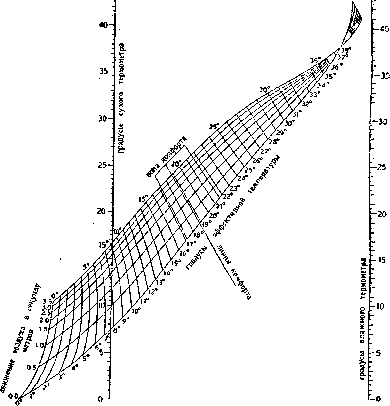
Nomogram for determining effective temperature and equivalent effective temperature of the normal scale: place a ruler so that a straight line connects the reading of the dry thermometer (left vertical column) with the reading of the wet thermometer (right vertical column); in the "degrees of effective temperature" scale, the straight line intersects the curved line corresponding to the given speed of air movement. The position of this intersection point is determined by the nearest line of effective temperature (et).
temperature, the comfort line at 18.9° equivalent effective temperature. The main difference between the basic and normal scales is that the effective temperature lines in the latter have a more vertical direction, i.e., for a clothed person, air temperature is a more important factor, while changes in relative humidity do not change the degrees of equivalent effective temperature as significantly as in the basic scale. Furthermore, air movement also does not play as large a role here—the cooling effect on a clothed person is much weaker, and the higher the temperature, the smaller this effect (see figure). Application of the effective temperature method. The effective temperature method made it possible to develop and construct so-called "comfort zones," which currently have practical significance in hygiene and sanitary engineering. The effective temperature scale developed by Americans, representing very great theoretical and practical interest, nevertheless suffers from a number of defects, some of which have been corrected and some of which are to be eliminated in further experiments. Such defects are: insufficient number of test subjects in the main series of experiments, overestimation of the importance of humidity for temperature within 15-23°, underestimation of the importance of air movement, fundamental incorrectness in establishing the same initial value in both scales, underestimation of the importance of thermal radiation for thermoregulation, etc. Since the scales of American authors are compiled for people at rest or performing very light work, they could be applied in establishing indices and comfort zones for schools, office work, etc., with the introduction of a number of extremely important corrections mentioned. The indices and zones established for Americans cannot be fully applied to residents of other countries (in particular the USSR); for people living in different climatic conditions, these indices and zones can only be established through appropriate research. As for workers in industrial conditions, the comfort indices and zones established by American researchers are completely inapplicable to them; their establishment requires research for various industrial groups under production and laboratory conditions.
Related articles
Mentioned in
Cite this page
“Effective Temperature.” Soviet Medical Encyclopedia. English translation of Bolshaya Meditsinskaya Entsiklopediya, 1st ed. (Moscow, 1928–1936), ed. N. A. Semashko. https://sovietmedicalencyclopedia.pages.dev/article/effective-temperature/