Comfort Zone
Historical document, translated for reference. It reflects medical knowledge of the 1920s–30s and is not medical advice.
Summary
The comfort zone refers to the optimal range of temperature, humidity, and air movement that provides normal thermal comfort for humans. This article discusses the experimental determination of comfort zones by American researchers and their practical applications in different conditions.
Encyclopedia article (1928–1936)
COMFORT ZONE, thermal. The zone that includes the most favorable combination of temperature, humidity, and air movement necessary for normal thermal and pleasant sensation of a person in the surrounding air. The concept of the comfort zone was first introduced by American Professor J. W. Sheppard in 1913. Subsequently, comfort zones were studied by experimental research of the American Society of Heating and Ventilation Engineers, the U.S. Public Health Service, the U.S. Bureau of Mines, and the Harvard School of Public Health (Boston), which established through careful and long experiments the dependence of human physical comfort in indoor air on effective temperature, i.e., the combined action of temperature, humidity, and air movement. To the present time, Americans have established three comfort zones: the main (1928) for people undressed to the waist, and two normal: winter (1923) and summer (1929) for people normally dressed for the season. The published comfort zones apply to American residents living in the geographical latitudes of the USA and in closed rooms with central heating. Experiments to determine comfort zones were conducted in psychrometric rooms (in laboratories of the North American Bureau of Mines in Pittsburgh and the Harvard School of Public Health in Boston), where the required combinations of temperature, humidity, and air movement were created by modern ventilation systems. The following entered these rooms
go
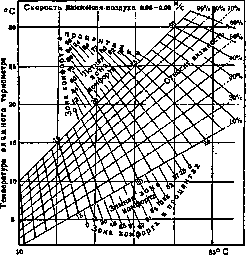
Temperature of the dry thermometer. Subjects, undressed to the waist, to establish the "main comfort zone" or normally dressed for the season to determine "normal comfort zones." In the rooms, subjects sat in comfortable chairs, read, wrote, and talked. They were asked every 10 minutes to record their opinion about physical comfort. Based on the data obtained, it was found that the cold (lower) boundary of the main comfort zone is 18.8° on the effective temperature scale, the hot (upper) boundary is 27.7°, and practically the optimal temperature for most people is 22.4°. The results of determining normal comfort zones are given in the table and diagram. Comfort Zones Effective temperature (normal scale) Dry bulb temperature Relative humidity 60% Width of comfort zone From the table and especially from the diagram it is seen that the width of the summer comfort zone is somewhat greater than the winter one and that the summer comfort zone is shifted to higher temperatures. The probable cold boundary for summer is 17.7° on the normal effective temperature scale, and for winter 15.5°, optimal for summer 21.3°, for winter 18.8°, and the upper warm boundary for summer 26.0°, and for winter 23.2°. The found changes in the normal comfort zone should be attributed to the influence of warmer clothing that people wear in winter, and partly to the action of different air temperatures to which they are accustomed in these seasons of the year. The optimal temperature in each comfort zone lies closer to the cold boundary of the comfort zone than to the hot one. Therefore, each comfort zone can be divided into two halves - cold (from the cold boundary to the optimal) and warm (from the optimal to the upper boundary of the zone), with the cold half of the zone being smaller than the warm one. Practical application of comfort zones for still and moving air. The described comfort zones apply to still and moving air in enclosed rooms without any adjustment in those conditions when climate, clothing, and heating (central) do not substantially differ from those under which the indicated comfort zones were found. Therefore, when determining optimal temperatures based on comfort zone data in other conditions different from American ones, it is necessary to take into account the following factors: clothing, climate, season of the year, type of heating (e.g., with stove heating, which gives a lot of radiant heat, the optimal temperature should be lowered compared to American standards), the amount of radiant energy that can act on people in rooms (e.g., in industrial workshops from heated surfaces of machines, boilers, etc.), and the number of people in rooms (accumulation of people in rooms lowers the optimal effective temperature). To take into account the factor of physical stress (during work), the American Society of Heating and Ventilation Engineers recommends lowering the corresponding values of effective temperatures assigned for people at rest by the following amounts: for light work by 1°, medium work by up to 1.5°, and for heavy work by 2.5° of effective temperature. With the above reservations, the main comfort zone is applicable in our conditions for determining optimal temperatures in rooms for people undressed to the waist, e.g., in some industrial workshops, mines, etc. For people normally dressed for the season, normal comfort zones should be used, summer or winter, depending on the season. To determine the probable degree of comfort under given conditions, the nomogram provided here can be used. Along the abscissa of the nomogram, the dry bulb temperature is plotted, and along the ordinate - the wet bulb temperature. Lines running from the left corner to the right indicate relative air humidity; lines of effective temperatures intersect the lines of relative humidity. Opposite the lines of effective temperatures belonging to one or another comfort zone, there are marks indicating in percentages how much a given effective temperature line can be used to determine the normal thermal sensation of a person in the air. The nomogram is applicable for practically still air (0.04-0.08 m/sec) and for people normally dressed for the season, at rest. Example: In rooms, we have 20° on the dry bulb thermometer (Td) and 15° on the wet bulb thermometer (Tw). The air is practically still. Determine the probable degree of comfort for these conditions in summer and winter. The intersection of Td=20° and Tw=15° gives a point that lies approximately on the line of effective temperature -18.3°. On the nomogram we see that the found value of effective temperature in summer can give normal thermal sensation only to 19% and in winter to 80% of all subjects, since in American experiments at this effective temperature in summer 19% of all subjects and in winter 80% had normal thermal sensation. (Catathermometer as a comfort indicator - see Catathermometry.) The study of the corresponding comfort zone is currently acquiring increasing importance in hygiene.
Related articles
Mentioned in
Cite this page
“Comfort Zone.” Soviet Medical Encyclopedia. English translation of Bolshaya Meditsinskaya Entsiklopediya, 1st ed. (Moscow, 1928–1936), ed. N. A. Semashko. https://sovietmedicalencyclopedia.pages.dev/article/comfort-zone/