Emergency Medical Aid
Historical document, translated for reference. It reflects medical knowledge of the 1920s–30s and is not medical advice.
Summary
Emergency Medical Aid is a medical-sanitary organization providing first aid in life-threatening accidents and sudden severe diseases, with transportation to medical facilities. The article traces the historical development of emergency medical services from ancient times to the Soviet era, highlighting organizational structures and requirements.
Encyclopedia article (1928–1936)
Emergency Medical Aid, a medical-sanitary organization whose task is to provide first aid in life-threatening accidents and in sudden severe diseases accompanied by danger to life, and to transport the relevant sick and injured persons to medical institutions. The first rudiments of the organization of Emergency Medical Aid date back to deep antiquity. Already in the first centuries of the new era, on the most busy roads along which masses of pilgrims moved, shelters-hospitals (xenodochies) were organized, which also provided Emergency Medical Aid. With the development of trade relations between states, these institutions were expanded on the main caravan trade routes. In the Middle Ages, various religious orders made it their task to provide Emergency Medical Aid. The first forms of independent organization of Emergency Medical Aid are found in Holland in the 15th century, but Emergency Medical Aid here was organized only for saving drowning people. To this time belongs the appearance in Holland of the first regulations on providing Emergency Medical Aid (1417 and 1455). Here also the first societies for providing Emergency Medical Aid ('rescue societies') were organized--in Amsterdam in 1767. The following year such a society was opened in Hamburg. Gradually, to the original task of saving drowning people, tasks of providing assistance to victims of various accidents who had fallen into an unconscious state and severely ill persons were added. In the era of industrial capitalism, with the unusual growth of industrial enterprises, the introduction of machines into all branches of production, the number of accidents increased extremely sharply due to the excessive exploitation of workers, the severe working conditions, and the unwillingness of capitalists to spend money on necessary measures to ensure the safety of workers. The enormous growth of cities, the intensification of traffic, and the mechanization of transport caused a significant increase in the number of accidents in capitalist countries. An acute need arose for a special organization of Emergency Medical Aid, which in all countries was initially the concern of various private societies and only gradually passed in a number of cities to the jurisdiction of municipal self-government. However, even now Emergency Medical Aid in many countries is organized by voluntary societies, the Red Cross, with some financial support from self-government bodies. The first foundations of a rationally organized Emergency Medical Aid were laid in Germany by the famous surgeon Friedrich von Esmarch. At his initiative, Samaritan schools and societies arose. The Red Cross and fire brigades played a particularly important role in the organization of Emergency Medical Aid. The inability to receive timely first medical aid in sudden diseases served in a number of countries as one of the impulses for the organization of Emergency Medical Aid, which initially had the upper hand in functions of providing first aid in various diseases. This was the case, for example, in Berlin and other cities of Germany at a time when industry and transport were little developed, whereas in Vienna with the oldest organization of Emergency Medical Aid, the impulse for the organization of Emergency Medical Aid was given by the terrible fire in the city theater (in 1881), which led to an enormous number of human victims. The systematic organization of Emergency Medical Aid was strongly hindered in capitalist countries by the conflicting interests of private practicing physicians and the population. Thus, for example, in Germany, where in 1892 invalidity insurance funds organized well-equipped Emergency Medical Aid stations in different areas of large cities and small clinics for providing necessary medical aid in accidents, which were also used by sickness insurance funds and the rest of the population, private practicing physicians through their corporate organizations entered into a struggle with these institutions and achieved in 1897 under the leadership of Ernst von Bergmann the organization of the Berlin Society of Emergency Medical Aid, which opened its own Emergency Medical Aid stations that stood guard over the interests of private practicing physicians. Even the Central Committee of Emergency Medical Aid, organized in 1901 on the initiative of Bergmann and Dietrich to coordinate the work of these Emergency Medical Aid stations, could not reconcile the conflicting interests of the warring organizations. Only in 1913 did the transition of all stations to the jurisdiction of the magistrate take place. According to the rules for the organization of Emergency Medical Aid issued in 1912 in Germany, the latter can be organized by all kinds of voluntary societies, but in this case constant supervision over them by certain physicians in state service or in the service of municipal bodies is mandatory. A similar organization of Emergency Medical Aid existed until recently in all other countries. The organization of Emergency Medical Aid in American cities is concentrated in hospitals, at which special premises are allocated for the Emergency Medical Aid station, easily accessible from the street. To transport the injured to hospitals, sanitary automobiles are available at the latter, which go out accompanied by a physician. Depending on the severity of cases, patients are placed under the care of interns or senior physicians of the corresponding departments of the hospital. In the exchange of international experience in the organization of Emergency Medical Aid, international congresses of Emergency Medical Aid, which took place--the 1st in 1908 in Frankfurt am Main, the 2nd in 1913 in Vienna, and the 3rd in 1926 in Amsterdam--were of great importance. In pre-revolutionary Russia, where the first Emergency Medical Aid station was opened in Warsaw in 1897, and then in Odessa in 1903, Emergency Medical Aid carriages, purchased with private funds, were usually located in large cities at police precincts; these carriages also served for the paid transportation of patients. Emergency Medical Aid was then little accessible to the population and was provided with great delay. In Moscow at the end of the 90s, several carriages were purchased with private funds. These carriages were located at police administrations. With the carriage, besides a paramedic, a police officer also went out to draw up a protocol. In 1908, the organization of Emergency Medical Aid passed to a voluntary society 'Emergency Medical Aid,' which had 1 Emergency Medical Aid automobile, but even this single Emergency Medical Aid automobile was during the imperialist war transferred to the city administration for the transportation of the wounded, and Emergency Medical Aid ceased to exist. There was no special organization of Emergency Medical Aid in other large cities--in Leningrad, Kharkov, Rostov, etc. Before the war on the territory corresponding to the modern RSFSR, the organization of Emergency Medical Aid, besides Moscow, existed only in 4 cities (Samara, Tula, Yaroslavl, Perm) in the form of 1-2 paramedics serving 1 Emergency Medical Aid carriage. Only after October did Emergency Medical Aid begin to develop strongly; by 1927 there were already 50 Emergency Medical Aid stations in cities. At present, in all cities, industrial centers, Emergency Medical Aid is organized in one form or another. Organization of Emergency Medical Aid. The need for providing Emergency Medical Aid by a special continuously functioning organization arises in individual accidents and sudden severe diseases, poisonings, and especially in mass gatherings of people--on transport, in mining operations, in factory enterprises, on streets, with intense movement of automobiles, trams, etc., at mass celebrations accompanied by huge gatherings of people, at airports, stadiums, at races, races, physical competitions, at large fires, at various natural disasters--earthquakes, floods, etc., in mass sudden severe diseases (poisonings); although disasters causing a large number of victims are very rare, a rationally organized Emergency Medical Aid must provide for all these possible cases of the need for mass transportation of the injured and providing emergency medical aid to a large number of people. In individual accidents and sudden diseases threatening life, Emergency Medical Aid responds to calls in case of injuries and fractures, severe bruises with loss of consciousness, severe burns and poisonings, prolonged fainting state, sunstroke, electric shock or lightning strike, freezing, drowning, acute delirium, etc. The basic requirement imposed on the organization of Emergency Medical Aid is ensuring proper medical aid without any delay, which has enormous significance for the outcome of an accident and a sudden severe disease and poisoning from the point of view of saving life and more or less quick and complete restoration of working capacity. To fulfill this requirement, Emergency Medical Aid must not only provide the necessary first aid at the scene of the incident, having for this purpose qualified medical personnel, but also, if necessary, immediately deliver the sick person or the victim of an accident to the nearest medical institution in the most convenient position, excluding the possibility of deterioration of the patient's condition during transportation. For this purpose, Emergency Medical Aid must have the necessary appropriately equipped means of transport--Emergency Medical Aid automobiles, Emergency Medical Aid carriages, motor boats, etc. The forms of organization of Emergency Medical Aid depend on the size of the populated place, the number of inhabitants, their territorial distribution by districts, the degree of development of industry and its nature, the degree of intensity of street traffic, the degree of provision with medical institutions and their location.
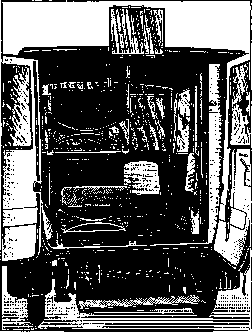
In small towns and worker settlements, "emergency medical aid" is organized at medical institutions, usually at a hospital, where there are specially invited doctors for making emergency calls or where a duty system for hospital and polyclinic doctors is organized, who receive special compensation for calls or for duty. In these cases, at the corresponding medical institution, there is an automobile (Fig. 1) or an emergency medical aid carriage, and in the reception room there is always an emergency medical aid bag ready with all necessary instruments, medications, and bandaging materials for providing emergency medical aid. The doctor responding from the emergency medical aid point takes this bag with them. The doctor is accompanied by a paramedic or nurse. In the sanitary automobile or in the emergency medical aid carriage, stretchers are placed, which by special devices are arranged so as to spare the patient from unnecessary jolts during movement. In large cities and major industrial centers, emergency medical aid exists in the form of a special organization—an emergency medical aid station. In the largest cities, besides the central emergency medical aid station, peripheral emergency medical aid points are set up in different districts, usually in the center, at hospitals (Moscow, Leningrad). The station and emergency medical aid points provide emergency medical aid in cases of accidents and sudden illnesses threatening the patient's life. Where home assistance does not operate during night hours, emergency medical aid provides home assistance in cases that cannot be delayed until the next day. In large cities, for example in Moscow and Leningrad, emergency medical aid stations perform a number of additional functions: transporting patients with acute infectious diseases, severe non-infectious diseases, agitated mental patients, alcoholics in the stage of acute psychosis, concentrating information about available hospital beds and providing corresponding information. Emergency medical aid stations are headed by a station director-doctor, who in large cities is assisted by a senior assistant doctor-doctor of the station. Usually from doctors with administrative experience in evacuation, responsible senior duty doctors are appointed (in Leningrad—a duty instructor), who themselves receive all calls by telephone. At the emergency medical aid station, doctors and middle-level medical personnel are always on duty for making calls. Usually emergency medical aid stations organize telephone and signaling communication between the senior duty doctor receiving calls and the medical personnel designated for calls, the garage where emergency medical aid automobiles are kept ready, the drivers' room, so that from the moment of receiving an external call until the departure of the automobile from the emergency medical aid station courtyard, several minutes pass, in Moscow no more than 3 minutes. In Moscow and Leningrad, personnel departure occurs 1 minute after receiving the call from the duty doctor. Corresponding signaling enables the senior duty doctor to check whether the doctor and driver have already gone to the automobile and when the automobile left the emergency medical aid station courtyard. To avoid false calls, the senior duty doctor, after transmitting the assignment with the call, if there is suspicion of a false call, checks by the telephone given at the call whether the call actually came from that telephone. When the duty doctor is having a telephone conversation about a call, the nurse or paramedic in the adjacent room takes an additional telephone receiver from the telephone apparatus through which the senior duty doctor receives calls, and records the address, reason for the call usually on a special card—an emergency medical aid call card. Having received the assignment from the doctor receiving the call, the nurse or paramedic goes to the automobile where the departing doctor and driver are already present, who received the signal to depart in their rooms at the moment the call was received by the senior duty doctor (while talking on the telephone, the latter presses the corresponding button of the electric signaling system). When the automobile leaves the courtyard, the gatekeeper also notifies the senior duty doctor by electric signaling. The latter has the opportunity to signal the gatekeeper about delaying the automobile at the gates; about returning automobiles, the gatekeeper signals the senior duty doctor. The senior duty doctor has a secretary who helps him in keeping records, telephone conversations about calls, receives signals from the gatekeeper, etc. In order to know in which district of the city the emergency medical aid automobile is located at a given time, the senior duty doctor marks their location with markers on the city map. This is especially important for very large cities where there are automobile parking points at medical institutions, mostly at hospitals, in different districts; an automobile that has gone to a remote district of the city stops at the nearest parking point at a hospital, where it waits for the next call from the emergency medical aid station. In some large cities (for example Leningrad), almost all hospitals are connected by direct telephone wires with the central emergency medical aid station. At the disposal of district emergency medical aid points, there are also outgoing doctors, middle-level medical personnel, emergency medical aid automobiles. Usually the central
Figure 1. Interior view of an emergency medical aid carriage with two stretchers.
2-* Fig. 2. Interior view of an emergency medical aid point.
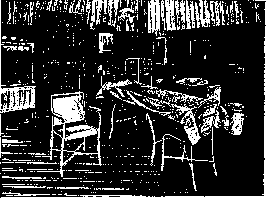
The Emergency Medical Aid station is directly connected by wire to peripheral district Emergency Medical Aid stations, to which the call from the corresponding district accepted by the central Emergency Medical Aid station is transmitted. The transmission of the call from the on-duty physician at the district station to the departing personnel is also mostly radio-equipped. The time of receiving and transmitting the call to the district station is immediately recorded on special automatic clocks. When district Emergency Medical Aid stations are present, assistance is provided within 2-15 minutes. The district Emergency Medical Aid station has the following premises: room of the senior on-duty physician, dressing room (Fig. 2), room for the on-duty middle medical personnel and drivers, room for the on-duty physician, dining room, bathroom, and kitchen. Physicians responding to the scene of an incident must be qualified physicians capable of providing emergency medical aid, quickly orienting themselves in the situation, and deciding on the necessary further medical intervention. Usually, physicians with at least 5 years of hospital experience, predominantly surgical, are admitted to the positions of Emergency Medical Aid physicians. After delivering the patient or injured person to the hospital, the physician fills out a referral slip, in which he notes the illness or nature of the traumatic injury and the assistance provided. These slips are sewn to the patient's medical record and, upon discharge or death of the patient, are returned to the Emergency Medical Aid station with the diagnosis of the illness indicated. If the visiting physician, called for a sudden illness, finds it necessary to send the patient to the hospital, he arranges for the transportation of the patient by issuing a requisition to the patient transport department at the Emergency Medical Aid station. For assistance in sudden illnesses, physicians-therapists are usually dispatched. In large cities, Emergency Medical Aid physicians do not have the right to issue sick leave certificates or certificates, and they are prohibited from prescribing prescriptions, as all necessary for providing Emergency Medical Aid must be carried with them. When responding to a call, the Emergency Medical Aid physician takes with him a bag or case containing necessary medications and equipment for emergency aid, a rubber tourniquet, a stomach tube, a set of splints, and if necessary, an apparatus for artificial respiration. The physician who has responded and provided emergency aid must call the Emergency Medical Aid station by telephone to find out where he should go next. Similarly, Emergency Medical Aid automobiles, upon arriving at the hospital, immediately report by telephone to the Emergency Medical Aid station their location. In case of a false call, the physician draws up an act and the guilty parties are held responsible. In Leningrad, the number of incorrect calls averages about 2% per year of all calls; the number of patients or injured persons left at home after receiving first aid constitutes 15-20% of all calls. Hospitals are obligated to accept patients and injured persons brought to them by Emergency Medical Aid, regardless of the availability of free beds. According to data from Moscow, the arrival of Emergency Medical Aid at the scene of an incident occurs on average 10-12 minutes after the call. In large cities, Emergency Medical Aid also includes emergency psychiatric assistance. On-duty psychiatrists are attached to Emergency Medical Aid stations, who respond to Emergency Medical Aid calls to provide assistance to mentally ill persons suffering from acute psychoses or who are dangerous to others due to their condition, as well as to alcoholics in a state of acute alcoholic psychosis. If necessary, the on-duty psychiatrist directs the patient to a psychiatric treatment facility in an Emergency Medical Aid vehicle. According to data on the work of the Moscow and Leningrad Emergency Medical Aid stations in recent years, the average number of calls per year for accidents in major centers can be taken as approximately 5-8 calls per 1,000 population, and for sudden life-threatening illnesses, 10-13 calls per 1,000 population. The average number of patients (including those transported to hospitals by the patient transport department of Emergency Medical Aid, see below) and injured persons from accidents transported per 1 sanitary automobile per year is 7,000-7,200 persons. These data allow for an approximate calculation of the number of sanitary automobiles necessary for major centers. In a number of large cities, Emergency Medical Aid includes nighttime medical assistance, formerly called urgent medical assistance; it is provided in cases where patients do not require immediate assistance in the next few minutes, but at the same time cannot, due to their health condition, wait until morning for a physician to come to their home. Such cases include various pathological conditions with significant and rapid weakening of cardiac activity, severe and repeated vomiting and diarrhea, attacks of various colic, etc. Nighttime medical assistance points, operating at Emergency Medical Aid stations, usually accept calls independently via city telephones or from persons coming to the point to request nighttime medical assistance. On-duty physicians of nighttime medical assistance do not have the right to issue sick leave certificates. At the nighttime medical assistance point, there is a senior on-duty physician to whom the nighttime medical assistance physicians are subordinate. These physicians are supplied with special medical bags with necessary medications and equipment. The radius of operation of the point is 2-3 km; according to Leningrad data, there are on average 25-28 visits for nighttime medical assistance per 1,000 population per year. In the largest cities, Emergency Medical Aid stations have a special department for patient transport, accounting for and distributing free beds in hospitals. This department is served by specialists in patient evacuation-evacuators. All acute infectious patients (except for measles) are transported to hospitals in special vehicles that are thoroughly disinfected after each transport of a patient. The accompanying personnel must observe established personal hygiene requirements-showers, disinfection of clothing when necessary, etc. Severe non-infectious patients are also transported in special sanitary vehicles. To facilitate the movement of sanitary vehicles, they have special identification marks (special coloring, red cross) and special horns, sirens. Service by sanitary transport for the working population in the USSR is free, unlike in capitalist countries where patient transport to hospitals is paid for. The patient transport department at Emergency Medical Aid transports to medical institutions patients not requiring immediate assistance according to requisitions from outpatient clinics, polyclinics, dispensaries, and home care physicians. Hospitals are obligated twice a day to report to the patient transport department and accounting for free beds in hospitals information about the number of free beds. Summaries of this data, broken down by specialty and medical institutions, are transmitted to district health departments, to which requests for hospitalization from treating physicians are received. District health departments call for sanitary transport through the patient transport department at Emergency Medical Aid. This department is served by a special staff. In Moscow and Leningrad, Emergency Medical Aid is closely connected with Emergency Medical Aid institutes, specially created for providing highly qualified emergency medical aid and clinical study of accidents. In Moscow, the Sklifosovsky Emergency Medical Aid Institute, in Leningrad, such an institute has been created on the basis of certain medical institutions and scientific research institutes. These institutes pay special attention to scientific research work on studying treatment and prevention methods in accidents. The institutes have departments of emergency surgery with a traumatology department, therapeutic departments, mainly studying poisonings, pathological-anatomical and forensic medical departments. In the Leningrad Emergency Medical Aid Institute, there is also a department of social pathology and prevention with offices for industrial and domestic trauma, educational-statistical and museum departments. In recent years, in a number of countries, airplanes have begun to be used for providing Emergency Medical Aid, especially in cases where assistance must be provided to accident victims or severely ill persons in remote, inaccessible areas. Australia was the first country to begin widely using sanitary airplanes in the last decade not only for providing Emergency Medical Aid but also for regular medical service in remote sparsely populated areas. In the USSR, the practice of providing Emergency Medical Aid and directing patients to treatment facilities with the help of special sanitary airplanes is also beginning to be widely practiced. Sanitary airplanes can have wide application in providing Emergency Medical Aid to rural areas, the Red Army. In large cities, Emergency Medical Aid also includes the organization of rescue on water. In this case, in a number of places on the banks of rivers, canals, in addition to rescue rings, there are motorboats for rescuing drowning persons. Particularly large tasks fall on Emergency Medical Aid serving coal mines. Emergency Medical Aid stations serving mines are called mine rescue stations (see Mining, mine rescue work). For providing Emergency Medical Aid on railroads, in trains, at stations, there are special first aid kits. In some trains and especially at railroad stations, there are tools necessary for freeing passengers trapped between cars and those who came under cars during railroad disasters. At major stations, there are so-called auxiliary trains consisting of a car with equipment for providing technical assistance in railroad crashes, a car for workers and a sanitary car with an operating room, dressing room, equipped with necessary surgical instruments, dressing materials, medications, stretchers, splints, etc.
The operation of these auxiliary trains is regulated by special rules. In rural areas, Emergency Medical Aid is provided by the nearest local medical institutions. With the increase in the number of automobiles in state farms and collective farms and the improvement of roads, Emergency Medical Aid will become accessible to the rural population as well. To facilitate the provision of Emergency Medical Aid, especially during mass gatherings, in addition to medical personnel, members of the Red Cross Society, and workers trained in first aid are assigned to duty at special temporary Emergency Medical Aid stations. In many countries, there are extensive Red Cross organizations that form special sanitary columns, whose duties also include providing Emergency Medical Aid. An interesting innovation in the organization of Emergency Medical Aid exists in Berlin, where, in addition to scattered Emergency Medical Aid stations throughout the city (usually consisting of 3 rooms, one of which is an operating room), special Emergency Medical Aid cabinets in the form of round columns, 3½ meters high and 1.1 meters wide, have been installed on many of the busiest streets. In the upper part of these cabinets are instruments, medicines, and first aid supplies for providing initial Emergency Medical Aid in case of accidents on the streets; in the lower part are mobile (on wheels) stretchers, which can be easily removed and quickly used to transport the injured to the nearest Emergency Medical Aid station or the nearest medical institution. The Emergency Medical Aid station monitors the proper condition of the stretchers and the replenishment of first aid supplies. The equipment of such a cabinet costs 3,500 marks. Emergency Medical Aid should participate in the implementation of preventive measures against accidents, often taking the initiative in drawing attention to prevention issues, since Emergency Medical Aid has the necessary data on the causes and nature of accidents. To reduce the number of requests for Emergency Medical Aid, i.e., to reduce the number of accidents, it is necessary to implement a series of preventive measures: establishing proper traffic flow (regulation) and monitoring compliance with established rules, proper accounting for the prospective development of traffic when planning and replanning cities, laying out new streets and expanding old ones; educating the population on traffic rules (using cinema, radio, schools, lectures, clubs, posters, etc.); monitoring the proper functioning of all safety devices (supervision of engines, brake operation, etc.); explaining to the population the dangers of improper use of gas and electricity; bringing violators of safety rules to legal responsibility; mandatory swimming instruction for schoolchildren, publication of popular brochures on first aid, etc. All activities of Emergency Medical Aid stations are regulated by special provisions that cover the organization of Emergency Medical Aid in individual and mass accidents, transportation of patients and the injured, the tasks of medical institutions in providing Emergency Medical Aid, and the duties of medical and technical personnel serving at Emergency Medical Aid stations. There are special instructions for Emergency Medical Aid physicians, Emergency Medical Aid paramedics, for on-duty psychiatrists on the procedure for serving infectious patients, on disinfection of vehicles, etc. (see Health Department, First Aid).
Related articles
Cite this page
“Emergency Medical Aid.” Soviet Medical Encyclopedia. English translation of Bolshaya Meditsinskaya Entsiklopediya, 1st ed. (Moscow, 1928–1936), ed. N. A. Semashko. https://sovietmedicalencyclopedia.pages.dev/article/emergency-medical-aid/