Embryotomy
Historical document, translated for reference. It reflects medical knowledge of the 1920s–30s and is not medical advice.
Summary
Embryotomy is an obstetric operation involving the dissection of a fetus for extraction through natural birth passages. This article describes the procedure, particularly decapitation in transverse lie cases, and alternative approaches when the neck is inaccessible.
Encyclopedia article (1928–1936)
EMBRYOTOMY, embryotomia, embryoulcia (from Greek embryon-embryo, fetus and tome-incision), fetotomy, an obstetric operation of dissection of the fetus for its extraction in parts through the natural birth passages. Under a broad understanding of this term, it also includes the operation of perforation of the head followed by cranioclasis (see Craniotomy), however, at present, E. is understood mainly as decapitation of the fetus in neglected transverse position (see Decapitation). With proper management of labor, such an indication should occur extremely rarely, since any transverse position of the fetus should be recognized in a timely manner during pregnancy or at the beginning of labor, when with intact membranes the operation of choice is turning the fetus by external or internal maneuvers. After some time after the discharge of waters, when the mobility of the fetus decreases to such an extent that it is already impossible or dangerous for the mother (uterine rupture) to perform a turn, the obstetrician is left with two paths: cesarean section - with a living fetus and favorable conditions - or E. Typical E. is usually performed with Brown's decapitating (sharp) hook and Siebold's scissors (other instruments have also been proposed, see Obstetric Instruments).-Technique of the operation: the operator's hand is introduced into the vagina and with two fingers the neck of the fetus is grasped from behind (see figure). If there is a prolapse of a hand, then pulling by the hand greatly facilitates this moment of the operation. With the other hand, the operator introduces the hook into the vagina and, under control of the internal hand, also grasps the neck of the fetus with it. After this, the hook is pulled so that it penetrates between the cervical vertebrae, and then rotational movements to the right and left are made with it, by which dislocation of the spine is achieved. Now the hook is pulled stronger and thus the soft tissues of the neck are drawn down so that they can be more conveniently incised with scissors. This completes the decapitation. After this, the trunk of the fetus is extracted by pulling by the hand, and then the head of the fetus is removed by hand or bone forceps. In cases where the neck of the fetus is inaccessible to the operator's hand, since the 'presenting' part is the chest or side, it is first necessary to incise the chest or abdominal wall and preliminarily remove the internal organs of the fetus (evisceratio), and then only incise the soft tissues and spine of the fetus in its most accessible part (spondylotomy, rachiotomy). The fetus thus dissected is extracted manually - first the lower part of the trunk is extracted, then the upper. It should however be said that when it is impossible to perform embryotomy strictly typically, the operator is allowed to act according to the peculiarities of the given case.
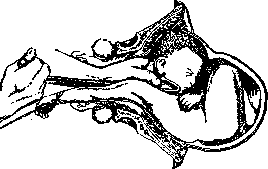
moment of the operation greatly facilitates this moment of the operation. Other hand, the operator introduces the hook into the vagina and under control of the internal hand also captures the neck of the fetus with it. After this, the hook is pulled so that it penetrates between the cervical vertebrae, and then rotational movements to the right and left are made with it, by which dislocation of the spine is achieved. Now the hook is pulled stronger and thus the soft tissues of the neck are drawn down so that they can be more conveniently incised with scissors. This completes the decapitation. After this, the trunk of the fetus is extracted by pulling by the hand, and then the head of the fetus is removed by hand or bone forceps. In cases where the neck of the fetus is inaccessible to the operator's hand, since the 'presenting' part is the chest or side, it is first necessary to incise the chest or abdominal wall and preliminarily remove the internal organs of the fetus (evisceratio), and then only incise the soft tissues and spine of the fetus in its most accessible part (spondylotomy, rachiotomy). The fetus thus dissected is extracted manually - first the lower part of the trunk is extracted, then the upper. It should however be said that when it is impossible to perform embryotomy strictly typically, the operator is allowed to act according to the peculiarities of the given case.
Related articles
Mentioned in
Cite this page
“Embryotomy.” Soviet Medical Encyclopedia. English translation of Bolshaya Meditsinskaya Entsiklopediya, 1st ed. (Moscow, 1928–1936), ed. N. A. Semashko. https://sovietmedicalencyclopedia.pages.dev/article/embryotomy/