Obstetric Instruments
Historical document, translated for reference. It reflects medical knowledge of the 1920s–30s and is not medical advice.
Summary
This article describes various obstetric instruments used in the 1930s, including cranioclasts, perforators, decapitation hooks, and instruments for uterine scraping and pelvic expansion.
Encyclopedia article (1928–1936)
OBSTETRIC INSTRUMENTS I
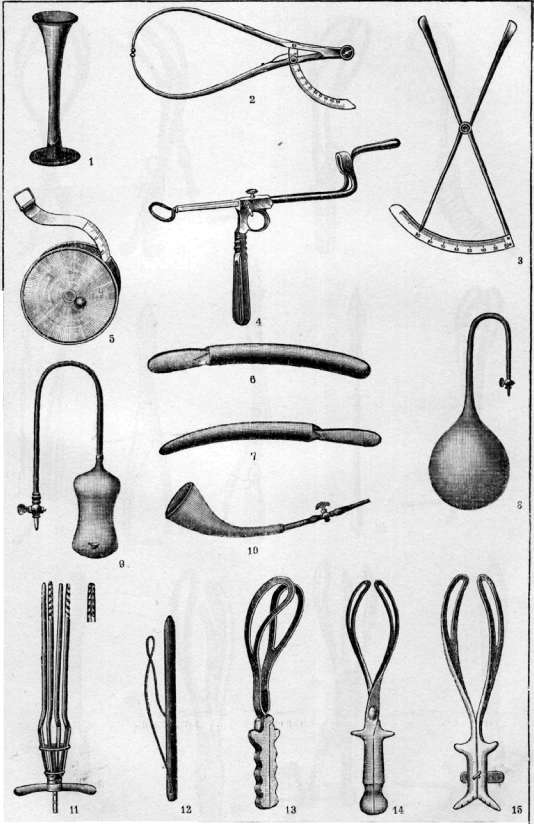
OBSTETRIC INSTRUMENTS II
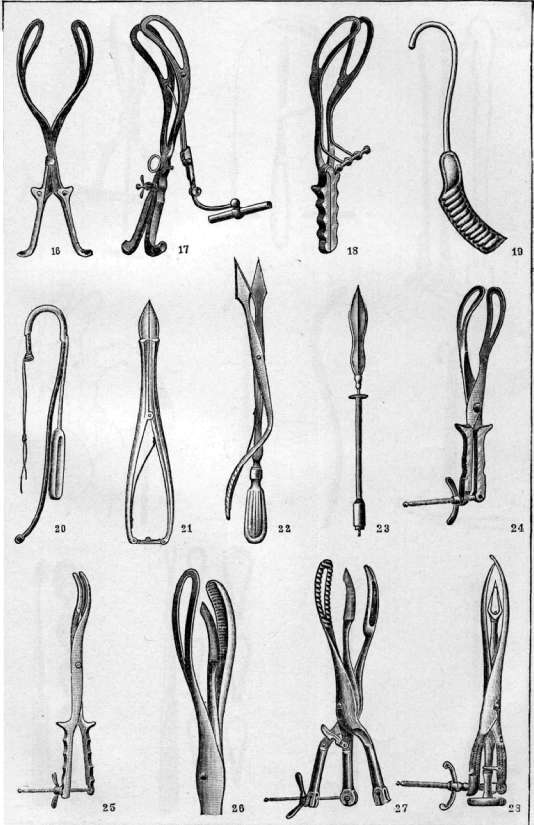
OBSTETRIC INSTRUMENTS III
Brown's cranioclast (Braun) - the most convenient and widespread modification; consists of two blades that cross each other and are secured in the handle area by a strong screw lock. The end of the blades, which is intended to be placed on the head, represents special spoons with a toothed surface, the convexity of these spoons faces in one direction. In one of the spoons there is a pointed hole corresponding in size to the opposite spoon. One of the spoons (massive) is inserted into the cavity of the fetal head, the other (pointed) is placed on its outer side. When screwing the lock, the spoons, tightly gripping the skull, allow for easy extraction of the reduced head volume (see figure 25).- Zweifel's cephalocranioclast differs from the previous instrument in that it pursues the goal not only of extracting the perforated head, but also of preliminary crushing it; it is built from three blades. Two spoons represent the same Brown's cranioclast, with one spoon inserted into the cavity of the perforated head, and the other placed on the surface of the skull bones; when these two spoons are shifted, a tight gripping of the skull bones occurs. The third spoon also lies on the surface of the skull bones; when all three blades are compressed by a screw lock located on the handle, the two outer-lying spoons approach each other and thus crush the head (see figures 26 and 27).- Tarnier's basiotrib, a combination of a cephalotrib with a spear-shaped perforator, consists of three blades connected by a common lock. The middle blade represents a spear-shaped perforator. The other two side blades represent ordinary cephalotrib spoons, with the only difference being that they are of unequal length. The different length of the basiotrib branches allows for small or large crushing. Small crushing is performed when only one short spoon acts, which after compression with the compressing apparatus is fixed by a strong hook to the middle blade-perforator. For large crushing, the screw compressing apparatus produces further compression of the head due to the shifting of the large spoon (see figure 28).- Döderlein's perforator-cephalotribtor - also a combination of a cephalotrib with a spear-shaped perforator. Crushing is also performed with a compressing apparatus located on the handle of the instrument; the perforator passes through the lock with a screw thread and moves forward by turning a transverse handle (see figure 29). Instruments for disrupting the integrity of the fetus. Brown's decapitation hook, for decapitation of the fetus with a prolapsed hand, consists of a strong metal rod, at one end of which there is a handle, and at the other end a hook. At the end of the hook there is a button. Decapitation occurs as follows: a hook tightly applied to the fetus's neck is rotated around its longitudinal axis and with its movement tears the spine and neck muscles (see figure 30).- Zweifel's trachelorector serves for the same decapitation and represents an instrument consisting of two Brown's decapitation hooks connected together along the length of the rod. When the handles are spread apart, the hooks also spread apart. The instrument is applied to the neck of the fetus in a folded manner, like a regular Brown hook. When the handles are spread apart, the fetus's neck is broken in half by the spreading hooks (see figure 31).- Aitken's saw, with the Ribemont-Bong-Döderlein attachment for conducting it, represents a hollow hook similar to Brown's, in the groove of which a chain saw moves freely. After the hollow hook is placed on the fetus's neck, the elastic end of the saw is inserted into the groove, which when it appears from the upper hole of the hook is caught and moved down. The lowered end can be enclosed in an additional grooved knee, which is a continuation of the end of the hook. The end of the chain is fixed in the handles, with which the sawing movements are performed. One can also do without the second knee, protecting the surrounding soft parts from the saw with a simple deep vaginal mirror (see figure 32).- Blond's decapitation thimble represents an instrument for conducting our wire saw for decapitation. The thimble is put on the thumb of the hand that will introduce the saw. To one end of the thimble a wire saw is attached, to the upper end a ring is attached. The thumb with the thimble goes around the fetus's neck and meets the index finger, introduced behind the fetus's neck from the other side. The index finger is tightly inserted into the ring of the thimble and with a reverse movement removes the thimble from the thumb, pulling along with it the wire saw attached to the thimble. In this way, the saw ends up thrown over the fetus's neck (see figure 33).- Siebold's scissors, for cutting the fetus, differ from ordinary scissors by their significant length, massiveness, and strength, allowing them to cut not only soft but also bony tissues of the fetus with ease. Instruments for expanding the pelvis. Gigli's needle, a large curved needle tightly fixed to the handle. At the end of the needle there is an eyelet, through which a wire saw is threaded. The needle pierces from behind the symphysis of the pubic bones and, appearing outside, receives into its eyelet the end of the wire saw, which is retained in the eyelet due to a small button. When the needle is withdrawn back, it pulls the saw along with it, bringing its end out on the other side of the symphysis. The saw is removed from the needle, the ends of the saw are placed on the handles, with which the sawing movements are performed and the symphysis or pelvic bones are sawn through (see figure 34). Instruments for removing the egg or its remnants. Removal of the egg or its remnants is carried out either by scraping with the help of spoons and curettes or by catching parts of the fetus with grasping instruments, so-called abort-zangs.- Obstetric spoon, an instrument intended for scraping the uterine cavity, represents a metal rod, one end of which ends with a handle, and the other with a spoon. On the handle, on the side where the spoon has a concave surface, there is a mark to accurately represent the position of the spoon in the uterine cavity at the moment of scraping. Obstetric spoons differ from gynecological ones by their larger size and blunt edge. The largest sizes are used for scraping remnants of the placenta in the postpartum period. - Simon's spoon, one of the most commonly used models (see figure 35).- Curette, an instrument also intended for scraping, differs from a spoon in that it has a loop at the end instead of a spoon. The obstetric curette differs by its larger size and blunt edge. Different modifications differ from each other in the length of the loop, its width, and curvature.- Recamier's curette, one of the most commonly used models (see figure 36).- Winter's curette, with a sharply curved loop shaped like a blunt beak (see figure 37).- Abort-zang, an instrument intended for removing remnants of the egg by grasping movements, unlike a regular corn-zang, should have a round shape to avoid possible perforation and should be devoid of a toothed surface.- Mathieu's pointed abort-zang, one of the most common and safest modifications of the abort-zang. The instrument represents ordinary forceps, the grasping surfaces of which are arranged in the form of smooth oval rings (see figure 38).- Bozemann-Fritsch's catheter is intended for washing the uterine cavity, consists of a curved metal catheter, on the end of which a curved hollow metal sleeve with side holes is placed. This sleeve is tightly fixed to the inner catheter by a screw nut (see figure 39). Other instruments. Repositories for replacing a prolapsed umbilical cord.- Catheter for suctioning fetal tracheal mucus, an ordinary elastic catheter.- Bar's (Bag) clamp, a loop-shaped, metallic, springy clamp for applying to the umbilical cord instead of its ligation.- Obstetric mirror, a regular vaginal mirror, differing in its WIDTH AND LENGTH.
Related articles
Mentioned in
Cite this page
“Obstetric Instruments.” Soviet Medical Encyclopedia. English translation of Bolshaya Meditsinskaya Entsiklopediya, 1st ed. (Moscow, 1928–1936), ed. N. A. Semashko. https://sovietmedicalencyclopedia.pages.dev/article/obstetric-instruments/