Autopsy Instruments
Historical document, translated for reference. It reflects medical knowledge of the 1920s–30s and is not medical advice.
Summary
An overview of the complete set of instruments used for human autopsy as described in the 1930s Soviet medical literature, including specialized knives, saws, chisels, and measuring tools.
Encyclopedia article (1928–1936)
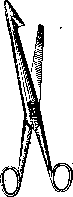
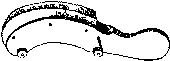
AUTOPSY INSTRUMENTS, a set of instruments necessary for performing human autopsies; in extreme cases, this may be limited to an autopsy knife, scissors, toothed forceps, and a saw, but for a proper autopsy it is advisable to have a full set of instruments. Such sets are commercially available, assembled in a special case. The large set includes: 1. Autopsy knives with blade lengths of 10, 15, and 20 cm, with a thick back and a curved belly (Figure 1). 2. Two dissecting knives of the surgical scalpel type. 3. A rib knife with a sturdy curved belly blade (Figure 2). 4. Virchow's brain knife with a double-edged blade 25 cm long and 4 cm wide (Figure 3). 5. Pik's myelotome (Figure 4). 6. Razor. 7. Blunt-ended scissors 25 cm long with rounded branch tips. 8. Intestinal scissors 25 cm long (Figure 5). 9. Buttoned scissors 12 cm long. 10. Small dissecting scissors with sharp branches. 11. Kupffer's scissors with curved branches. 12. Bone scissors. 13. Rib shears. 14. Bow saw. 15. Leaf saw. 16. Luer's double saw (Figure 6). 17. Bone forceps. 18. Three chisels of various sizes. 19. Chisel with a transverse handle (Figure 7). 20. Raspator. 21. Skull holder. 22. Steel or wooden mallet. 23. Two anatomical forceps. 24. Two toothed forceps. 25. Schorr's forceps. 26. Two button probes. 27. Grooved probe.
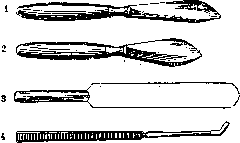
Figure 5. Intestinal scissors.
Figure 6. Luer's double saw.
probe. 28. Two pairs of double hooks 10 and 6 cm. 29. Four claws. 30. Metal and rubber catheters. 31. Tubulator with a stopcock. 32. Injection syringe for 100 cm3 and cannulas for it. 33. Three clamps (Pean). 34. Two spoons of the round ladle type of various sizes. 35. Curved needles for sewing up corpses. 36. Measuring metal ruler 30 cm long.
37. Tape measure with a metal measuring tape. 38. Measuring compass. 39. Three measuring cylinders of 200, 500, and 1000 cm3. 40. Scales for weighing organs. 41. Magnifying glass. 42. Whetstone for sharpening knives. Sets that also provide for the embalming of the corpse include a large injection syringe with a capacity of 500 or 1000 cm3 with cannulas and extensions. Most often, however, such a syringe with its related accessories is placed in a separate box.
Figure 7. Transverse chisel.
At the present time, electrical devices for sawing bones have also been introduced into the number of autopsy instruments. In particular, for sawing the skull and spine, the Reiner device is used; for sawing long bones, the Lubarsch apparatus. A. Abrikosov.
Related articles
Cite this page
“Autopsy Instruments.” Soviet Medical Encyclopedia. English translation of Bolshaya Meditsinskaya Entsiklopediya, 1st ed. (Moscow, 1928–1936), ed. N. A. Semashko. https://sovietmedicalencyclopedia.pages.dev/article/autopsy-instruments/