Probes
Historical document, translated for reference. It reflects medical knowledge of the 1920s–30s and is not medical advice.
Summary
Probes are instruments for introduction into wound channels or body cavities for diagnostic or therapeutic purposes. They vary widely in form, size, and material depending on their specific applications, including specialized types for different body parts and functions.
Encyclopedia article (1928–1936)
PROBES, instruments for introduction with diagnostic or therapeutic purpose into wound channels or body cavities. Probes differ greatly in form, size, and material from which they are made, depending on their purpose. Depending on their objective, probes can be divided into two groups: 1) probes for examination and 2) probes for protecting tissues from damage during operations. The first group is especially extensive in variety of models. In manipulations in various areas of the body for special examination and special therapy, a great variety of probes are used (probes for the Eustachian tube, for the nasolacrimal duct, esophagus, stomach, duodenum, intestinal probe, uterine probe, probe for examining the bladder cavity, etc.), described in special sections. Probes are made from various materials, mostly metal (nickel silver, steel, silver). In addition, probes can be elastic (for the bladder) and rubber (for the biliary-intestinal canal). Metal probes are mostly made of soft metal to give them the necessary curvature in each individual case of use (following the shape and direction of the wound channel or cavity being examined). Metal probes for examining some cavities (bladder) were made hollow, so that when searching for solid objects (stones) in cavities, a louder sound would be obtained when the probe strikes a solid object.
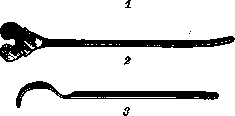
Figure 1-4.
The most common in surgical practice should be considered the so-called button probe. This probe is a metal rod, one end of which has a thickening in the form of an olive or small ball; the other end is rounded. Button probes vary in thickness (from hair thickness and more) and length (from 20 cm and more) and are used when examining wound channels and fistula tracts to determine their direction, length, and presence of foreign bodies or sequestra. A variety of the button probe is the uterine probe. Very thin button probes (hair-like) are used for examining very narrow natural canals (salivary ducts of the submandibular and parotid glands, nasolacrimal duct). For convenience of holding these thin probes in hand, they are provided in the middle of their length with a thin metal plate (fig. 5). Some probes have olive-shaped thickenings on both ends and are then called double button probes. Some types of button probes are equipped with handles for ease of manipulation. These handles have various shapes and in different probes are positioned at various angles to the rod. Such probes are used in otorhinolaryngological practice (fig. 6). Ordinary button probes, without special purpose, are also on one end provided with a leaf-shaped metal plate. This same plate is used when applying various ointments to the wound and around it, i.e., this end of the probe is used as a spatula. Another variety of the button probe is a probe with

Figure 5.
an eye on one end (fig. 1). This probe is used for passing drains through tissues, tying them to the eye with a thread. Button probes were used in the past mainly for examining wound channels in field surgery, most often to determine the presence of a metal projectile in tissues after gunshot wounds. In the absence of radiological methods at that time, probing was widely used. Since examination with an ordinary button probe did not always satisfy, individual surgeons designed a whole series of complex probes, which now have only historical interest. Thus, Nelaton introduced into practice the bullet probe, which had a porcelain spherical tip on which, when in contact with the lead bullets common at that time, a dark mark remained. Based on this sign, the presence and position of the bullet were determined. For these purposes, models of electric probes were also designed. The electric probe consisted of a rod through which two insulated wires with bare tips at the end passed. These wires from the probe handle went to an instrument with a bell. As soon as the insulated ends touched metal in the wound, the current was closed, resulting in the sound of a bell. In addition, a number of probes with telephone devices were proposed. A representative of the second group is the grooved probe. These probes are made of metal and have a groove along their entire length. o----------- Figure 6. The front end of the probe is rounded, the back is equipped with a handle in the form of a leaf with a cutout in the middle (fig. 2). The cutout of the handle was used in the previously common operation of incising the attached frenulum of the tongue, 7G6 The special purpose of grooved probes is to protect surrounding tissues from cutting instruments. A scalpel is introduced along the groove of the probe during operations for phimosis, for incising the hernial ring, fistula tracts, etc. Here, mention should be made of a special variety of the grooved probe, equipped with a small hook at the end (fig. 3). This probe is used for passing the necessary instrument from one opening to another during trepanation of the skull. In recent years, the solid probe (Buyalsky, Kocher) has become widespread, which can be used as a grooved probe, as well as for bloodless separation of tissues (muscles, fasciae). This probe is a plate, the edges of which are rounded on all sides. One half of the plate serves as a handle, the other, tapering toward the end, is the actual
Related articles
Mentioned in
Cite this page
“Probes.” Soviet Medical Encyclopedia. English translation of Bolshaya Meditsinskaya Entsiklopediya, 1st ed. (Moscow, 1928–1936), ed. N. A. Semashko. https://sovietmedicalencyclopedia.pages.dev/article/probes/