Bougienage
Historical document, translated for reference. It reflects medical knowledge of the 1920s–30s and is not medical advice.
Summary
This article from the 1928–1936 Soviet Great Medical Encyclopedia details the medical procedure of bougienage, which involves introducing instruments into excretory ducts or passages such as the urethra and esophagus to achieve dilation. It covers the anatomical considerations, techniques for both soft and metal bougies, potential complications, and specific methods for managing strictures.
Encyclopedia article (1928–1936)
BOUGIENAGE, the introduction of instruments into an excretory duct for the purpose of its dilation. The use of bougies, especially in urology, must be conducted with the same aseptic precautions as any surgical operation; therefore, bougienage should be avoided whenever possible during exacerbations of local inflammatory processes. Skill in handling a bougie is the foundation of all urological technique. When introducing a bougie into the male urethra (introduction in women presents no difficulty), one must remember the physiological curvature of the urethra, which has the shape of a recumbent letter S, in which the outer curvature is formed by the pendulous part of the penis and is easily straightened, while the inner curvature, formed by the part of the urethra that bypasses the pubic symphysis, is more rigid (it can be straightened only by a straight metal instrument by stretching the suspensory ligament of the penis once the bougie has already entered the bladder cavity). This part, passing through the muscular floor of the pelvis and the prostate gland, is the most difficult for the passage of the bougie and is the site most frequently damaged during bougienage, as well as the source of various complications. Bougienage with soft bougies is simpler and safer and only very rarely can be the cause of more serious or dangerous injuries to the canal, among which the main one is the creation of a false passage following the rupture of the urethral wall itself. Casper generally advises performing bougienage up to No. 16, Charrier only with elastic bougies, of which he prefers filiform ones with a neck thinner than the caliber of the bougie itself. The introduction of bougies is usually performed with the patient lying on their back, while the physician stands on the left side of the patient (some prefer to stand at the patient's right side) and holds a carefully lubricated soft bougie (after cleaning the external opening of the urethra) in the right hand, between the thumb and index finger (holding it not closer than the middle, so that the section touched by the hands does not penetrate into the urinary bladder); this small but important precaution largely protects against subsequent cystitis. The left hand holds the tip of the penis with the same fingers and pulls it perpendicular to the long axis of the body, whereby the first curvature is straightened, the urethra is elongated, and the bougie slides along it more easily. The tip of the instrument is inserted into the canal, after which the entire instrument is usually easily pushed through to the bladder. Bougienage should begin with thicker
numbers, approximately 16–18, to immediately determine the presence and location of the stricture. If the instrument does not pass immediately, one must act not with force, but with patience. The usual obstacle is the spasmodic contraction of the urogenital diaphragm and the sphincter of the urinary bladder. These obstacles are easily overcome by careful and persistent pressure: the spasm passes, and the instrument slips through the obstacle. Of particular difficulty are narrow cicatricial strictures, particularly if the entrance lies eccentrically (due to scarring). In such cases, a thin, if necessary filiform, sometimes with a curved end, bougie is taken, and an attempt is made patiently and persistently to find the entrance of the stricture by probing for it. In the most difficult cases, bougienage with 3–5 filiform bougies simultaneously helps; these are well lubricated and introduced up to the stricture. Then they are manipulated in turn, trying to probe the opening, and usually after several attempts, one of the bougies enters the stricture and passes through it. In such cases, the bougies are left in the urethra for 22 hours. The patient usually urinates past the bougie more easily than without it. This causes a mild inflammatory irritation that softens the stricture, and the next day a thicker bougie is easily introduced. This is continued until sufficient
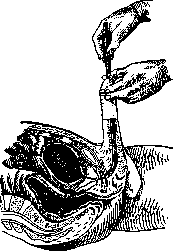
Figure 2.
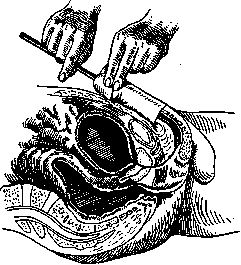
canal patency is achieved. In bougienage with a metal bougie, three moments are distinguished. In the first moment, the physician holds the head of the penis in the left hand and the hub of the bougie—directed with its curve downward—in the right hand, and inserts it into the canal, pushing the penis onto the instrument while holding the latter parallel to the midline of the abdominal wall (see Figure 1). The instrument penetrates thereby to the bulbar part of the canal, and its curve should lie upon the pubic symphysis. During introduction, the bougie must be held between the thumb and index (sometimes middle) finger of the right hand, firmly and gently, like holding a violin bow. The instrument must convey to the hand the sensation of passage and, as it were, probe its own path. In the next moment, the hub is raised
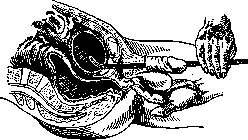
Figure 3.
of the abdomen, and the instrument penetrates past the bulb into the membranous part of the canal (see Figure 2); in the third moment, the penis is released from the left hand, the hub is lowered, the instrument is advanced into the depth, and it penetrates into the bladder (see Figure 3). The 2nd and especially the 3rd moments are the most critical in terms of the possibility of trauma. Mild bleeding after the introduction of a bougie is encountered fairly often during the first attempts and is of no significance. Heavier bleeding is always a sign of either awkward or excessively rough manipulation. For very difficult cases, bougienage with Lefort metal bougies with elastic guides is especially recommended. First, the elastic guide is introduced, then the metal bougie is screwed on and guided right behind it. This manipulation should not be performed when the bladder is empty. The elastic end coils into a ring in the bladder, and the metal one easily passes any stricture behind it without the risk of a false passage or damage. Bougienage of the esophagus is performed using special probes (see Probes). They are usually introduced after preliminary cocainization of the patient's pharynx in a sitting position. The probe is held like a pen with the right hand, while the index finger of the left hand pushes the patient's tongue downward, after which the probe is introduced along the posterior wall of the pharynx into the esophagus. The patient's swallowing movements facilitate the procedure. If the probe enters the esophagus, it usually slides easily into the stomach (42–44 cm). Difficulty indicates an obstacle and requires extreme caution, since damage to the esophageal wall is possible, the consequences of which are always extremely severe: injury (in the case of foreign bodies) to the aorta (needles, bones) and pleura, as well as inflammatory and phlegmonous processes of the mediastinum, often leading to death.
Related articles
Mentioned in
Cite this page
“Bougienage.” Soviet Medical Encyclopedia. English translation of Bolshaya Meditsinskaya Entsiklopediya, 1st ed. (Moscow, 1928–1936), ed. N. A. Semashko. https://sovietmedicalencyclopedia.pages.dev/article/bougie-2/