Dental Instruments
Historical document, translated for reference. It reflects medical knowledge of the 1920s–30s and is not medical advice.
Summary
This article describes the evolution and classification of dental instruments from the early era focused solely on tooth extraction to the more specialized instruments used in dental therapy and surgery in the 1930s.
Encyclopedia article (1928–1936)
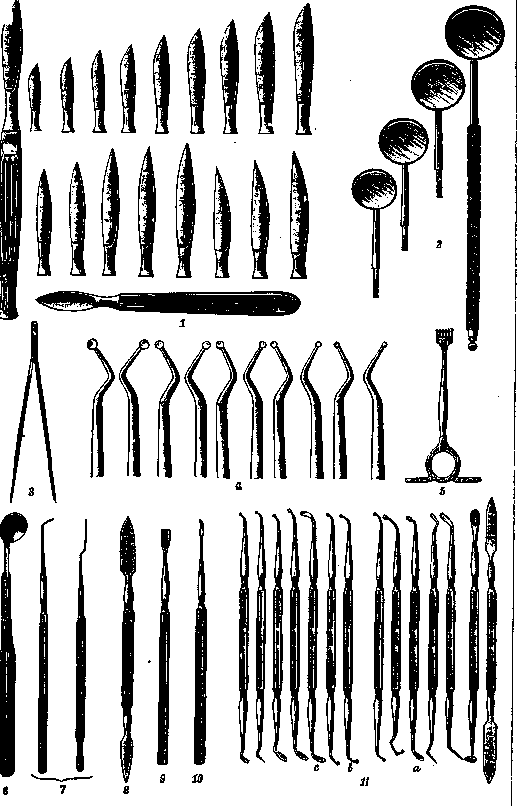
DENTAL INSTRUMENTS. In the early period of dental development, when treatment was limited to tooth extraction, only instruments for removing teeth and roots were available. Later, when attempts were made to treat both the tooth itself and surrounding tissues, a number of instruments for treating carious cavities, tooth canals, gums, etc., appeared. As dentistry developed into stomatology, the dental instrumentarium became even more diverse. At present, it can be divided into two main groups: 1) for treating diseases of the teeth and oral cavity, 2) for dental operations. The principal instruments used in the therapy of diseases of the teeth and oral cavity. A. Diagnostic instruments.- 1) Dental tweezers (figure 3): its main purpose is to easily and firmly grasp cotton rolls, swabs, and balls, and to easily and effortlessly leave them in the tooth or oral cavity. To achieve these goals without tiring the hands, a rationally designed tweezer is made such that the grasping ends are so thin that they can grasp the smallest cotton ball and leave it in a carious cavity of very small size. The open end of the tweezer is made of steel that requires minimal force to overcome its springiness, but at the same time this springiness is sufficient for the rapid opening of the tweezer tips. The ends of the tweezer are curved like a bent index finger or almost at a right angle, so that they can penetrate hard-to-reach distal cavities. For the purpose of asepsis, the outer surface of the handles is smoothly polished; so that it does not tire the operator's hands, large transverse notches are made on it.-2) Dental mirror (figure 2): its purpose is to transmit the image, display and illuminate the operative field, and to retract the tongue, lips, and cheeks during manipulation in the mouth. Glass mirrors still in use cannot withstand sterilization and become dull. Therefore, recently there has been a tendency to replace glass mirrors with mirrors made of stainless steel, which are not damaged by boiling. But modern mirrors of the latter type (so-called Krupp mirrors, figure 6) also do not fully meet the requirements made of them - they are somewhat dull. The main requirements for a dental mirror are as follows: a) clarity of reflection; b) the length of the mirror handle should be at least 15 cm and not smooth, but wavy or faceted, for convenience of holding in the hand; c) the angle between the mirror and the handle should be 120°, because only under this condition can any corner of the mouth be illuminated.-3) Dental probe (figure 7). Its purpose: a) to examine the enamel of the tooth to determine damage from incipient caries, b) to examine the dentin to determine its condition, c) to transfer medicinal substances into the tooth cavity, d) to introduce cotton balls, swabs, and pledgets into the tooth cavity and remove them from it, e) to check the proper fit of a filling to the healthy tissues of the tooth, f) to check the proper grinding of teeth and roots when preparing them for crowns and pin teeth. The following three forms of dental probes are most commonly used: a straight probe and two bent at 90° and 120° angles. B. Instruments for preparing carious cavities of the tooth for filling. 1) Drills and burs. 2) Excavator (figure, 4). Its purpose is to remove food debris and softened dentin from the carious cavity, to remove tartar from the depths of the gingival pocket, to remove various types of soft inlays from the tooth. To perform its purpose, the most common excavators have a working part in the form of a flat, sharp round spoon. The working part is at an obtuse angle to the handle (bayonet type) and at a right angle. Finally, there is a fairly common form (according to Witcel) where the spoon is a direct extension of the handle. 3) Enamel knife (figure 9). Its purpose is to chip away parts of enamel and dentin. The most common and rational form is that of a chisel of various widths. C. Instruments for filling teeth. This group includes instruments for filling with amalgams and cements (phosphates and silicates). These instruments, like excavators, can be single-ended and double-ended. Dental Instrumentarium I I /I
Dental Instrumentarium II INSTRUMENTARIUM
DENTAL
Double-sided instruments are more commonly used, because without releasing the instrument from the hand, one can perform twice as many manipulations with it than with a single-sided one. Instruments for filling teeth are divided into instruments for mixing cements (spatulas), for introducing filling material into the prepared cavity and condensing it there (pluggers), and for smoothing the filling introduced into the prepared cavity (carvers). Spatula (fig. 8). The most commonly used ones, which serve for mixing cement, must be sufficiently flexible and thin, because only these properties allow them to mix cement well. Their shape in the form of a pointed shovel also makes it possible to introduce cement into a carious cavity. Cement plugger (fig. 11a) has a bottle-shaped head in the working part, so that when filling the tooth cavity with cement, the latter is not squeezed back out. For condensing (plugging) amalgam, round heads are used (fig. 11e). A carver (fig. 11c) has the purpose of smoothing fillings and giving them the required shape. The most commonly used carvers usually have the form of various thin, rounded at the end plates. Double-sided instruments are most often used - carver-plugger (fig. 8). G. Instruments for treating tooth canals. 1) Drill-burs. 2) Nerve extractor instrument, used for removing the pulp from the tooth canal. It consists of a thin rod, covered in the lower third with special notches. With rotational movements of the fingers, pulp tissue is wound onto it, which is thus extracted. 3) Miller's needle - a thin, smooth, round or faceted needle, onto which a thin wick of cotton is wound; by impregnating the latter with various solutions, antiseptics and other medicinal substances are thus introduced into the canal. D. Instruments for treating gums and oral mucosa. 1) Instruments for removing dental calculus (fig. 10) serve to free the neck and crown of the tooth from dental calculus. Thorough and painless cleaning of the tooth from calculus is possible only if the instrument corresponds to the anatomical shape of the tooth, if the instrument easily penetrates the interdental space (thin instrument) and is designed such that the scraping end does not damage but rather pushes aside the gum. For this purpose, the most commonly used instruments have a sickle and half-moon shape or are even more adapted, for example, instruments according to Sachs. Main instruments used in operative dentistry. A. Instruments for removing teeth and roots. Forceps and elevators. The design and method of action of these instruments are based on the application of lever principles. Modern forceps are used for removing teeth and roots; they consist of a handle (shank) and the working part - beaks. Both handles are connected by locks of different systems. Since the time of Tomes (Tomes; 1841), the beaks have such an anatomical shape as to tightly fit around the neck of the tooth and the crown, if it exists, and if not, then the root itself. Depending on the tooth or root for which they are intended to be removed, the beaks have a corresponding shape, and the name of the forceps depends on this shape. Thus, there are forceps for upper (fig. 12a) and lower molar teeth (fig. 13a), for upper (fig. 12e) and lower incisors and canines (fig. 13e), for upper premolars (fig. 12c) and lower premolars (fig. 13e), for roots of upper (fig. 12d) and lower teeth (fig. 13d). The handles (shanks) of forceps are extremely diverse. But the basic requirement made of them is as follows: the operator's hand should be able to freely pass 1-2 fingers between them in their closed state and when closing, easily develop maximum finger strength. For this, the lower halves of commonly used rational forceps have a corresponding curvature and strength. The lock of the forceps must be stable and simple (aseptic). A distinction is made between the American type of forceps - when one shank is fixed as if in a vise of the other, the German type - when both shanks are fixed on one screw, the French type - when the American lock is given an oval shape. In the lock, the relationship between the beaks and shanks must be such that the beaks are bent relative to the shanks along the horizontal plane (a somewhat outdated system) or along the vertical plane (modern system). It should also be noted the relationship between the beaks and shanks in the form of a bayonet in root forceps for the upper jaw (bayonet forceps). These forms are very convenient for approaching distant roots of molar teeth. Elevators basically represent a wedge of one shape or another, kind, size, etc. Resting on the edge of the socket or a neighboring tooth, it raises the required root from the socket and pushes it out (fig. 14). B. Instruments used for producing local anesthesia. Syringe. This instrument was previously required to be able to produce an injection under pressure when injecting into the submucosal tissue and dental papilla. For this, a syringe was designed where the needle is screwed onto it. Modern dentists, thanks to the improvement of anesthesia techniques, do without this syringe, using a regular syringe used in general surgery, such as the Record type. C. Instruments used in operative procedures in the oral cavity. 1) Knives (fig. 1). In addition to general surgical requirements, these instruments must also meet the following requirement - convenient size, so that the knife can be manipulated in the mouth without damaging healthy tissues. 2) Sharp hooks (fig. 5) - the insignificance of mucoperiosteal flaps is taken into account, and therefore the size of the toothed part is small. 3) Dull hooks (fig. 15) - the need to hold the tongue, cheek, i.e., significant surfaces is taken into account. 4) Chisel (fig. 16). They are required to have: sufficient length of the handle, taking into account the depth of the oral cavity. - The handles of the mentioned instruments in rational types have a wavy faceting. All other instruments used both in oral surgery and in maxillofacial surgery do not differ from instruments used in general surgery.
A. VerlotskiV.
Related articles
Mentioned in
Cite this page
“Dental Instruments.” Soviet Medical Encyclopedia. English translation of Bolshaya Meditsinskaya Entsiklopediya, 1st ed. (Moscow, 1928–1936), ed. N. A. Semashko. https://sovietmedicalencyclopedia.pages.dev/article/dental-instruments/