DENTAL PROSTHESES
Historical document, translated for reference. It reflects medical knowledge of the 1920s–30s and is not medical advice.
Summary
This article from the 1930s Soviet medical encyclopedia defines dental prostheses as artificial replacements for missing teeth or jaw parts, discusses their historical development from cosmetic to functional purposes, and categorizes different types including plate, crown, and bridge prostheses.
Encyclopedia article (1928–1936)
DENTAL PROSTHESES (from Greek protithemi - I put before, I replace), mean any artificial superstructure, attachment, addition in the oral cavity with the aim of completely or partially replacing lost teeth or parts of the jaw. Initially, dental technology sought to achieve this narrow goal by inserting into the gaps left by the loss of natural teeth prostheses that filled and merely covered these gaping openings. Elimination of the cosmetic defect served as the first impetus for the development of dental prosthetics. All ingenuity was initially directed toward finding and obtaining those materials which, after processing, would give dental prostheses most resembling the natural lost teeth. The imperfection of these first dental prostheses is evident from the fact that they usually had to be removed from the mouth during eating; they also interfered with speech. As a survival of this narrow understanding of the purpose and function of dental prostheses, this view still remains to some extent today in the minds of the general population. Thanks to the successes of modern scientific dental prosthetics, cosmetic goals in this field are beginning to noticeably yield place to purely functional and preventive tasks. In addition to ordinary dental prostheses, which aim to restore impaired chewing function in partial or complete loss of teeth, more complex are jaw prostheses, the task of which is to replace defects of tissues and jaw bones after gunshot and other injuries and after surgical interventions in the excision of malignant tumors. Jaw prostheses with superstructures for covering large defects of soft parts of the face are called facial prostheses. Various types of splints, immobilizing fragments of jaw bones and loosened ('pyorrheal') teeth, also belong to dental prosthetics. The therapeutic usefulness of prosthetic dentistry is based on a general medical and biological foundation. In the construction of modern dental prostheses, a significant role is also played by a number of special disciplines: mechanical and chemical technology, metallurgy, ceramics. Before making a particular dental prosthesis, the prosthetist must first discuss all the features of the case. These include not only the degree and types of destruction of the chewing apparatus, but also the age of the patient, his cultural level, and his general state of health. In mass practice, it is necessary by necessity to introduce standardization. But where it is possible to individualize, the same case can be prosthetically processed by different methods. In certain cases, the choice of prosthesis construction depends on the professional peculiarities of the patient's occupation: singers, wind instrument musicians, orators, lecturers primarily need fixed, non-removable prostheses (see below). Special caution must be exercised in the choice of one or another system of prostheses in epileptics, paralytics, and the mentally ill. Thus, the choice of one or another system of prosthetics for a given mouth represents in each individual case a creative clinical task and can only by necessity be reduced to a template. Individual indications in each particular case generally come down to achieving maximum functional usefulness of the prosthesis, with the invariable requirement of eliminating in it all factors harmful to the remaining teeth in the mouth.
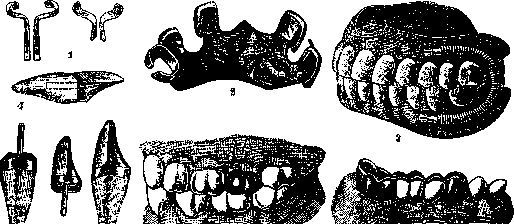
Dental prostheses are of different types of constructions. - Plate prostheses are made of rubber or metal (gold, stainless steel), more rarely of a combination of rubber with gold (combined prostheses). These prostheses are removable and serve to replace part of the teeth or both dental arches of the upper and lower jaw (partial and complete prostheses). They are held in place in the mouth by the adhesion of the plate to the palate due to the viscosity of a thin layer of mucus filling the narrow gap between the prosthesis and the mucous membrane. This mucus, like lubricant between two contacting surfaces, develops surface tension (capillary energy), creating incomparably greater adhesion of the plate than that created by suction cups of airless chambers working with negative air pressure. Such adhesion of the prosthesis, based on physico-molecular laws, can be strengthened by means of a suction chamber, ordinary or rubber, or with the help of clamps (fig. 1 and 2) or springs for edentulous mouths (fig. 3). - Pin crown is made of porcelain dental crowns and serves mainly for replacing front teeth. It is fixed on a permanent or removable metal pin in the root of the tooth (fig. 4). In cases of deep spread of the carious process, a pin crown with a metal ring covering the neck of the tooth under the gum is used (Richmond pin crown; fig. 5). Of ready-made factory pin crowns, the most common are Logan crowns with a pin fixed in the porcelain mass and with a separate pin. - Hollow crown (gold or platinum) represents a metal capsule having the shape of a natural tooth. Such a crown is the oldest type of dental prostheses. The hollow crown, covering a filled tooth severely affected by the carious process, anatomically restores the lost parts of this tooth and its chewing function, and the antagonist tooth is freed by this crown from the harmful consequences of its removal from normal articulation and from the act of chewing (fig. 6). The hollow crown is fixed on natural teeth with cement for dental fillings. In addition, the hollow crown is the most common method at present for fixing fixed bridge dental prostheses (fig. 7). Bridge prostheses were already known in ancient times. They do not have a plate covering the mucous membrane of the mouth and serving as a base to which artificial teeth are attached. A bridge prosthesis consists of 2 parts: supporting and intermediate. The roots and teeth serve as supporting points. The difference between non-removable and removable bridge prostheses lies not only in that the former are fixed immovably on supporting teeth and roots, while the latter can be removed from the mouth, in which the preventive task enters as a natural condition. Functional prostheses Rumpel divides into three categories: 'physiological', 'semi-physiological' and 'unphysiological'. Physiological include removable and non-removable bridge works. Semi-physiological prostheses (plate), otherwise called 'support', partly rest on the roots of natural teeth, partly transmit chewing pressure to the ridges of alveolar processes and the palate. Their functional qualities are lower than those of the first group. Finally, unphysiological prostheses are those plate prostheses in which the chewing pressure falling on the prostheses is transmitted exclusively to the soft tissues surrounding the jaw ridges and palate. In these cases, the patient, chewing with such prostheses, is completely deprived of the physiological sensation experienced by him in normal conditions.

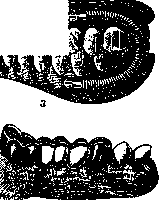
according to the patient's wish, but mainly in the fact that in fixed prostheses, the chewing pressure is transmitted exclusively to the abutment teeth and roots, while in removable plate prostheses this pressure is distributed almost uniformly over the ridges of the alveolar process covered by the plate and the palate. The sensation of chewing with fixed bridge prostheses is therefore no different from the natural one; with removable plate prostheses, however, patients do not experience such a natural sensation. A rationally constructed fixed bridge prosthesis is usually secured on two (rarely three or more) abutments; the intermediate parts suspended between them have a heart-shaped or wedge-shaped cross-section, not reaching closely to the alveolar ridge. Only intermediate parts of bridge work of this shape allow the patient to easily and thoroughly clean these prostheses with a brush from food particles adhering to them, and consequently to keep them clean. Removable bridge dentures have the most varied construction and are secured to abutment points with the help of crowns, pins, sleeves, spring locks, studs, etc. Removable bridge dentures are easily removed and cleaned of food residues. Due to the difficulty of manufacture and high cost, removable and fixed bridge dentures have not yet become widespread in the USSR. The modern principles of constructing dentures primarily pursue a preventive task: creating a structure of the prosthesis that excludes all unfavorable factors that adversely affect the remaining teeth in the mouth and traumatize or irritate the soft tissues of the mouth. In addition to preventive tasks, modern dentures are also required to increase the functional capacity of the disabled mouth. According to these two most important goals, all types of dentures have recently been divided into purely preventive and functional, according to the proposal of Rumpel (K. Rumpel). In the process of making dentures, there are a series of stages, each of which is not only a step for the subsequent one but also a condition for the correctness of further work. Even the preparation of the mouth for inserting the prosthesis is an essential factor, to a large extent determining the suitability of the prosthesis being made. Removal of diseased tooth roots, bringing the remaining teeth in the mouth to a healthy state, elimination of mobile, loosened, shaky proliferations of the covering tissues on the alveolar ridge, removal of sharp edges from the ridge covered with thin mucous membrane, separation from the edge of the ridge of straps that dislodge the dentures, deepening the vaults of the mouth vestibule—all these measures often serve the purpose of both fixed wearing of the prosthesis and protecting it from excessive breakage, prolonged wearing, and better function. Taking impressions of the jaws of a living mouth is done with soft wax-like masses or plaster. From the impression obtained, not only accuracy and clarity of the imprint are required, but it is also necessary that the imprint clearly indicates the area of the jaw processes and palate that during eating during functional movements are covered by immovable mucous membrane. This gives the laboratory technician (dental technician) the opportunity to construct a prosthesis that does not spatially extend beyond these immovable soft tissues. Subsequently, the doctor and patient are protected from excessive loss of time on shortening and processing the prosthesis when it is delivered. For taking such functional impressions, oral trays are used. Recently, there has been a requirement to create and use for each case an individual tray that most accurately fits a given mouth. The plaster models cast from these impressions must be mounted in articulators (see), where they should occupy a position in spatial relation to each other and to the joint axis, completely coinciding with the living model. For correct mounting of plaster models in such an articulator, the prosthodontist performs a series of manipulations in the patient's mouth with wax or shellac templates, during these try-ins achieving correct positioning between templates, occlusal height, magnitude of the joint slope angle, etc., in order to obtain an exact copy of the relationships between templates during the jaw movements of the patient. Only then is it possible to correctly mount the models in the articulator. After this, the artificial teeth are set on the model according to a number of anatomical, physiological, and cosmetic rules. After the fabrication of the trial wax model with teeth, a new try-in is made in the patient's mouth to examine how correctly the teeth were set. Packing with rubber, vulcanization, boiling, processing, and finishing of the dentures follow only after satisfactory results of the aforementioned try-in. The correctness and precise implementation of the necessary procedures of this part of the work ensure the production of a satisfactory denture, significantly reducing the time for manufacture and adaptation to using the denture. The complexity of the technical procedures in making dentures requires the establishment and equipment of special dental laboratories with supply of them with special production tools (grinding, stamping, rolling, soldering, casting, and other apparatus, and a set of instruments for processing and finishing dentures). When taking impressions, plastic substances or plaster paste are most often used. Among the plastic materials are wax, gutta-percha, stearin and similar compositions (Kerr's mass). The plaster used in dental laboratories is calcined in special furnaces at a temperature of 130-150°. With a pure chemical composition, it is white. To give it greater plasticity or speed of hardening, as well as for coloring it to more easily distinguish the boundary between the impression and the model, various chemical substances (NaCl, K2SO4, carmine, white clay, etc.) are added to the plaster solutions. Due to the importance of obtaining accurate impressions and models, plaster has been well studied from the chemical and physical properties aspects, as evidenced by extensive literature. Plastic materials for impressions made from wax with the addition of turpentine, sesame oil, Burgundy resin, paraffin, vermilion, etc., have also been subjected to scientific and technical processing. These materials are especially used for making wax templates and rollers when taking the bite. Rubber (Gummi elasticum) has long been given special attention in dental technology. The consumption of rubber expanded significantly after the publication by Goodyear in 1839 of the method of vulcanizing rubber. Rubber for dental purposes is made in various colors (black, white, pink, red, gray-yellow). For this, various coloring substances (zinc oxide, vermilion, sulfur, etc.) are added to it. Vulcanization (see) in dental laboratories is carried out in special hermetically sealed boilers—vulcanizers. When the pressure in the boiler reaches 7 atmospheres, the temperature should fluctuate between 165-169° for 70 minutes. Only under these conditions does the vulcanization of rubber proceed well. Not all varieties of various rubber products have the property of shrinking equally during vulcanization. Special care must be taken during vulcanization of thick rubber plates: it must be done slowly and at lower atmospheric pressure, otherwise such plates turn out to be very porous and brittle. A number of metals also find extensive application in dental prosthetics. Of noble metals, gold is especially used. Its application in this field was already known to the Ethiopians and Nubians 1,600 years before the Christian era. Among the Romans, there was even a law according to which gold dentures at burial should be buried with the corpse. In dental technology, gold is used in alloy with copper, silver, cadmium, platinum (ligature gold). Alloying gives gold considerable elasticity. The successes of dental technology are closely linked to the progress of metallurgy (Roach recently made an alloy of gold with steel—Sta.hlgold, whose springiness was especially suitable for clasps). In addition to alloys of noble metals, recently in dental technology, for economic reasons, ligatures of inexpensive metals, for example copper (Randolf metal, cosmos metal), have been tried; from stainless steel (Krupp's chrome-nickel steel), aluminum. Among the latter, Krupp's steel has been most successful. Platinum and platinum-iridium, despite their valuable qualities, are replaced by palladium due to their high price. Aluminum and its alloys as dental prosthetic materials are not yet successful. Among materials for making metal models (matrices) and counter-models (patrices), zinc and a number of low-melting alloys of zinc, tin, antimony, and bismuth should be mentioned (M. Mollot-Metall, Wood-Metall, Helvetia-Metall, Babbit-Metall, Metall Spence's, etc.). For castings of metal models, molding mass (a mass composed of clay and glycerin) is used for coating them. For soldering large parts of metal dentures or cast metal works, various sealing (inlaying) masses (Einbettungsmasse) are used.
These sealing masses for castings must possess refractoriness, a smooth surface, and immutability of form. Their composition includes gypsum, chalk, pumice, white clay, sand, asbestos, talc, etc. The production of stamping, casting, soldering, and threading of metals in the manufacture of dental prostheses is associated with the use of various machines and apparatuses that make this work precise and mechanized. Artificial teeth. The earliest attempts at making artificial teeth, discovered in archaeological excavations, existed among the Etruscans (9th-4th centuries B.C.). In the first centuries A.D., the wearing of artificial teeth is noted by Roman classics [satires of Martial ('Tais habet nigros, niveos Laecania. Quae ratio est? Empos haec habet, ilia suos'-'Taissa has black teeth, Laecania has white ones. Why? Because the first has her own, the second has purchased ones')]. The material for making artificial teeth at that time served as natural human and animal teeth, ivory, and gold. Until the middle of the 16th century, there is a gap in our knowledge about the manufacture of artificial teeth due to the absence of any literary data. Peter Foreest, a Dutch physician living in the second half of the 16th century, briefly mentions artificial teeth made of ivory, edged with gold, and removable during meals. In the early 18th century, the Parisian surgeon Pierre Dionis describes the manufacture of artificial teeth made of ivory, suspended in the mouth on a gold wire. For the first time, we find an extensive exposition on the technique of making dental prostheses by P. Fauchard, who knew how to make artificial teeth from 'glaze' (porcelain). From this time on, porcelain attracts special attention in the manufacture of artificial teeth as a material that does not change in the mouth and best satisfies the increased cosmetic requirements. Among those who improved the technique of processing porcelain mass for making artificial teeth during the 18th-19th centuries, we should name Mouton, Duchateau, Guerard, Dubois de Chemant, and Fonzi. Besides France, porcelain teeth were produced in England, Belgium, and America. America and England particularly competed in the production of porcelain teeth. The former made porcelain teeth from two layers: a core (base) and a casing (enamel). The latter produced these teeth from a uniform, homogeneous mass. Subsequently, Germany also participated in the production of artificial teeth. In pre-revolutionary Russia, artificial teeth were imported from abroad. Very recently, the production of porcelain teeth has been established in the USSR at the State Ceramic Factory in Leningrad. Porcelain teeth are now manufactured industrially from feldspar, quartz (silica), and kaolin (porcelain clay). To obtain various color shades in porcelain teeth and achieve the greatest resemblance to natural ones, before firing the raw porcelain mass, oxides of various metals (titanium, cobalt, chromium, nickel, gold, etc.) are added to it. The mixture of ingredients in the porcelain mass, as well as the methods of mixing, processing, and packing into molding copper plates, the duration and temperature of firing, and a number of other operations in the manufacture of porcelain teeth usually constitute the secret of each factory. The porcelain mass is fired in copper molds consisting of two halves (front and back), in which halves of various anatomical forms of teeth are engraved. Both halves of the molds together create a cavity, which before firing is filled with raw porcelain mass. Firing is carried out at 1,300-1,500° and requires great experience and skill to avoid a whole series of defects (cracks, bubbles, shrinkage, etc.). According to Flagg's theory, the shape of a person's front teeth is in some inverse correspondence with the shape of his face. In connection with this, at present, three types of anatomical form teeth (Gysi-Williams) are made: square, triangular, and oval. Great progress is also observed in the manufacture of the chewing surface of molar (lateral) porcelain teeth. The enormous variety of forms, sizes, and colors of teeth is further increased by giving them a number of devices that help to connect them with the base of the prosthesis or the roots of natural teeth or the need to repair fixed dental prostheses in place in the mouth. Such devices include so-called crampons of various metals and ligatures, channels and tubular holes for packing them with base material or cement, clasp protectors, etc. The manufacture of porcelain teeth at present has become a special kind of industry, producing hundreds of millions of teeth and served by a large workforce. The scale of production of porcelain teeth indicates the need to strengthen preventive measures to combat caries, which causes too early and constantly increasing need for wearing dental prostheses. Both removable and fixed dental prostheses require constant daily care, cleaning them from food particles, dirty deposits, etc. This is achieved by cleaning the prostheses with a toothbrush, tooth powders or pastes. It is the duty of the prosthetist not only to teach the patient this care but also to design dental prostheses in such a way that such cleaning is easily feasible. Neglect of these hygienic rules invariably leads to inflammatory phenomena of the soft tissues of the mouth covered by the prosthesis and to a number of complications that make wearing the prosthesis in the mouth harmful and impossible.
N. Astakhov. Zauser splints, view of wire and metal plate splints. Wire splints are used for simple and complex fractures, plate splints-for resections of the jaws. A round or semicircular wire (of gold, nickel silver, aluminum, or aluminum bronze) 1-2 mm thick is drawn exactly along the necks of teeth above the gum edge with the calculation to set the fragments of the jaw in correct relation. The splint is tied to firmly standing teeth with bronze-aluminum ligature. As a more stable splint for jaw resection, a metal plate 1/2 mm thick, 2 cm wide, and of a length corresponding to the defect of the jaw is used. A metal plate bent in the shape of a normal jaw is sewn into the fragments of the jaw with a ligature; thus fixation of the fragments is created.
Related articles
Mentioned in
Cite this page
“DENTAL PROSTHESES.” Soviet Medical Encyclopedia. English translation of Bolshaya Meditsinskaya Entsiklopediya, 1st ed. (Moscow, 1928–1936), ed. N. A. Semashko. https://sovietmedicalencyclopedia.pages.dev/article/dental-prostheses/