Obturators
Historical document, translated for reference. It reflects medical knowledge of the 1920s–30s and is not medical advice.
Summary
This article from the 1928–1936 Soviet medical encyclopedia defines obturators as prosthetic devices used to close defects in the oral cavity, particularly those connecting the mouth and nasal cavity. It details their construction, function, and various types, including those for congenital and acquired defects.
Encyclopedia article (1928–1936)
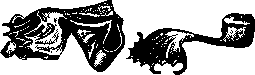
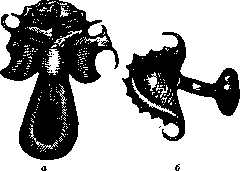
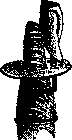
OBTURATORS (from the Latin obturare - to plug), prostheses and devices serving to close or "plug" unnatural openings in the walls of the oral cavity. Obturator prostheses are most often used to close defects of the hard and soft palate, in which there is an abnormal communication between the cavities of the mouth and nose. Obturators are also used to close defects in the alveolar process of the upper jaw penetrating into the maxillary sinus, or to close large openings remaining after trepanation and partial resection of the walls of periapical cysts of the jaws. Large defects remaining after complete resection of the upper jaw are filled with obturator prostheses, restoring the bone and tooth defect and creating a separation between the cavities of the mouth and nose. The use of obturators is generally indicated only in cases where it is impossible to perform closure of the defect by plastic surgery or when the patient refuses operative treatment. Depending on the location, shape, size, and other features of the defects and on the role that the obturator must perform in the function of the cavities of the mouth and nose, special types of obturators and various types of their construction are distinguished. Obturators of the simplest construction are used to close acquired defects of the hard palate, defects of the alveolar process penetrating into the maxillary sinus, and openings of periapical cysts. In these cases, there are openings surrounded by hard edges that do not change their shape. It is sufficient to adapt a plate made of hard rubber covering the edges of the defect and partially plugging its lumen, and thereby all the functional disturbances associated with the defect are eliminated (Fig. 1). The construction of obturators used to restore defects of the soft palate is significantly more complex. The size and shape of these defects constantly change depending on the function of the surrounding muscles. The obturator of the soft palate must be adapted to the movements of the soft palate and the muscles of the posterior and lateral walls of the pharynx. Thanks to this, at the moment of muscle contraction, complete separation between the nasal and oral parts of the pharynx is achieved. However, its presence in the area of the defect must not hinder either the movements of the soft palate nor the free passage of the stream of air through the nasopharyngeal passage during breathing. The functional merits of the obturator of the soft palate are determined, on the one hand, by how well they eliminate the entry of food into the nasal cavity during eating, and on the other hand, by how well the function of the soft palate is restored during speech. The prognosis regarding the restoration of normal speech, however, depends not only on the quality of the obturator but also on the features of the defect itself and on the functional development of the entire nervous-muscular reflex apparatus participating in the act of speech (see Logopathy and Logopedics). Defects of the soft palate for which the use of an obturator is indicated must be divided into three groups: 1. Congenital clefts of the soft and hard palate not subjected to operative intervention. 2. Congenital clefts of the palate after operative interventions that have not led to complete restoration of the soft palate. 3. Acquired defects of the soft palate, most often of syphilitic origin. In defects of the first group, obturators adapted to the movements of the muscles of the soft palate and pharynx are applied; in defects of the second group, the mobility of the soft palate is usually severely disturbed by scars and tissue tension, as a result of which it is much more difficult to adapt an obturator so that it does not limit the remaining movements, does not cause bedsores, and performs its function. Closure of the nasopharyngeal passage is achieved due to the contraction of the superior constrictor of the pharynx, forming a bulge on the posterior wall of the pharynx - the Passavant's ridge. It is most difficult to achieve restoration of function when obturating acquired defects of the soft palate after gummas of the palate and pharynx, since in these defects there is often no mobility at all of the palate muscles and the constrictor of the pharynx. The functional quality of obturators also depends on how they are fixed in place. Immobile fixation of the entire obturator, in particular fixation to the teeth, is usually applied only for defects in the hard palate or alveolar process. For obturators of the soft palate, a whole series of various constructions allowing either complete mobility of the entire obturator (floating obturator) or relative mobility of that part of the obturator located between the muscles (using springs, hinges) have been proposed by different authors. However, there are also immobile obturators of the soft palate creating conditions for the formation of quite normal speech (meat-obturator, Warrick's obturator, etc.). The following obturators are best known: 1. Kingsley's obturator (1864) for the soft palate consists of two plates of soft rubber connected to each other and attached by a hinge to a supporting plate on the hard palate. The upper plate of the obturator is longer than the lower one and contacts the posterior wall of the pharynx. This obturator is no longer used. 2. Suersen's obturator for congenital unoperated clefts of the soft palate (Fig. 2) consists of a large immobile piece of hard rubber located in the nasopharynx. Separation of the oral and nasal parts of the pharynx is achieved due to the contraction of the m. constrictor pharyngis superior. The work of the muscles of the soft palate is not taken into account. This obturator is no longer used. 3. Schiltsky's obturator consists of a piece of soft rubber hollow inside, located in the nasopharynx and fixed by a spiral spring to a supporting plate on the hard palate (Fig. 3). It is used for insufficient soft palate after operations that do not give elongation of the palate (for example, after Langenbeck's operation). 4. Warrick's obturator is a simplified modification of Suersen's and consists of a plate of hard rubber filling the lumen remaining at the moment of greatest contraction of the muscles of the pharynx and soft palate (Fig. 4). The obturating plate in unoperated clefts is connected immovably or by a hinge to the supporting plate; after operation for insufficient palate it is connected to the supporting plate by a thin gold rod. 5. Case's obturator (1904) is used only for unoperated clefts of the soft and hard palate. It consists of a very thin and light plate of black rubber with edges that exactly embrace the edges of the cleft (Fig. 5). The obturator is held only on the edges of the cleft and easily moves "floats" between the two halves of the soft palate. From falling back, the obturator is held by the upper anterior surface of Passavant's ridge. Case's obturator is one of the simplest and cheapest in terms of manufacturing technique and at the same time excellent in functional terms. 6. Schalit-Froschels' obturator (1928), named by the authors the meat-obturator, is applicable in all types of insufficiency of the soft palate. It consists of a piece of hard rubber closing the openings of the choanae from the side of the nasopharynx and thereby limiting the exit of air through the nasal cavity (Fig. 6). In the middle of the obturator there is a permanent channel for breathing. The authors assert that to eliminate nasal speech it is not necessary to achieve complete separation between the oral and nasal parts of the pharynx, but it is sufficient to limit the exit of air towards the nasal cavity to a certain extent. 7. Warrick's nipple obturator for feeding newborns with cleft palates consists of a plate of soft rubber covering the alveolar process and the cleft of the hard and soft palate and connected by a metal lever and a celluloid ring with a rubber nipple (Fig. 7). 8. Brophy's obturator for breast-feeding newborns having cleft palates consists of a plate of soft rubber attached to an extraoral handle, which the mother holds to keep the obturator in place during feeding. The obturator should be applied from the first days after birth. Besides the described obturators, there are many other proposals, e.g., Martin's, Delair's, Brugger's, Guerini's, Brandt's, Pickerill's, etc. Pickerill fixes the obturator of the soft palate by a hinge to a supporting plate on the hard palate, and for greater mobility of the obturator he hooks it by a hook to a loop created by sewing together the two halves of the uvula of the soft palate. Brandt used a rubber air balloon.


Related articles
Mentioned in
Cite this page
“Obturators.” Soviet Medical Encyclopedia. English translation of Bolshaya Meditsinskaya Entsiklopediya, 1st ed. (Moscow, 1928–1936), ed. N. A. Semashko. https://sovietmedicalencyclopedia.pages.dev/article/obturators/