Metallurgy
Historical document, translated for reference. It reflects medical knowledge of the 1920s–30s and is not medical advice.
Summary
This article from the 1928–1936 Soviet Great Medical Encyclopedia outlines the fundamentals of metallurgy, focusing on ferrous metallurgy, including the extraction of cast iron, iron, and steel from various iron ores using blast furnaces.
Encyclopedia article (1928–1936)
METALLURGY, the extraction of metals from their natural compounds—ores, is divided into two branches: ferrous and non-ferrous. Ferrous metallurgy encompasses the production of cast iron, iron, and steel. Cast iron is extracted from iron ores known as ironstones: red hematite (Fe2O3), magnetic iron ore (Fe3O4), spathic iron ore (FeCO3), and brown iron ore, the composition of which is not constant. Into the blast furnace (see figure), which is a tall cylindrical tower lined with special grades of refractory brick and faced on the outside with iron sheets, iron ore, coke or charcoal, and "fluxes" (limestone, dolomite, clay shale) are charged in separate layers using a hoisting machine. These fluxes combine with impurities present in the ore to form fusible slags whose specific gravity is less than that of cast iron, which is why they float, cover the iron, and thereby protect it from secondary oxidation.
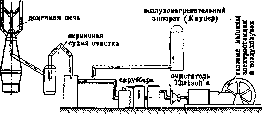
Diagram of the gas pipeline and blast furnace gas cleaning.
from the blown air. With special high-power blowing machines, a huge amount of air is blown into the blast furnaces through special devices (tuyeres), preheated in special apparatuses called "cowpers" (see figure) up to 800°. Smelting in a blast furnace is a reduction process. The iron reducers are solid carbon and its gaseous monoxide, and the process itself proceeds according to the following main reactions: 1) Fe2O3 + 3CO = 2Fe + 3CO2; 2) Fe3O4 + 4CO = 3Fe + 4CO2; 3) Fe2O3 + 3C = 2Fe + 3CO; 4) Fe3O4 + 4C = 3Fe + 4CO. As molten pig iron and slag are formed, they are discharged in the form of large fiery jets by punching a special opening ("notch") present in the furnace, wherein the pig iron is either poured on the ground into specially prepared earthen or cast-iron molds, where upon solidification it takes the form of bars, or poured into iron ladles in which it is transported to the steelmaking departments, while the slag is discharged into pools with water, where it is granulated and extracted already in the form of a coarse-grained mass. As a result of blast-furnace smelting, various grades of pig iron and very valuable by-products—slag and gases—are obtained. The blast-furnace gas, which is formed in huge quantities (during the smelting of 1 t of pig iron, an average of 4,600 m3 of gas is obtained), consisting of CO2 + CO + H2 + N, due to the content of 26-30% CO, is a very good fuel (850 - 1,100 cal. per m3) and is used to heat cowpers, operate gas blowers, and numerous units and installations to which it is supplied through huge gas pipelines spread in a dense network at modern metallurgical plants. Preliminarily, it is subjected to purification from blast-furnace dust containing a significant amount of Fe, Mn, Zn, Pb, chloride and cyanide compounds, in special devices—dry and wet gas cleaners. Iron and steel are obtained from pig iron by the Bessemer and open-hearth processes. These methods are named after their inventors. The preparation of steel by the Bessemer method comes down to the following. In a large iron pear-shaped vessel ("converter") lined on the inside with a refractory siliceous material, which is preliminarily strongly heated, molten pig iron is poured, which is brought from the blast furnace in ladles. By means of powerful blowing machines, air is supplied into the converter from below under high pressure, which is blown through all the molten pig iron. The air blown into casco gives up all its O2 to the metal; combustion of impurities of silicon, manganese, carbon, and partly iron takes place; the heat released during this, especially due to the combustion of Si, is so significant that the metal is in a molten state all the time. On average, 18-20 minutes are enough for the pig iron poured into the converter to turn into carbon-free cast iron. Thus, every 18-20 minutes, 15-20 tons of iron are obtained from each converter, cast into molds and usually sent directly to rail-rolling shops for the manufacture of rails from it. The Bessemer process in the converter proceeds rather turbulently and is accompanied by the noise of gases bursting out of the converter, the gurgling of metal, and a loud hum of blown air. At the same time, this process is characterized by the formation of a huge bright flame, which, with the increase of CO in the converter, becomes blindingly white; the ejection of huge cascades of fiery sparks and, at the end, large clouds of smoke forming characteristic brown clouds, by which the Bessemer shops can be guessed from afar. In open-hearth steel production, pig iron and iron scrap are loaded into special-design flame gas furnaces in which the temperature is brought to 1,700°-1,800°. Such a high temperature is achieved by burning producer gas (CO + CO2 + CH4 + H2 + N), which is obtained by burning solid fuel with insufficient air access in special apparatuses called "gas generators," or, which is much rarer, by burning finely sprayed oil. The producer gas and air supplied through a pipeline network, which enter the open-hearth furnace separately through wide openings located above the ends of the hearth, are passed preliminarily through regenerators—special heating chambers located under the furnace. Thus, the open-hearth furnace itself has a "working space"—the melting place, regenerators (usually 4—2 for gas, 2 for air), flues for gases, and reversing valves to control the movement of these gases. With well-developed gasification at metallurgical plants with a complete cycle, blast-furnace gas mixed with coke-oven gas serves as fuel for open-hearth furnaces. In the front wall of the furnace, there are several "windows" closed by movable doors; through these "windows", the materials for melting are charged; in each door, there is a viewing window to observe the progress of melting. From the opposite side, the furnace has a special opening through which the finished steel is discharged each time by punching it, which flows as a molten mass along a trough into casting ladles, from which it is distributed into "molds" (metal vessels of various shapes). Rolling production embraces a whole complex of works aimed at giving metals such sizes and profiles that make them most suitable both for the direct manufacture of finished products (rails, pipes) and for mechanical engineering and the construction of metal structures. The equipment of rolling shops falls into two main departments. The first—the preparatory department—consists of various systems of heating furnaces belonging to the category of "flame" or "reverberatory" furnaces, heated either by producer gas or solid fuel, in which the metal is heated to the required, usually very high temperature. The second department—the rolling department proper—consists of rolling mills, which in their simplest form represent a structure composed of two round rolls of different lengths and diameters, lying with their ends—"necks"—on two standing frames. The rolling process in its simplest form consists in the fact that the red-hot metal—the "billet"—is introduced between two rolls rotating in opposite directions, which during their movement catch the billet and drag it forward. At the same time, the metal, under the influence of strong pressure, significantly changes both shape and dimensions. On special, extremely complex mills—Mannesmann, Stiefel (inventors)—pipes intended for especially critical structures are rolled. These types of pipes are known as "seamless," since they are not welded or riveted from thick iron plates, but are extruded from a solid billet by pushing a solid refractory rod through it. There is also "cold" rolling, when metals are rolled without preliminary heating. This type of rolling has extremely limited application in ferrous metallurgy, and is used mainly in the rolling of soft non-ferrous metals: tin, lead, brass bronze, silver, gold. Non-ferrous metallurgy is engaged in the extraction of copper, lead, zinc, tin, aluminum, and other non-ferrous metals. The method of their extraction has much in common with the extraction of pig iron, iron, and steel, while at the same time presenting a great deal of difference. Non-ferrous metals are extracted mainly from ores, which are usually in combination with sulfur and other elements. Sometimes native metals are found in the form of veins containing pure metal. The most important of the non-ferrous metals is copper. The extraction of copper from ore is very similar to the extraction of pig iron and is carried out in shaft furnaces—a kind of small blast furnace. The process here is also reduction. As a result of smelting, blister copper is obtained, which turns into red copper only after refining by the oxidation or electrolysis method. Lead is also extracted in shaft furnaces, where the temperature is relatively low—550-600°. The resulting metal is also subjected to special purification, after which pure lead is obtained. Zinc is obtained by preliminary roasting of the ore to convert it into zinc oxide. The roasted ore, mixed with coal, is heated to 1,500°, due to which zinc turns into vapors, which are captured and sent to refrigerators with a temperature down to 500°, whence the metal in liquid form is poured into special molds. The metal is remelted once more to free it from lead, which, however, remains in it in the amount of 1%. To obtain tin, the ore is crushed and cleaned by washing before being loaded into the shaft furnace; then it is subjected to roasting to remove arsenic impurities. After smelting in a shaft furnace, the metal is remelted to free it from impurities of lead, iron, copper, zinc, bismuth, and nickel. Meteorological factor.
Melting and heating furnaces, molten and incandescent metals represent powerful sources of thermal and radiant energy generation, which is a typical occupational hazard among metallurgical workers (Table 1). These tasks are performed in front of furnaces whose covers have been removed or significantly raised; during the pouring of molten metal with the help of heavy metal tools: prickers, scrapers, crowbars, etc., requiring the application of very great efforts, leading to large energy expenditures associated with significantly increased heat production of the organism. It is also evident from this table that in the listed shops the temperature has a "zonal" character and that the difference in temperature of the tables. Average indicators of t°, intensity of radiant energy in the zones. Name of the shop, Name of the unit and work performed, Condition of the unit, Name of the profession, Distance from the heat-generation source in meters, Average indicators of t° by protected thermometer in winter and summer, radiant energy in small calories in winter and summer... [omitting tabular debris for flow] From Table 1 it is evident that work in the main professions of blast furnace, open-hearth, Bessemer, and rolling shops is characterized by the constant presence of high t°, combined with simultaneous very intense irradiation of workers with radiant energy. At the same time, the very performance of work here is associated with a significantly increased muscular tension, which is especially pronounced in such works as punching the taphole for casting iron from blast furnaces, punching the outlet for casting steel from open-hearth furnaces, cleaning pits and dressing the hearth in these furnaces, tilting and removing ingots from heating furnaces, rolling shops, etc. All the different zones of one and the same shop are often contrasting, which is especially observed in the cold season. This is explained by a number of factors. Buildings, mainly for production reasons, remain insufficiently closed, leaving large spaces for the penetration of outside air both from the walls and from the roof, while at the same time having no heating devices. The heating of air from production sources of heat generation usually reaches a distance of up to 8 m, whereas the dimensions of the shops significantly exceed this figure; consequently, the shop as a whole remains in many zones, including places where workers are during pauses in work, completely unheated. The performance of work in the mentioned shops usually requires such a working posture in which some one side or one part of the body is exposed to radiation; the rest of the body at the same time is under the influence of a significantly lower temperature. Photo-chronometric observations have established that the work of the leading professions in the named shops is characterized by extremely short separate operations, measured by a small number of minutes, followed by pauses of the same duration. However, since in their sum these operations occupy sufficient duration over the course of the working day, estimated by many hours, the combination of the above factors results in a sharp violation of the thermal equilibrium of the organism, a strong increase in the duration of restitution, and at the same time favors the development of "cold" diseases. Harmful gases. Modern technology allows metallurgical plants to use gasified fuel, which is rapidly and widely introduced due to the great economic advantage it has compared to solid fuel. Gaseous fuel is obtained in huge quantities, first of all as a by-product in the process of blast furnace smelting of iron. Then, in all cases where coke ovens are located relatively close to the plant, the latter uses coke oven gas, which in its calorific value several times exceeds blast furnace gas. In very many cases, gas obtained from solid fuel in gas generators is burned in furnaces (open-hearth, rolling). Gaseous fuels are supplied to numerous and diverse units scattered over the huge territory of the plant through iron gas pipelines that stretch in different directions for several kilometers. Along the way, blast furnace gas passes through a series of special devices where it is subjected to purification from solid suspended particles. Reserves of gasified fuel are collected and stored in special gas holder devices. As a consequence, the aforementioned gases may be encountered on the territory of the plant, each consisting by composition of a mixture of a number of gaseous products (CO, CO2, CH4, H2, N). This circumstance can cause the presence in plants of many zones polluted by the admixture of CO to the air surrounding the workers (Table 2). Cases of poisoning occur in various forms: mild and moderate, entailing a short-term loss of working capacity, expressed mostly in several hours, and severe, accompanied by the development of specific forms of diseases and long-term loss of working capacity. In first place by the number of CO poisonings are blast furnace shops, characterized by the multiplicity of works, the performance of which is always associated with a high probability of the entry of blast furnace gas into the atmosphere of the working zone. Such works include: servicing the top platform with manual charging of the charge into the furnace; servicing gas pipelines, especially their periodic cleaning from accumulating and caked large masses of blast furnace dust; servicing Cowper apparatuses, where the heating of colossal quantities of air blown into the furnace is produced by means of a vast amount of hot blast furnace gas; repair of furnaces, Cowper apparatuses, gas pipelines, gas purification, etc. Following the blast furnaces are power shops, where poisonings are caused by the leakage of blast furnace gas, utilized here as fuel for steam boilers and gas engines, through seams and other leaks in the mentioned units. Cases of occupational poisoning here are noted among the personnel servicing boiler facilities and blowing machines. In open-hearth shops, a significantly smaller number of cases of occupational poisoning is noted. This is explained by the preferential use of producer gas here, the resinous formations of which contribute to clogging the leaks present in brick masonry, and at the same time the network of gas pipelines here is very small. Occupational poisoning here is noted among workers servicing charging apparatuses and stoking holes at gas generators, especially old systems, poorly mechanized (Siemens); when working on reversing valves regulating the direction of gas and air; at regenerators in cases of increased gas pressure in them, etc. Very few cases are observed in rolling shops, where along with gaseous fuel in "flame" and "reverberatory" furnaces, solid fuel is often used.
Here, air pollution occurs during the breaking up of furnaces and in cases of increased pressure in furnaces, when clouds of smoke and gases burst out along with tongues of flame. The burned coal and coke, as well as the melted ores, always contain certain impurities of sulfur. This causes the potential appearance of SO2 impurities in the air, which is frequently encountered in work zones, though usually not exceeding the permissible limits of 0.04 mg per 1 liter. The granulation of hot slag in the water of granulation basins is accompanied by the formation and violent release of large amounts of vapor, along with which H2S enters the air in certain areas of the blast furnace shops. The characteristic hydrogen sulfide smell is often felt at a considerable distance from the blast furnaces, especially with the appropriate wind direction. However, the concentration of H2S usually does not reach levels that cause acute poisoning in humans. Chronic exposure of metallurgical industry workers to sulfur dioxide (SO2) and hydrogen sulfide (H2S) undoubtedly takes place. Dust factor. In addition to gaseous products, the air in the areas and shops of metallurgical plants is polluted by an admixture of mineral and metal dust particles of various compositions and sizes. Table 3. Air dustiness in metallurgical shops. Name of shop Work zones Amount of dust (in mg) per 1 m3 of air: Trestles, coke car loading zone 120–180; Trestles 830–3,830; Trestles 180–250; Foundry yard area 110–160; Blast furnace: Area of the hatch during the transfer of materials from cars to buckets located in the tunnel 102–280, Passages between blast furnaces 150–480, At platforms near hatches where accumulated gas escapes 535–1,970; Open-hearth: Working platform of furnace 12–48, Foundry yard, ditch area 18–23, Gas generator platform 14–30, Dolomite department 98–145; Rolling: At finishing mills 12–32, At roughing mills 8–27, At platforms of operators 3–24, Area of hot cutting by saw 24–29. The loading of the charge into the blast furnace is accompanied by the generation of large amounts of dust resulting from the grinding of small particles of ore, coke, and fluxes during their unloading from cars, loading into cars, buckets, skips, etc. Blast furnace gas, leaving the top, carries away a lot of dust consisting of a mixture ranging from relatively large to the smallest particles, which, having passed through devices using gas, are carried away along with smoke into chimneys. As a result, a lot of dust is formed in the blast furnace shop. In open-hearth shops, dust is produced as a result of the pulverization of coal during its unloading into gas generators; the breaking and grinding of small pieces of scrap iron, limestone, etc., loaded into the furnace; the breaking and crushing of refractory materials used to line the ditch after each steel tapping; a particularly large amount of dust (continuous streams) is formed in the dolomite grinding departments, which for technical reasons is thrown into the furnace after each melt. Large masses of air entering under high pressure during the blowing of converters into molten pig iron atomize it into small particles. Along with the abundance of gases bursting from the converter, numerous metal droplets are carried away, forming a dazzlingly bright fireworks display of sparks breaking up in the form of small stars that gradually fade and cool. These small metal particles form the main content of large dust accumulations in Bessemer shops; to this are added impurities from crushed particles of refractory materials used for lining converters. In rolling shops, dust is produced predominantly due to flying microscopic metal particles—"scale"—during the rolling of red-hot metal by rolls. Various impurities in the form of crushed coal, refractory materials, etc., may be added to the scale. Noise. In blast furnace shops, noise is generated by air blown under high pressure through iron pipes, and by various knocks from unloaded and loaded charge materials. Approximately the same, but less intensely expressed causes, to which the movement of cranes and charging machines is added, cause noise in open-hearth shops. The blowing of large masses of air under very high pressure into converters, combined with the turbulent gurgling of liquid metal in them, creates a specific noise in Bessemer shops in the form of strong buzzing and roaring. But noise is most strongly and particularly characteristically expressed in rolling shops. Iron rolls of various sizes, continuously rotating at high speed on numerous mills installed in the shops, systematically catch red-hot iron billets and strips of various sizes fed to them, pressing and pushing them through themselves. This movement is accompanied by loud cracks resembling gunshots, which, together with the roar from rotating rolls, the clatter of falling strips and sheets, and the piercing buzzing screech of the mechanical sawing of red-hot metal, creates a noise in the shop that reaches a very high pitch and persists in the shop almost continuously throughout the working day. Traumatism. Serving furnaces in which temperatures of the order of 1,000° and higher develop; the release and pouring of fiery streams of molten metal; complex manipulation of pieces of red-hot iron of various sizes and shapes; loading and transporting combustible metals and heavy, cold metal with sharp cutting edges; loading bulk, lumpy, heavy masses of charge raw materials—all this requires constant, intense attention, special vigilance, and precision from the worker and creates a constant risk of injury. Therefore, in terms of the number of injuries, the metallurgical industry occupies one of the first places, yielding only to the coal industry (see Traumatism). According to the number of injuries occurring, the shops of the metallurgical industry are arranged in a descending curve sequentially from blast furnaces to open-hearth, rolling, and Bessemer shops. This fact is only partly due to the gradual relative decrease in the number of workers employed in these shops; mainly, however, the successive decrease in the hazard coefficient for traumatism in them is determined by the changing intensity of the above-mentioned factors generating industrial injuries in metallurgy, which is not the same in all shops. In blast furnace shops, where this intensity is most strongly expressed, such serious additional factors as the formation of explosive mixtures in cases of air suction into the gas sphere or in cases of hot pig iron getting into water, and the sudden ignition of gas in cases of careless handling in the presence of fire, may still occur; therefore, blast furnace shops occupy first place in terms of the degree of danger regarding industrial injuries. In the general morbidity of metallurgists, industrial trauma accounts for over 40%. Morbidity. In the metallurgical industry, where heavy muscular labor prevails and where work simultaneously requires increased attention, the factor of natural occupational selection is expressed extremely vividly. The workers as a mass represent, by all indicators, people of strong build and health. Nevertheless, the complex of occupational hazards caused by the technology of production processes in metallurgy, as a result of more or less prolonged exposure, leads to a number of pathological changes in the body and diseases. Thus, as a result of wear and tear, an increased percentage of cardiovascular disorders is noted. As for the respiratory organs, diseases of the upper respiratory tract with a predominance of hypertrophic forms and frequent emphysematous changes in the lungs are noted, which can be partly considered as a compensatory adaptation of the body to heavy and hot work. Alteration of salt metabolism due to heavy sweating and consumption of large amounts of water can cause gastrointestinal disorders, most often in the form of gastritis. A group of surgical diseases is noted, the origin of which may be associated with muscular overstrain: lumbago, expansion of the inguinal rings, inguinal hernias. Varicose veins of the lower extremities and flat feet are also observed. As a result of exposure to radiant heat, skin diseases are noted in the form of erythemas, most often erythema caloricum, which usually develops on the face (nose, cheeks, chin). Health-improving measures. 1. Mechanization of labor processes through the introduction of hoisting machines and mechanisms. Since these measures significantly reduce the duration of individual operations accompanied by high temperatures or the release of harmful gases and dust, they thereby reduce the duration of the negative impact of these ingredients. In a number of cases, when the health-harmful process can be completely mechanized, such as, for example, charging the charge at the top of the blast furnace using a skip hoist and charging apparatus, human participation is completely excluded. 2. Replacement of manual labor in servicing units by machinery.
This is especially important in operations where heavy muscular labor is combined with the simultaneous impact of temperature and the danger of injury or poisoning: e.g., plugging and unplugging the slag and iron notches in blast furnaces; casting pig iron discharged from the blast furnace into molds; punching the taphole in an open-hearth furnace to tap steel; charging the charge into an open-hearth furnace. 3. Protection against the effects of radiant energy. Installation of water cooling systems, e.g., for the frames and doors of open-hearth furnaces, for the furnace doors of rolling mills; installation of asbestos shields on the front wall of furnaces; installation of water curtains in front of the converter throat in the Bessemer process. 4. Facilitation of heat transfer and restitution processes. Installation of stationary or movable ventilation systems blowing air over workers in hot work zones using a system of pipes or propellers. 5. Elimination of air pollution in workshops by harmful impurities. Installation of gas-removal ventilation systems, e.g., exhaust ventilation at welding furnaces; installation of a steam-air counter-blast to prevent gas penetration through leaks, e.g., at the stoking holes of gas generators; around the bells on a blast furnace; installation of dust-extraction ventilation, e.g., in the grinding departments of dolomite workshops. 6. Rational organization and physiological rationalization of labor. Ensuring a correct work and rest regime; rational allocation of people to workplaces; uniform distribution of loads among workers; ensuring proper movement of material and human flows through the workshop, which does not create bottlenecks for work and conditions for industrial injuries due to oncoming and intersecting flows. 7. Rational arrangement of units. Such overlapping or grouping of units that aggravates the action of harmful factors must not be allowed; e.g., close adjacency of welding furnaces to rolling mills, arranging them one directly in front of the other at very close distances; small distances between blast furnaces, between converters should not be allowed; surface, and especially underground gas pipelines instead of elevated ones, must certainly not be allowed. 8. Rational individual devices, e.g., protective goggles for hot work must be selected with correct centering, appropriate color, and frame; protective special clothing must be selected differentially depending on the nature of the work and the labor environment. 9. Rational sanitary and domestic installations and sanitary-technical equipment, e.g., provision of washbasins, showers supplied with hot and cold water; arrangement of special recreation areas in hot workshops equipped with water-cooling devices; the drinking solution proposed by the Central Institute of Occupational Safety; centralized supply of hot workshops with boiled, cooled, carbonated water with a small salt solution (0.75% solution). 10. Vocational selection. 11. Gas rescue stations equipped with gas masks, e.g., 'Dega', inhalers, and artificial respiration apparatus, e.g., 'In-habad'. The main function of the stations is working in gas-hazardous places using trained station personnel equipped with gas masks. In addition, they also provide assistance to the poisoned when necessary. 12. Labor protection legislation providing for a shortened workday, additional leave, increased social insurance pensions for many professions engaged in metallurgy; the labor of women and adolescents is not permitted in many operations. - Professional hazards of non-ferrous metallurgy: in the smelting and processing of copper (see), nickel (see), lead (see), and zinc (see Foundry fever).
Related articles
Mentioned in
Cite this page
“Metallurgy.” Soviet Medical Encyclopedia. English translation of Bolshaya Meditsinskaya Entsiklopediya, 1st ed. (Moscow, 1928–1936), ed. N. A. Semashko. https://sovietmedicalencyclopedia.pages.dev/article/metallurgy/