Articulator
Historical document, translated for reference. It reflects medical knowledge of the 1920s–30s and is not medical advice.
Summary
This article from the 1928–1936 Soviet Medical Encyclopedia describes the development and function of dental articulators, devices used to simulate jaw movements for the precise fitting of dentures and bridges. It traces the evolution of these instruments from simple hinged models to more complex systems designed to replicate individual mandibular movements.
Encyclopedia article (1928–1936)
ARTICULATOR (from Latin articulus—joint), a device used to set artificial teeth in bridge and removable dentures. An articulator is usually made of copper. Its main parts are: a wire arch or plate, to which the plaster model of the upper jaw is attached during work, and a plate shaped and sized like the lower jaw bone; the model of the patient's lower jaw is attached to it. Both plates are connected to each other by a joint that allows for movement. At the present time, there are
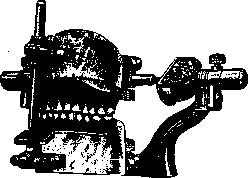
Articulator of the Schroder-Rumpel system.
more than 100 different models of articulators, which is explained by the fact that, as the movements of the lower jaw are studied, the joint of the plates is given various designs with the goal of making it possible to produce with the plaster casts of the jaws the very same movements that a given person makes. In old articulators, both plates were connected by a wire axis, which made it possible for the device to reproduce only the closing and opening of the teeth. Bonville gave the articulator the ability to make forward and lateral movements. Grittmann built an articulator sufficiently satisfactory for bridge work, reproducing approximately the statically average movements of the articular head of the lower jaw in the joint; the Gysi-simplex articulator reproduces these movements more accurately. However, none of the named devices reproduces natural individual movements, which is why they cannot be considered entirely satisfactory. The human jaw, during its movements, continuously changes the position of the imaginary vertical and horizontal axes of its movement, which is why there has been a striving to build articulators without a fixed axis. The large Gysi articulator belongs to such articulators. When using this device, a drawing of the path that the articular heads of the lower jaw make when opening the mouth is obtained beforehand, and with the help of special attachments, the articulator is forced to reproduce these movements. A more perfect device was built by Schroder and Rumpel, and later by Rumpel alone. Recently, an articulator has been built which, with the help of a drive (an electric dental drill), produces chewing movements, which is used for more precise fitting of the chewing surfaces of the upper and lower teeth; the patient is thereby spared the unpleasant and lengthy procedure of grinding in the mouth.
Related articles
Mentioned in
Cite this page
“Articulator.” Soviet Medical Encyclopedia. English translation of Bolshaya Meditsinskaya Entsiklopediya, 1st ed. (Moscow, 1928–1936), ed. N. A. Semashko. https://sovietmedicalencyclopedia.pages.dev/article/articulator/