Razor
Historical document, translated for reference. It reflects medical knowledge of the 1920s–30s and is not medical advice.
Summary
The article describes various types of razors used in medicine and personal grooming, including folding razors, safety razors, and specialized microtome blades, along with their maintenance and the best manufacturers according to 1930s standards.
Encyclopedia entry (1928–1936)
Razor, a cutting tool, the type, form, and size of which depend on its purpose. For shaving hair, a folding razor with a blade sharpened equally concave on both sides (see Figure 1 A) is used, or else a safety American razor gconsisting of a special attachment that screws onto a round handle, into which a thin, double-edged plate is inserted. In skin transplantation operations according to Tiersch, a B. is used, the blade of which is flat-ground on one side (see Figure 1 B). The same type of razor is also used in microscopic technique when a microtome is not available. Massive microtome razors: large Weir

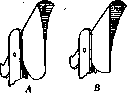
Figure 1.
german (Weigert), similarly sharpened as the previous one (see Figure 2), and short ones for freezing microtomes. The blade of the B. is honed on a whetstone, followed by finishing

Figure 2.
Figure 3. on a leather strap, which requires skill and a special technique when turning the razor, which is done through the edge opposite the tip (see Figure 3). The best razors are considered to be Swedish, safety-American, and microtome-German.
Related articles
Mentioned in
Cite this page
“Razor.” Soviet Medical Encyclopedia. English translation of Bolshaya Meditsinskaya Entsiklopediya, 1st ed. (Moscow, 1928–1936), ed. N. A. Semashko. https://sovietmedicalencyclopedia.pages.dev/article/razor/