Hemometers
Historical document, translated for reference. It reflects medical knowledge of the 1920s–30s and is not medical advice.
Summary
Hemometers are instruments for measuring the amount of hemoglobin in blood. This article describes various types of hemometers used in the 1930s, including colorimetric devices like the Sahli and Burker hemometers, and more complex instruments like the Fleischl-Miescher hemometer.
Encyclopedia article (1928–1936)
HEMOMETERS, or hemoglobinometers, instruments for measuring the amount of Hb in blood. Most H. determine Hb colorimetrically, comparing the color of the blood being examined with the color of some standard, although there are H. constructed on a completely different principle—for example, Hüfner's spectrophotometer or Gartner's hemophotograph, which determines the amount of Hb by the degree of blackening of photographic paper from light that has passed through a certain layer of the blood solution being examined. Plesch proposed determining Hb objectively, by causing light that has passed through a layer of blood to fall on a selenium cell included in the circuit of a mirror galvanometer, which changes its electrical conductivity depending on the intensity of illumination. The deviations of the galvanometer are an indicator of the degree of light absorption by the blood and, consequently, the content of Hb in it. At present, colorimetric H. are most used in practice. Sanli—a modification of Gowers' apparatus, and Miescher's H.—an improved Fleischl's H. - The Sanli hemometer consists of a small graduated test tube (see Figure 1). Before examination, a small amount of decinormal hydrochloric acid solution is poured into it, then 20 cubic mm of the blood being examined is added to it: the hydrochloric acid converts its Hb into hematine. After waiting a minute, the blood in the test tube is diluted with water until its color matches the attached standard containing a standard hematine solution. The level of liquid in the test tube will show the Hb content in the blood, with the normal content being taken as 100% in this hemometer. The Sanli H. is convenient for its speed of determination; the counting error is 1.5%. Burker proved spectrophotometrically that the standard hematine solution remains unchanged, at least for 8 months. Burker's H. (see Figure 2) is constructed on the type of Duboscq's colorimeter (see) and has the additional advantage that, along with two vessels containing colored solutions (standard and blood solution), it has two vessels for solvents. On each side, the rays successively pass through the colored medium and through the solvent. With good reagents and proper coloring, the amount of hemoglobin can be determined in absolute figures with an accuracy of tenths of a percent. Fleischl-Miescher's H. (allowing determination of the amount of Hb in absolute %) is more complex in construction and requires more time for determination, but in return gives more accurate figures. It consists of a small chamber, 15 or 12 mm high, divided by a vertical partition into two halves; one half is filled with blood diluted with a special mixer 200, 300, or 400 times with a 0.1% soda solution, the other—simply with water. Further, the chamber is closed with a glass cover and transferred to the hemometer table, right over the hole in it. Under this hole is placed a movable wedge of ruby glass (see Figures 3 and 4). The chamber with the blood solution is positioned so that only the half filled with water comes over the ruby wedge. Then, to the observer looking from above, both halves of the chamber appear colored: one with the blood solution, the other with the ruby glass. By moving the wedge, an equal color of both halves of the chamber is achieved. The colors should be compared under artificial lighting, because daylight gives different, incomparable shades of color. The determination should be carried out as quickly as possible to avoid eye fatigue. The position of the wedge is noted on the H. scale, and further calculation is done using the table attached to each H. The table gives the Hb content per volume of blood; with its help, the absolute percentage of hemoglobin in the patient's blood can be determined by simple calculations. In a normal person, this % is 14. For control, the determination can be repeated with a different dilution of blood and in a chamber of a different height. Fleischl-Miescher's H. is one of the best instruments for comparative determinations of Hb. According to Müller (Franz Müller), the counting error does not exceed 0.48%.
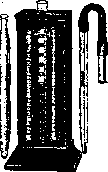
Figure 1. Sahli hemometer.
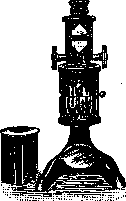
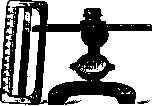
so that over the ruby wedge comes only the half filled with water. Then, to the observer looking from above, both halves of the chamber appear colored: one with the blood solution, the other with ruby glass. By moving the wedge, an equal color of both halves of the chamber is achieved. The colors should be compared under artificial lighting, because daylight gives different, incomparable shades of color. The determination should be carried out as quickly as possible to avoid eye fatigue. The position of the wedge is noted on the H. scale, and further calculation is done using the table attached to each H. The table gives the Hb content per volume of blood; with its help, the absolute percentage of hemoglobin in the patient's blood can be determined by simple calculations. In a normal person, this % is 14. For control, the determination can be repeated with a different dilution of blood and in a chamber of a different height. Fleischl-Miescher's H. is one of the best instruments for comparative determinations of Hb. According to Müller (Franz Müller), the counting error does not exceed 0.48%.
Figure 3. Fleischl hemometer. Figure 4 Fleischl hemometer.
Related articles
Mentioned in
Cite this page
“Hemometers.” Soviet Medical Encyclopedia. English translation of Bolshaya Meditsinskaya Entsiklopediya, 1st ed. (Moscow, 1928–1936), ed. N. A. Semashko. https://sovietmedicalencyclopedia.pages.dev/article/hemometers/