Demucosation
Historical document, translated for reference. It reflects medical knowledge of the 1920s–30s and is not medical advice.
Summary
Demucosation is a surgical technique for removing the mucous membrane from an excluded intestinal segment, proposed by Sapozhkov as an alternative to extirpation. The procedure involves stripping the mucosa from the muscular layer by blunt dissection and is described as painless and requiring no anesthesia.
Encyclopedia article (1928–1936)
Demucosation (from Latin de- negative particle, and mucosa - mucous membrane), removal of the mucous membrane for the obliteration of an excluded part of the intestine instead of the severe operation of extirpation. Demucosatio intestini - removal of the mucous membrane from a unilaterally or bilaterally excluded intestine, an operation proposed by Sapozhkov. - Technique of the Operation. In bilateral exclusion of the intestine, if both ends of the excluded intestine are sutured into the skin, one first proceeds to isolate the mucosa from one end of the intestine. To this end, with the help of a knife or scissors and forceps, the mucosa is separated from the underlying tissues along the entire circumference of the end of the intestine, and an attempt is made to form a cuff from the mucosa, completely analogous to how this is done during the Whitehead operation for hemorrhoids (see Figure 1). After the formation of the cuff, clamps are applied to the free edges of the latter, and further release of the mucosa is performed by simple pulling on the clamps and pushing back the muscular layer by blunt dissection. As soon as the elongated cylinder of the mucous membrane reaches a sufficient length, the clamps are removed, and the lumen of the cylinder, to avoid infection by the contents of the intestine, is closed, for which the free end of the cylinder is simply tied with a thread (see Figure 2). Following this, one proceeds in exactly the same way to release the mucosa from the other end of the excluded intestine; and here, upon release of a cylinder of mucosa of a known length, the free end of the cylinder should be tied with a thread. After the mucosa has been released for a certain distance from both ends of the excluded intestine, one proceeds to the further, already complete extraction of the mucosa from the entire excluded segment of the intestine. To do this, one simply begins to pull with the left hand with moderate force on any of the already released ends of the mucosa, while helping the easier extraction of the mucosa with an elevator or the finger of the right hand, with which the adjacent muscular layer of the intestine is pushed back by blunt dissection (see Figure 3). This extraction is performed very easily - the muscular layer of the intestinal wall, at this, as it were, peels off from the extracted mucosa. Those strands that stretch to the latter from the muscularis (vessels and nerves) are simply torn, and the torn vessels almost do not bleed and do not require ligatures. Upon extraction of the entire mucosa, the seromuscular sheath remaining in the abdominal cavity does not require drainage, as it immediately collapses. During the traction of the mucosa itself, one must pay attention to ensure that the peeling of the mucosa occurs exactly at the boundary between the mucous and muscular membranes and that the latter (i.e., the muscular membrane) is not torn anywhere and does not subsequently begin to be extracted together with the mucosa. In unilateral exclusion, the mucosa is extracted without reaching 3-4 cm to the anastomosis; its excess is excised, and the remainder is invagi-
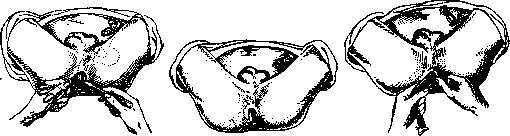
Figure 1.
Figure 2.
Figure 3.
-nated into the lumen of the intestine in the direction of the anastomosis with the help of a muco-mucosal purse-string suture, applied according to the type of sero-serosal suture by Lembert. Demucosation is indicated only in the presence of a completely normal mucous membrane in the excluded intestine. The length of the extracted mucosal cylinders can be very significant (several meters). Usually, the mucosal cylinder is 2 1/2-3 times longer than the remaining seromuscular sheath. The entire operation is performed without any anesthesia: it is completely painless. One does not have to fear bleeding: the vessels, tearing in the thinnest place (in the mucosa), are immediately thrombosed; besides this, bleeding, if it does occur, happens into a small closed cavity: the seromuscular layer, under the influence of the torn nerves, immediately contracts until the complete destruction of its lumen.
Related articles
Mentioned in
Cite this page
“Demucosation.” Soviet Medical Encyclopedia. English translation of Bolshaya Meditsinskaya Entsiklopediya, 1st ed. (Moscow, 1928–1936), ed. N. A. Semashko. https://sovietmedicalencyclopedia.pages.dev/article/demucosation/