Exhibitions
Historical document, translated for reference. It reflects medical knowledge of the 1920s–30s and is not medical advice.
Summary
This article discusses the role and history of hygienic and health protection exhibitions as a tool for public health education. It details the development of these exhibitions in Russia and abroad, highlighting their use of visual methods to promote sanitary knowledge and combat public ignorance.
Encyclopedia article (1928–1936)
Hygienic exhibitions, or health protection exhibitions, are institutions organized according to a specific plan that visually acquaint visitors with issues of health protection. The task of a hygienic exhibition is to present to visitors, in a visual and understandable form, the modern state of one or another branch of hygiene from both theoretical and practical points of view, to identify the most pressing needs in the field of health protection, and to facilitate their satisfaction by organizing public opinion around these issues. By its nature, an exhibition can be designed either only for specially trained visitors (scientific exhibition) or for broad segments of the population (popular exhibition, exhibition on sanitary education, etc.). In scale, an exhibition can be local, regional, national, or international; furthermore, hygienic sections of exhibitions are usually organized at general world exhibitions, aiming, just like national or international exhibitions, to highlight the sanitary state of various countries, their achievements in the field of sanitary culture, sanitary technology, health care organization, medical care, etc. National and international exhibitions possess the character of competitions, and in bourgeois countries—also of commercial competition. The question of the program of an exhibition, its size, character, etc., is decided in each individual case depending on local cultural, economic, sanitary, and living conditions. By their content, exhibitions are divided into single-topic and multi-topic, and by their character and sphere of action, exhibitions can be divided into permanent and temporary, stationary and mobile. Sometimes hygienic exhibitions constitute only a part of a general, non-specifically hygienic exhibition (exhibitions on local history, public education, agriculture, etc.). The first major international hygienic exhibition was the Brussels Hygienic Exhibition of 1876. In the 19th century, in addition, one should note the international hygienic exhibitions in London in 1884 and in Le Havre in 1893. In the 20th century, the largest hygienic exhibitions were: the Dresden International Hygienic Exhibition in 1911, the Amsterdam International Hygienic Exhibition in 1921, the Vienna Hygienic Exhibition in 1925, and the large exhibition on issues of hygiene, social security, and physical culture in Düsseldorf in 1926—'Gesolei'. Much attention was paid to issues of health protection at the following world exhibitions: in Paris (1878, 1889, and 1900), in Chicago (1895), St. Louis (1904), as well as at the exhibition in Wembley in 1924–25. In Russia, the beginning of hygienic exhibitions was laid by the creation of a Russian section at the Brussels International Hygienic Exhibition in 1876, in the organization of which Professor Dobroslavin took an active part. The exhibits, before being sent to Brussels, were displayed in the Solyanoy Gorodok, which served as a kind of first Russian hygienic exhibition (the collection of instruments, models, and other visual aids compiled for this exhibition according to Dobroslavin's idea was taken as a model for similar collections in France and Belgium). In 1893, the Russian Society for the Protection of Public Health organized the First All-Russian Hygienic Exhibition in St. Petersburg; this exhibition had about 50,000 exhibits and admitted about 500,000 visitors. In 1911, Russia took part in the Dresden International Hygienic Exhibition (a special Russian pavilion). The next All-Russian Exhibition on hygiene was organized only in 1913, also in St. Petersburg, with the active participation of the Pirogov Society of Physicians (in particular, with the participation of Z. G. Frenkel, A. V. Molkov, D. I. Nikolsky, and others) and local self-governments (cities and zemstvos). During its organization, the exhibits of the Russian pavilion at the Dresden Hygienic Exhibition, created under the leadership of Professor V. V. Podvysotsky, were used to a significant extent. The exhibition included the following sections: I. Hygiene of populated places. II. Housing. III. Nutrition of the population. IV. Hygiene of upbringing and education. V. Fight against infectious diseases. VI. Fight against popular ailments (infant mortality and alcoholism). VII. Hospital affairs. VIII. Public medicine. IX. Factory hygiene. X. Hygiene of transport routes and means of transportation. XI. Public charity. The exhibition was visited by about 400,000 people (of whom about 60,000 were excursionists). Popular hygienic exhibitions, exhibitions on sanitary education, and popular exhibitions on health protection play an outstanding role in the dissemination of hygienic knowledge among the population. An exhibition is one of the most important forms of sanitary-educational work, in which the visual method is used to the maximum, of course, accompanied by the descriptive method (the living and printed word); this is the difference between an exhibition and most other forms of using the visual method, when these forms play the role of 'visual aids' to talks, lectures, etc. The purpose of exhibitions on health protection is to provide a large number of people with visual training in a short time. Together with other educational means—the word, the press, slides, and cinema—exhibitions are a means of a kind of 'mass attack on popular ignorance' (Fischer-Defoy). While assigning the exhibition its due and undoubtedly important place among the forms of hygienic agitation and propaganda, one should, however, as Vogel does, warn against overestimating the importance of exhibitions. Even Lingner, the creator of the Dresden Hygienic Exhibition and the German Hygiene Museum, who was perfectly familiar with the psychology and technique of exhibition business, expresses the opinion in one of his works that it can be considered quite sufficient if an exhibition has caused a kind of hygienic shock to the public ('quasi hygienische Erschütterung'). The beginning of the organization of special exhibitions for the purposes of mass hygienic education of the population was laid by Lingner. At the exhibition of German cities in Dresden in 1903, he, together with the German Society for Public Hygiene, organized for the first time a popular exhibition 'Diseases of the population and the fight against them' ('Die Volkskrankheiten u. ihre Bekämpfung'), which in subsequent years was expanded in a number of other cities in Germany (Munich, Frankfurt, Kiel, etc.). The favorable reception given to this exhibition served as a stimulus for Lingner for further work in this field, which was expressed in the organization at the Dresden International Exhibition in 1911 of the 'Der Mensch' pavilion, which specifically pursued the goals of popularizing knowledge about human health and which is still an unsurpassed model of exhibition art in the field of health protection. The materials of the Dresden Exhibition served as the basis for the subsequent organization (in 1912) of the permanent German Hygiene Museum (see Museum), which played and continues to play even now a huge guiding role in the creation of hygienic exhibitions both in Germany and in other countries. Among other permanent exhibitions abroad (some of them are incorrectly called museums), one should point out: in Germany—the Museum of Occupational Safety ('Bayrisches Arbeiter-Museum') in Munich and the State Museum for Accident Prevention and Occupational Hygiene ('Reichsmuseum für Unfallverhütung u. Gewerbehygiene', also bearing the name 'Ständige Ausstellung für Arbeiterwohlfahrt') in Berlin; in Holland—the Museum of Occupational Hygiene ('Veiligheids Museum') in Amsterdam; in Finland—the 'Permanent Exhibition on Occupational Safety' in Helsinki. Temporary and mobile exhibitions on various issues of health protection have now become widespread in all states. In Russia, the proposal to use museum-exhibition work for the purposes of sanitary education was first made by the Pirogov Commission for the Dissemination of Hygienic Knowledge at the X Pirogov Congress in 1907. By the beginning of the imperialist war, there was data on the organization of exhibitions in a number of provinces (Moscow, Saratov, Kharkov, Yekaterinoslav, Voronezh, St. Petersburg, Vologda, Kiev, Kostroma, Vladimir, Podolsk, Vitebsk, Nizhny Novgorod, Perm, Ufa, and Samara). In addition to the organization of special hygienic exhibitions, since 1910, the organization of health protection sections at agricultural exhibitions has been practiced. At the same time, mobile exhibitions on railway transport arise in the form of exhibition cars. On the North-Western Railways in May 1912, the first exhibition car was created. In 1913, the first mobile hygienic exhibition was organized in Baku in an industrial district, which included a section on industrial hygiene and daily life. In the same year, a 'Mobile Museum-Exhibition' began to function at mining and metallurgical enterprises in the south of Russia, which developed very significant activity. The largest and methodically most perfect popular hygienic exhibition before the revolution was the 'Demonstrative Exhibition on the Fight against Popular Ailments', organized by the Pirogov Commission for the Dissemination of Hygienic Knowledge at the All-Russian Hygiene Exhibition in 1913. The list of exhibits (about 1,000) of this demonstrative exhibition published by the Commission includes an article by Ya. Yu. Kats on the organization of mobile exhibitions, based on the account of all the accumulated experience of the work of zemstvo mobile exhibitions. This work can still be considered a guiding one on this issue. Individual organizations, for example, the League for the Fight against Tuberculosis, the Society for the Fight against Infant Mortality, etc., also used exhibitions as a necessary link in the system of their educational work. It is especially worth noting the 'Permanent Exhibition on the Care of Infants and Their Feeding', which existed in Moscow at the S. V. Lepyokhin Maternity Hospital and the hospital for postpartum women named after L. I. Timister. This exhibition was also displayed at the All-Russian Hygiene Exhibition (in the pavilion of the city).
Moscow) and had huge success. Many of its exhibits served as the basis for the publication by the Pirogov Commission for the Dissemination of Hygienic Knowledge of the "Album on Infant Care." The beginning of the imperialist war almost completely destroyed the exhibitions that existed in Russia. Only after the October Revolution, in connection with the development of museum and exhibition work in the USSR, is the organization of hygienic exhibitions of various types being observed again on a large scale. Unlike Western European exhibitions, hygienic exhibitions in the USSR widely cover the socio-economic foundations of health, reveal the class essence of socio-pathological phenomena, and indicate the genuine paths for the improvement of the health of the working people. Even during the years of the Civil War, 14 health protection exhibition-wagons were created, primarily in the Red Army, where sanitary education received its greatest development; these were disbanded in 1922 after the end of military operations. In addition, a number of health protection wagons were part of various agitation trains. In 1919, A. V. Molkov formed a Demonstrative Exhibition on Health Protection in Moscow; in the same year, the Museum of Health Care was opened in Petrograd. Similar exhibitions were successively organized in other cities of the USSR, either independently or at houses of sanitary education (see). The largest exhibitions at the present time, besides Moscow and Leningrad, are in Rostov-on-Don, Krasnodar, Yaroslavl, Nizhny Novgorod, Penza, Perm, Odessa, Kiev, Tiflis, and Baku. As of January 1, 1927, there were about 80 exhibitions in the RSFSR at houses of sanitary education, about 500 permanent exhibitions at dispensaries, houses of the peasant, etc., and about 1,500 mobile exhibitions (of which about 200 were in the countryside). In connection with the development of preventive principles in medical practice, an exhibition should become a mandatory integral part of every medical-preventive institution—outpatient clinic, dispensary, prophylactorium, rest home, sanatorium, hospital, etc. Permanent exhibitions are either organized independently according to a special program or are part of a museum, separated from its collections to illuminate one issue or another for the general public. This distinction in terminology (exhibition or museum) is not always, however, maintained when naming the corresponding institutions: for example, the foreign museums listed above or, in the USSR, the Museum of Occupational Safety, the Leningrad Museum of Health Care, etc., are by their nature more exhibitions than museums. - Permanent exhibitions, independent or at houses of sanitary education, in an expanded form should include the following departments: I. Socio-economic foundations of health (with sanitary statistics). II. Man—with the following sub-departments: a) origin of man and comparative anatomy, b) embryology, c) anatomy and physiology, d) death and post-mortem phenomena. To clarify the peculiarities of the human organism in different periods of its life, a number of additional sub-departments should be connected to this department: e) women's hygiene (including the hygiene of pregnancy and childbirth), f) infant hygiene, g) hygiene of children and adolescents. In addition, questions of first aid, physical culture, sex hygiene, choice of profession, etc., can be covered in this same department, unfolding into independent sub-departments under appropriate conditions. III. Problems of collective life—with sub-departments: a) labor and health, b) nutrition, c) housing and improvement of populated areas. IV. Microbiology and infectious diseases (with disinfection). V. Social diseases and the fight against them. VI. Organization of health care—with sub-departments: a) history of medicine, b) development of Soviet medicine, c) network and activity of medical-sanitary institutions (including resort business), d) military-sanitary defense of the country, e) self-activity of the population in the field of health protection (including the activity of Red Cross societies). - The largest exhibitions in the USSR are: The Popular Exhibition on Health Protection at the State Institute of Social Hygiene of the People's Commissariat of Health (see figure 3). The exhibition was opened in July 1919 at the State Museum of Social Hygiene as a demonstrative popular exhibition, and in 1920 it was moved to a separate premise, including over 3,000 exhibits (see Museum). The Popular Exhibition includes the following departments: a) socio-economic foundations of health, b) origin of man and embryology, c) biology, anatomy and physiology, with a first aid department, d) infectious diseases, e) social diseases. In addition, there is one periodically changed department (for example, in 1926 the department of military-sanitary defense of the country, in 1927 the department of Soviet medicine, etc.). During the existence of the exhibition up to and including 1927, over 400,000 visitors passed through it, of which about 150,000 were organized (6,500 excursions). - The Scientific-Demonstrative Exhibition on the Protection of Motherhood and Infancy of the People's Commissariat of Health was founded in Moscow in August 1919 (see figure 1). The exhibition includes the following departments: women's hygiene, statistics of infant mortality, infant hygiene, diseases of infancy transmitted through insects, tuberculosis, syphilis, acute infectious diseases of children, skin diseases. Most of the exhibition's exhibits (the total number is over 1,000) are distinguished by their artistic design; some idea of their character is given by photographs of the exhibition's exhibits included in the book published by the Mother and Child Protection Department: "Exhibition on the Protection of Motherhood and Infancy." From January 1, 1925, to July 1, 1928, over 65,000 visitors passed through the exhibition. Regarding museums of occupational safety and others, see Museum. Mobile exhibitions play a large role in sanitary education, making it possible to reach significant masses of people who can almost or not at all be drawn into the sphere of sanitary-educational influence by other forms of work. A mobile exhibition should not be large or cumbersome; the number of exhibits should be limited not only due to the conditions of the premises and transportation, but, mainly, in view of the impossibility for an insufficiently prepared viewer to focus attention for a long time on things unfamiliar to him. The danger of an abundance of material must be eliminated by its careful and strict selection. At the same time, it is necessary to diversify the exhibits as much as possible, including in the exhibition, in addition to tables and diagrams, also models and object exhibits (items for child care, for the sick, items necessary for the hygienic maintenance of the body, clothing, housing, pathological-anatomical preparations, a microscope, etc.). In an expanded form, a mobile exhibition should also include a magic lantern with slides, a stereoscope, a microscope, and a mobile cinema. It is desirable to give the exhibition local interest by citing statistical materials from local life, highlighting local sanitary and everyday peculiarities, etc. For the deployment of mobile exhibitions, a warm, dry, and sufficiently spacious premise is necessary (in the countryside, one has to count on 1-2 school classrooms; mobile exhibitions are usually also deployed in clubs, reading huts, etc.). It is desirable that each department of a mobile exhibition be placed in a separate room; if one large hall is provided for a mobile exhibition, it is recommended to divide the room into separate parts by appropriate placement of boards, tables, stands, proper draping, etc., dedicating each to a separate topic, so that the viewer's attention can be focused on that topic. Material for a mobile exhibition must be adapted for easy packing and transportation. Tables should be glued to cardboard and fitted into a light frame, or in an extreme case, glued to canvas, which can be rolled onto a stick. Glazing is not recommended. For placing exhibits, it is recommended
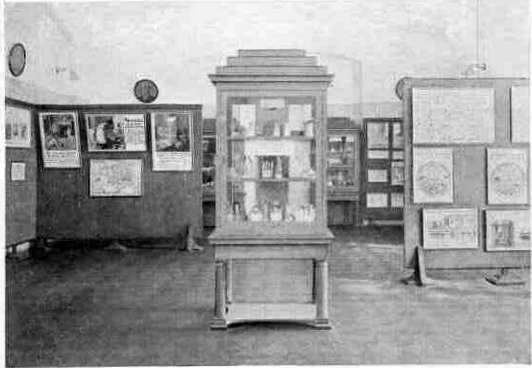
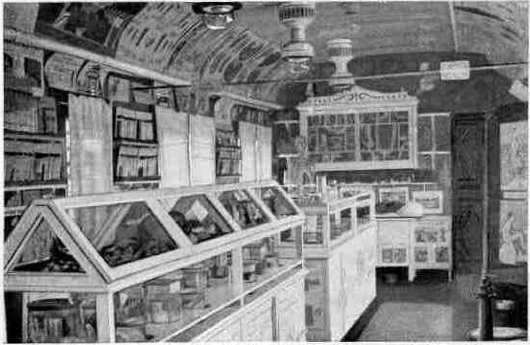
[Caption unrecoverable]
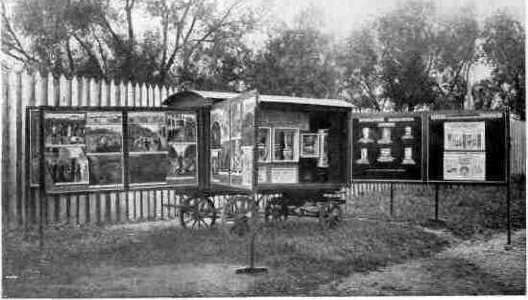
use panels made of simple uprights with crossbars, nailed on site according to the dimensions of the charts, diagrams, etc. Such panels are cheap and easily transported. One of the basic conditions for the success of a mobile Exhibition is the involvement of the Soviet public in the work of its preparation and arrangement, starting with the sections of health councils, political-educational bodies, cultural departments, and ending with the cultural commission of a club or reading hut, the labor protection commission at an enterprise, the sanitary commission in a school, the health cell in a hospital, etc. Attention should be paid to properly informing the population about the opening of an Exhibition (announcements, posters, articles in the local newspaper, dissemination of information about the Exhibition through schoolchildren, etc.). Great importance is also attached to the proper use of a mobile Exhibition (organizing explanations at the Exhibition, organizing excursions to the Exhibition and guiding them, organizing circles, lectures, and reports at the Exhibition, conducting courses, distributing sanitary-educational literature, etc.). In connection with the difficulties usually encountered when using mobile Exhibitions (transporting exhibition material, setting it up and taking it down), the search for better forms of mobile Exhibitions began long ago. In this regard, two types of adaptations are being outlined: a) folding Exhibitions in crates, b) Exhibition-railway cars and Exhibition-barges on transport, as well as vans, c) Exhibition-trams and Exhibition-automobiles. The forms of mobile Exhibitions listed in point 'b' make it possible not to spend time in each of the visited locations on setting up and taking down the Exhibition, which, according to the experience of other types of mobile Exhibitions, takes about 2 days in each location. The health protection Exhibition-railway car has received wide application almost exclusively in the USSR (see Figure 2). Instead of the 5 exhibition-railway cars that existed before the revolution, there are currently 21 Exhibition-railway cars on various railways of the USSR (total railways in the USSR - 26): of these, 16 exhibition-railway cars are in the RSFSR, 4 in Ukraine, and 1 in Transcaucasia. The type of car is almost everywhere four-axle, in some cases Pullman. At the same time, two trends are observed: one boils down to the fact that, considering the need to often use the Exhibition-railway car as an auditorium for talks and lectures, the middle of the Exhibition-railway car is left unoccupied, placing exhibits only along the walls of the Exhibition-railway car. The other consists in the desire to maximize the use of exhibition space, considering that the main task of the Exhibition-railway car is the demonstration of the Exhibition's exhibits. For this purpose, the middle of the Exhibition-railway car is also occupied by exhibits. Recently, all these parts are being made movable so that they can be moved aside if necessary and the Exhibition-railway car could be turned into an auditorium. For this purpose, Exhibition-railway cars have a number of special devices: folding benches, collapsible tables, rotating panels, etc. It should be noted that the role of Exhibition-railway cars in serving not only the transport population, but also the population of areas adjacent to the transport line, including the peasantry, which accounts for 25 to 40% of the total number of visitors to the Exhibition-railway cars. The total attendance of all exhibition-railway cars in the USSR in 1926 reached 750,000 people. The Exhibition-van for sanitary education purposes was first used in 1925 by the State Venereological Institute (see Figure 4). From 1926, the Exhibition-van also began to be used in the sanitary-educational work of the Moscow Health Department. The prototype of this form of work are mobile Exhibitions on two-wheeled carts, used in the Red Army during the Civil War, and 'sanitary-educational wagons' (sanitary agitation wagons), also used in the Red Army to serve the sanitary-educational work of the recruitment districts of territorial units. Great ease of movement and quick packability make the Exhibition-van a particularly valuable form of mobile Exhibition. Usually, a van of the design by agronomist P. P. Kukushkin is used, first exhibited by him at the agricultural exhibition in Moscow in 1923. The size of the van is 2.8x1.4x1.2 m; it has a frame construction. There are 8-10 frame-panels. Besides the frames, there are also niches for convex exhibits. The frames rotate, so that they can be set to any position. The total exhibition area of all frames is 63-78 sq. m. On the narrow sides of the van, a seat for the driver is placed in a recess, and on the opposite side, one for the Exhibition leader. Inside the Exhibition-van there are pull-out drawers (2 on each side) for a library and spare exhibits; space for a mobile cinema projector, screen, radio installation, uprights (supporting the frames), etc. The weight of the van with two occupants does not exceed 560 kg. Setting up the Exhibition-van requires no more than 5 minutes. The Exhibition can be demonstrated to 120-150 people simultaneously. Temporary Exhibitions can take the form of report Exhibitions, sanitary-educational showcases, 'health corners,' and 'health boards.' Report Exhibitions are arranged at congresses or within the walls of the institution whose activities they reflect (hospital, outpatient clinic, dispensary).
Related articles
Mentioned in
Cite this page
“Exhibitions.” Soviet Medical Encyclopedia. English translation of Bolshaya Meditsinskaya Entsiklopediya, 1st ed. (Moscow, 1928–1936), ed. N. A. Semashko. https://sovietmedicalencyclopedia.pages.dev/article/exhibitions/