Eyeglasses
Historical document, translated for reference. It reflects medical knowledge of the 1920s–30s and is not medical advice.
Summary
This article from the 1928–1936 Soviet medical encyclopedia provides a detailed historical overview of eyeglasses, explaining their optical principles, classification, and the various corrective and protective functions they serve.
Encyclopedia article (1928–1936)
Eyeglasses, simple or complex optical systems which pursue various goals, namely: 1) correction of anomalies of refraction and accommodation; 2) correction of certain defects in the function of the eye's muscular apparatus and 3) protection of the eye from mechanical damage and the harmful influence of certain types of radiant energy. - Eyeglasses for the correction of anomalies of refraction and accommodation. Depending on the position of the principal focus, eyeglass lenses or lenses are divided into two groups: converging, designated by the sign +, and diverging, designated by the sign -. For converging lenses the principal focus (counting from the light source) lies behind the lens, and for diverging lenses it lies in front of it. Consequently, parallel rays after passing through a converging lens become convergent, and through a diverging lens become divergent. Lenses of the first kind are applied for the correction of hypermetropia, and of the second kind for the correction of myopia. Depending on the distribution of refractive power along different meridians, eyeglass lenses are divided into two groups: spherical lenses, in which the refractive power is the same in all directions, and cylindrical and toric lenses, in which the refractive power of the lens is different in different directions. The refractive power, or refraction, of a lens is measured by its principal focal distance. If we denote the refractive power by D and the focal distance by F, the relationship between these two quantities will be expressed by the following formula: D = 1/F. Thus, the greater the principal focal distance, the smaller the refractive power of the lens, and vice versa. The unit for measuring the refractive power of a lens is the diopter (see). Depending on from where the principal focal distance of the lens is measured, principal and vertex refraction are distinguished. In principal refraction the focal distance is measured from the principal planes of the lens, and in vertex refraction from the surface of the lens. By the principal planes of a lens are understood two planes characterized by the fact that if an object is located in the first of them, then in the second after the refraction of rays in the lens a direct image equal in size to the object is obtained. Only in the abstract case of infinitely thin lenses do the principal planes of the lens coincide with its surfaces, and only in this case is principal refraction equal to vertex refraction. For all actually existing lenses, however, there exists a certain difference between these two quantities, the magnitude of which depends on the shape of the lens. For example, it is greater for bi-convex lenses than for bi-concave lenses, and for meniscus lenses it is greater than for lenses of other shapes. In present-day ophthalmic optics, lenses are designated by their posterior vertex refraction. According to the shape of the refracting surfaces, spherical lenses are divided into bi-form, plan-form and meniscus lenses. In bi-form lenses both surfaces of the lens are convex or concave (bi-convex and bi-concave lenses). This is the most common form of lenses with us up to the present time, although the least perfect from an optical point of view. In plan-form lenses one of the surfaces is flat, the other convex or concave, and finally in meniscus lenses one surface is convex and the other concave. If in this case the convex surface has a smaller radius of curvature than the concave one, then the lens is converging, and with the inverse ratio it is diverging. Meniscus lenses are in turn divided into two subgroups: periscopic lenses, in which the refractive power of one of the surfaces is 1.25 D, and meniscus lenses in the narrow sense of the word, in which the refractive power of one of the surfaces is 6.0 D. Spherical lenses are applied in hypermetropia, myopia and presbyopia. For the correction of astigmatism, cylindrical and toric lenses are used. - In a cylindrical lens the refractive power of the lens, in contrast to spherical lenses, is different in different meridians. In each cylindrical lens two main perpendicular meridians are distinguished: one of them is the axis of the lens, and the other is the direction perpendicular to the axis. In the direction of the axis a cylindrical lens possesses the least, and in the direction perpendicular to the axis the greatest refractive power; in intermediate meridians the refractive power takes on a series of intermediate values between these two quantities. According to the character of the surfaces, cylindrical lenses can be divided into three groups: plan-cylindrical lenses, bi-cylindrical lenses and spherocylindrical lenses. In lenses of the first kind one of the surfaces is cylindrical, the other flat; in the second group both surfaces are cylindrical, and in the third group one surface is cylindrical and the other spherical. Lenses of the first group are applied for the correction of simple astigmatism, and the second and third groups for the correction of complex and mixed astigmatism. The purpose of corrective lenses in cases of anomalies of refraction consists in transferring the image onto the retina so as to enable the eye to see clearly. Besides this useful action, eyeglass lenses possess a whole series of undesirable side properties. These include 1) influence on the size of the image on the retina, 2) change of perspective; 3) distortion of the shape of visible objects; 4) chromatic aberration and 5) oblique astigmatism. - 1. The influence of an eyeglass lens on the size of the image in the eye is explained by the fact that an eyeglass lens placed in front of the eye influences its refractive power. Therefore the refractive power of the system "eyeglass lens + eye" will be different from the refracting system of the eye itself. From optics it is known that the size of the image obtained through an optical system is in a definite dependence on the refractive power of the system. This explains the circumstance that myopes when wearing corrective lenses complain of a decrease in the size of visible objects, while hypermetropes, on the contrary, indicate an increase in their size. - 2. Change of perspective. When examining objects of the external world the eye performs a series of rotational movements, the center of which is the point of rotation of the eye. An eyeglass lens produces a certain apparent displacement of the point of rotation, owing to which the eye when wearing lenses must perform movements of a different magnitude (i.e., turn through a different angle) than is the case with the naked eye. Since we judge mainly on the magnitude of eye movements about the mutual position of objects, this creates a distorted representation of spatial relationships, i.e., distortion of perspective. In this connection, a corrected myope perceives all objects as if pushed away into the distance, and a corrected hypermetrope, on the contrary, as if brought closer. - 3. Chromatic aberration is based on the fact that rays of light of different wavelength, which make up a complex white light beam, are refracted by the lens to different degrees, which leads to the decomposition of light. In ordinary eyeglass lenses this phenomenon is expressed so weakly that when looking straight ahead through the lens it manifests itself in nothing. Only in the case when the patient looks through the peripheral parts of the eyeglass lens, then when examining dark objects on a light background, colored rims may appear around the object due to chromatic aberration. - 4. Distortion of objects is due to the fact that the magnification of objects caused by the lens does not remain the same throughout the field of view. It is expressed in the fact that any fixed line lying outside the axis of the lens, when examined through the lens, experiences a certain apparent curvature, which is of two kinds. When looking through converging lenses a square experiences a cushion-like curvature, and when looking through a diverging lens a barrel-like curvature (Fig. 1). Distortion of objects, like all other side actions of eyeglass lenses, is most sharply expressed in lenses of great refractive power, and this distortion is very distressing for the patient. For example, during the descent of a staircase, the steps seem to him not straight, but concave or convex; when passing through a door in the same position, the door jamb seems to him to be in that position. All this causes uncertainty in walking, sometimes dizziness. About these
[ch' taking strong ~G/T-\T~ | V'N.~~| eyeglass lenses, must be prevented. In the future Fig t as glasses are worn, all these phenomena usually disappear, because the patient learns to correctly evaluate visual impressions received through the glasses. 5. Astigmatism of oblique bundles is one of the optical defects of a lens that most reduces its value. When examining objects of the surrounding world, the eye often has to look not only through the central parts of the lens, but also through its more peripheral parts. With such a direction of gaze, the rays entering the eye pass through the eyeglass lens at a b. or m. significant angle to its axis. This oblique passage of rays through the lens is the cause of the astigmatism of the refracted light bundle. In the latter, rays emanating from one point of the object, after refraction, are no longer collected in one focal point, but in two focal lines separated from each other. The mutual distance between these focal lines is the measure of astigmatism of oblique bundles. Thanks to this feature, spherical lenses, firstly, acquire cylindrical properties with lateral directions of gaze, and, secondly, the difference between the refracting power of the two principal meridians of the lens changes sharply in cylindrical lenses. The degree of astigmatism of oblique bundles depends mainly on two moments: the strength of the lens and the angle at which the rays fall to the axis of the lens. The greater the angle of inclination and the stronger the lens, the greater the astigmatism of oblique bundles. In weak lenses this phenomenon is expressed only to a small extent. For example, for a lens of -14.0 D when looking through the peripheral parts of the lens, astigmatism of about 6.0 D is obtained, while for a lens of -2.0 D it is only about 0.5 D. Astigmatism of oblique bundles leads to the fact that a wearer of O. practically cannot use the peripheral parts of the eyeglass lens, because at the same time completely blurred images are obtained on the retina. Therefore, when wearing strong lenses of a patient when examining objects located not directly in front of him, but somewhat to the side, he can no longer limit himself to turning the eyes, but must turn his head. In order to avoid this inconvenience and make it possible to use the periphery of the eyeglass lens, in recent years a number of firms have released anastigmatic lenses under various names, in which this astigmatism of oblique bundles is practically completely eliminated (point lenses of the Zeiss firm, isocrystar of the Busch firm, etc.). These lenses have the shape of menisci. For aphakic eyes after lens extraction, Zeiss produces special anastigmatic catoptric lenses, calculated by Gullstrand. In those cases where it is not possible to obtain anastigmatic lenses, the astigmatism of oblique bundles can be significantly reduced by the appropriate selection of the shape of the eyeglass lenses. For this purpose, it is recommended for lenses (both + and -) in the range from 6.0 to 10.0 D to prescribe menisci, from -10.0 to -17.0 periscopic and from -17.0 to -25.0 plan-lenses. In general, it should be noted that for eyeglass lenses with a higher refracting power, the bi-form (biconvex and biconcave) is the least advantageous of all forms of eyeglass lenses, because they possess the greatest degree of astigmatism of oblique bundles and distort images more than other lenses. For lenses up to 6.0 D the shape of the lenses has no special significance in view of the fact that, I
I
reflected only very weakly. To eliminate astigmatism of oblique bundles, cylindrical lenses are prescribed instead of toric lenses. In some cases of refractive and accommodative anomalies, such as presbyopia in combination with hypermetropia, in high degrees of myopia, etc., the patient has to have two pairs of lenses: one for distance, and another for near. In a number of professions, frequent change of O. causes a number of inconveniences. In connection with this, bifocal eyeglass lenses were introduced, in which two lenses with different refracting power are combined in one eyeglass frame. Each bifocal lens consists of two parts: one for near and one for distance. In most bifocal lenses, the part intended for looking near occupies only a small segment of the eyeglass lens. Bifocal lenses are of three kinds: 1) two lenses of different refracting power, having the shape of a semi-oval or a semicircle, are connected together in one socket of the eyeglass frame. 2) On an eyeglass lens of a certain refracting power, a small surface with a different radius of curvature than the rest is ground out in one of its sections. 3) A small additional lens is glued to an eyeglass lens of a certain refracting power. The appearance of bifocal lenses is shown in Fig. 2. In all eyeglass lenses described so far, the beneficial effect in terms of increasing visual acuity caused by them is exclusively the transfer of the principal focus to the retina. Not always, however, is it possible to achieve desirable results by this path. In such cases, it is necessary to resort to magnifying systems in the form of telescopic glasses and telescopic loupes. Telescopic glasses represent an optical system consisting of two lenses: one converging and one diverging. Both these lenses are fixed immovably in one common frame. They were constructed in 1909 by the Zeiss firm on the basis of calculations by Rohr. Their general appearance is shown in Fig. 3. They give magnification from 1.3 to 1.8 depending on the selection of lenses. Thanks to their magnifying action, telescopic glasses can increase visual acuity in refractive anomalies and in those cases where ordinary correcting glasses do not give an effect. Along with the magnifying action, telescopic glasses possess one essential disadvantage, consisting in the fact that they narrow the field of view. This last property is expressed the more sharply, the stronger the magnifying power of the system. Therefore, when prescribing telescopic glasses, the weakest systems should be given, which give good visual acuity. In connection with this, special tables for determining visual acuity (see) have been proposed for the selection of telescopic glasses, which make it possible to conduct a more precise examination than ordinary tables. To the disadvantages of telescopic glasses also belongs their great weight (40.0 g) compared to ordinary glasses (about 15.0 g). The use of telescopic glasses is indicated in the following cases: 1) in high myopia, where glasses of the ordinary type only slightly improve visual acuity, 2) in diseases of the fundus of the eye (optic nerve, retina, vascular) with a significant decrease in visual acuity both in emmetropia and in combination with refractive anomalies. Since telescopic glasses consist of a combination of two lenses, it is possible to eliminate not only astigmatism of oblique bundles, but also the distortion of objects and chromatic aberration. For work at close range, telescopic loupes can be applied. They give greater magnification than telescopic glasses, but at the same time possess a smaller field of view. With them it is possible to achieve magnification of 5-6 times and more. Telescopic loupes have the appearance of small binoculars. They are worn either on a forehead strap or are installed on a work table on a special stand (Fig. 4 and 5).

Figure 3.
A special kind of eyeglass lenses are contact lenses. These are thin lenses in the form of menisci, which are put directly on the cornea. Until recently these lenses were used only in keratoconus. Recently attempts were made to use them in irregular astigmatism on the basis of corneal opacities, namely in those cases when visual acuity is reduced not so much due to a violation of the transparency of the cornea, as on the basis of a change in the curvature of the corneal surface. Contact lenses are applied in the following way. Cocaine is instilled into the eye, the concave surface of the lens is moistened with a physiological solution and, with the head tilted forward, it is placed on the cornea. There it adheres due to its capsule and is held in place by the eyelids. Their favorable action is based on the fact that at the place of the anterior surface of the cornea, which in the case of keratoconus or corneal opacities has an irregular configuration, becomes the correct surface of the contact lens. Their inconvenience consists in the fact that they cause irritation of the eye after some time, and therefore they can be worn in succession only for a few hours. Until now, therefore, contact lenses have not yet received wide distribution.
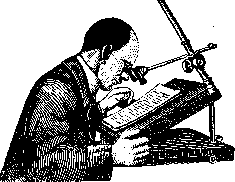
Figure 4.
With muscular asthenopia on the basis of latent strabismus, prismatic eyeglass lenses are applied. Any prismatic lens deflects rays to its base. The purpose of prismatic lenses is to give the eyes the opportunity to see binocularly despite the incorrect location of visual lines, without special tension from the muscular apparatus of the eye. This is achieved by the fact that the lenses themselves transfer the image from the peripheral parts of the retina to the area of the yellow spot. Prismatic lenses are designated by the strength of their deflecting action,

Figure 5.
that is, by the angle of deviation, which can be expressed in degrees or linear units. In the latter case the deflecting force of the prism is expressed in prism diopters. A prism of one prism diopter deflects a ray of light to such an extent that after passing through the prism it is displaced by one centimeter at a distance of one meter. In addition to heterophoria (see), prismatic glasses are also used in disorders of convergence. - As regards the shape of eyeglass lenses, up to now the most common have been oval lenses. Recently they are being displaced by large round lenses, the advantage of which is that even at extreme directions of gaze the eye still looks through the lens and not past it. This, however, makes sense only when wearing anastigmatic lenses. When wearing lenses of the old ordinary forms of grinding, large round lenses do not represent any optical advantages, since, due to the large astigmatism of oblique bundles, the periphery of the lens cannot be used at all. History of Eyeglasses. The place and time of the invention of eyeglasses are still unknown. Eyeglasses first appeared at the end of the 13th century, their homeland being probably Venice. This was facilitated by the fact that Venice was at that time the only place where high-quality colorless glass was produced. At first only biconvex lenses appeared, intended mainly for correcting presbyopia. Concave lenses began to come into use two centuries later. The fairly widespread opinion that eyeglasses were known to the Chinese long before their appearance in Europe finds no confirmation in the reports of the first travelers to China. The original forms of eyeglass optics were sharply different from those existing today. At first only single magnifying glasses with a handle were used, and the glass was held before the eyes by the handle. Only later did glasses with lenses for both eyes appear. These glasses were distinguished by the absence of temples; during use they had to be held on the nose with the fingers. Manufacturing of eyeglass lenses. Eyeglass lenses are made from optical glass. The starting material for them usually consists of plates of mirror glass, which must satisfy the following requirements for these purposes: it must be extremely transparent, colorless, free of bubbles and striae (striae are stripes inside the glass formed due to insufficient mixing of the glass mass during melting), resistant to chemical influences, and have a refractive index of nD=1.523. From these plates pieces of oval or round shape are cut. These pieces are given a curvature of the surface close to the required one by the following two methods: bending the glass or pressing it. In the first method a heated disc is placed on a bending mold made of fireclay with corresponding depressions. In special furnaces these molds are then heated until the softened glass, under the action of its own weight, fills the depression in the bending mold (Fig. 6). This method is applicable only for lenses of the meniscus type. - Pressing the glass has a wider application, since it is applicable for lenses with any form of surfaces. To obtain pressed glass, the cut pieces are first heated in a furnace to 450-700°. From the furnace the glass is placed on
the pressing mold (Fig. 7).
FIG. 6.
Fig. 7.

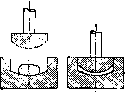
pressed into a steel mold, the diameter of which corresponds to the diameter of the finished glass and the bottom of which approximately corresponds to the curvature and shape of one of the surfaces. After this, another mold corresponding to the curvature and shape of the second lens surface is pressed from above (Fig. 7). The further final processing of the glasses takes place on grinding and polishing machines, the main part of which consists of rapidly rotating metal cups having the corresponding radius of curvature. Protective eyeglasses are intended to protect the eyes from mechanical damage and from the harmful action of radiant energy. Due to the enormous variety of production processes and the associated possibilities of damage, there are no universal protective eyeglasses suitable for all purposes, but there is a large variety of different types, of which each possesses certain advantages and disadvantages. Eyeglasses intended to protect the eyes from mechanical damage must, in the main, satisfy the following requirements: 1) they must sufficiently protect the eyes from those damages which are possible during a given production process, and 2) must not adversely affect the functions of the eye. In the latter respect, the question of fogging of the glasses, as well as the limitation of the field of vision caused by the glasses, deserves special attention. Two measures have been proposed to combat fogging of the glasses: inserting thin celluloid plates behind the glasses, coated on the side facing the eye with a thin layer of gelatin, and lubricating the glasses with special fat lubricants. In the first case, moisture droplets are absorbed by the gelatin without disturbing its transparency, in the second case they spread over the greasy surface of the glass as a thin layer. However, all these means are capable of protecting the glasses from sweating for a longer or shorter period of time, but by no means for the entire working day. The limitation of the field of vision is caused by those protective devices in the form of metal grids or scale-like metal plates which surround the glasses of protective eyeglasses. Protective eyeglasses against mechanical damage can be divided into the following groups: 1) Eyeglasses protecting the eye only from the front. This includes "international" type eyeglasses consisting of large round glasses of the meniscus type in an ordinary eyeglass frame. 2) Eyeglasses in a metal frame with protection on all sides. This includes Dolganov's protective eyeglasses with a metal grid around the glass, eyeglasses with metal scale-like walls around the glasses (Zhyulebin and others). - Eyeglasses without glasses. In them, protection is achieved by means of dense metal grids or by means of metal plates in which a series of slits for vision are cut. In addition, there is still a number of other groups and types. Each of these types of eyeglasses has its own disadvantages and advantages, and the question of which of them are the best in certain production conditions has not yet been resolved. In general, workers, due to a whole series of inconveniences and imperfections which are inherent to all protective eyeglasses to a greater or lesser extent, resort to them only reluctantly and only in case of extreme necessity. - To protect the eyes from the harmful action of ultraviolet energy, so-called Gallaudet glasses (see) are used, and for the purpose of uniformly weakening all rays of the visible part of the spectrum or for protection against ultraviolet or infrared rays - smoked glasses of various saturation. For protection against infrared rays, yellowish-green glasses colored with ferrous oxide are used. For protection against ultraviolet rays, any glasses can be used, since the glass itself delays these rays. Sets of trial eyeglass glasses. For selecting glasses, sets of trial eyeglass glasses are used. These sets represent wooden boxes lined with velvet and divided into nests. They contain 1) spherical glasses, converging and diverging; 2) cylindrical glasses - converging and diverging; 3) prismatic glasses; 4) trial frames and a number of additional items. To the additional items, the number of which differs in different sets, belong 1) colored glasses (red and green); 2) Maddox rod; 3) metal round plate; 4) the same plate with a small round hole; 5) the same plate with a narrow slit; 6) a series of smoked glasses of various saturation and 7) a ruler divided into mm. Spherical glasses are usually available from ±0.25 to ±20.0 D, and cylindrical glasses from ±0.5 to ±8.0. When moving from weaker to stronger glasses, the gradation is initially more gradual (0.25 and 0.5), and then it is more abrupt (+1.0 D and above). According to the decision of the temporary committee on ophthalmic optics at the Main Chamber of Weights and Measures, approved by VSNKh on April 7, 1927, the minimum composition of glasses in these sets is as follows: 1) 20 pairs of positive and 20 pairs of negative lenses from 0.5 to 20.0, 2) 14 positive and 14 negative cylindrical lenses from 0.5 to 5.0 D and 3) 10 prismatic glasses of strength from 0.5 to 5.0 prismatic diopters. However, significantly more complete sets are in circulation. For convenience of use, usually positive lenses, both spheres and cylinders, are enclosed in gold-plated, and negative lenses in silver-plated rims. On the handle of each rim or on the glass itself is indicated the refractive power of the glass in diopters; on cylindrical lenses, in addition, there are marks indicating the direction of the axis of the cylinder. Trial eyeglass frames serve for attaching glasses to the eyes during the selection of glasses. A good trial frame must satisfy a whole series of requirements. It must make it possible to insert several glasses in front of the eye simultaneously, rotate the glasses in front of the eye, and move the placed glass both in the horizontal and vertical directions. All this is necessary both for the correct centration of the glasses, i.e., for the eye to look through the center of the glass during the selection of glasses, and for the purpose of giving the axes of cylindrical glasses the proper inclination. For measuring the position of the cylinder axis on the rim, there are divisions in degrees. The appearance of one of the "best modern frames", manufactured by the Zeiss firm, is shown in Fig. 8. Since these improved, so-called "universal" frames are very expensive and not always necessary when selecting glasses, then in addition to these sets there is one or several simpler frames, which however have a whole series of disadvantages and inconveniences.
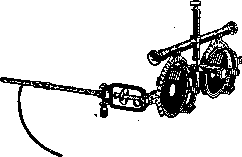
Figure 8.
Colored glasses are used to investigate diplopia in some simple cases of damage to the eye muscles. For more complex cases (damage to the eye depressors and elevators), the Maddox rod is used. The metal round plate is used to cover one of the eyes during the verification of visual acuity or the selection of glasses, and the plate with a round hole is used when selecting glasses under atropine. In this case, the hole plays the role of a diaphragm and lets rays into the eye only through the central parts of the pupil, dilated by atropine. - Smoked glasses are used for rough orientation in disorders of light perception, and a ruler is used to measure the distance between the pupils. - Until recently, sets of trial eyeglass glasses were imported to us from abroad, mainly from Germany. Recently they began to be manufactured in the USSR by the trust of precision mechanics and optics, and these sets are equipped with very perfect frames. Since a set of trial eyeglass glasses is a measuring instrument and inaccuracies in the execution of the glasses included in it can give rise to errors in prescribing glasses, in 1927 a number of rules, which these sets must satisfy, were developed by the temporary committee on ophthalmic optics at the Main Chamber of Weights and Measures. At present, both at the Main Chamber and in a number of its departments, corresponding verification points have been organized. - All sets of trial eyeglass glasses released for sale undergo mandatory verification and are supplied with corresponding certificates, and a stamp indicating their suitability is affixed to each of the glasses in the set. For the selection of telescopic glasses, the Zeiss firm has released special sets of trial telescopic glasses, as well as sets of corresponding trial frames. Methods of checking eyeglass glasses. When prescribing and especially when dispensing eyeglass glasses by prescriptions, one often has to face the necessity of checking the optical properties of a given eyeglass glass. The simplest, accessible, and at the same time sufficiently accurate method is the method of neutralization, the essence of which consists in the cl
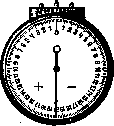
Figure 9.
In the following. If one looks through an eyeglass lens at some distant object and at the same time makes small movements with the lens, the object being fixed may remain stationary, which indicates the plane-parallel character of the lens, or else it also makes some movements. The presence of such imaginary movements of the object indicates that we are dealing with an optically active lens, and in the case of a negative lens the direction of the object's movement coincides with the movements of the lens, whereas in the case of a positive lens it is opposite. By determining the character of the lens in this way, one takes from the set a lens of the opposite sign and, applying it to the eyeglass lens, tries to find the lens for which the imaginary movements of the object disappear. Then the power of the lens taken from the set is equal to the power of the eyeglass lens. When checking lenses of the meniscus type by the neutralization method, a number of special rules must be observed; failure to observe which may give very significant errors. - For checking eyeglass lenses, a number of instruments-spherometers and dioptimeters are also used. The general form of a spherometer is shown in Fig. 9. It consists of a dial divided into diopters, on which a hand moves, and of three pins. The middle of these pins is movable in the vertical direction and stands above the level of the two outer fixed pins. When an eyeglass lens is applied to the pins of the spherometer (Fig. 10), the middle pin changes the degree of its standing in dependence on the radius of curvature of the glass surface. Thus a spherometer determines directly only the radius of curvature of the glass surface. For checking cylindrical and prismatic lenses, spherometers of special design-cylindrometers and prismometers-are applied. Since the refractive power of a glass depends not only on the radius of curvature of its surfaces but also on its refractive index, the graduation on the dial of a spherometer is made in calculation for a certain refractive index. Thanks to this, a spherometer is a very inaccurate instrument, because if the refractive index of the eyeglass lens being examined differs from that index which was taken into account during graduation, then all its indications are already incorrect. On the basis of these considerations, the use of spherometers during the issue of eyeglass lenses is prohibited. The most perfect instruments for checking the optical properties of eyeglass lenses are dioptimeters. They represent very complex and expensive instruments produced by some large German and American optical firms. Dioptimeters make it possible to determine accurately all the main optical properties of eyeglass lenses, such as: refractive power, the position of the axes of cylindrical lenses, the deviating action of prismatic lenses and the correctness of centring.
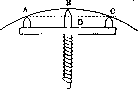
Figure 10. Spherometer: A and C are fixed pins; B, D, E is the movable pin.
Sensation
518
Related articles
Mentioned in
Cite this page
“Eyeglasses.” Soviet Medical Encyclopedia. English translation of Bolshaya Meditsinskaya Entsiklopediya, 1st ed. (Moscow, 1928–1936), ed. N. A. Semashko. https://sovietmedicalencyclopedia.pages.dev/article/eyeglasses/