Binocular Instruments
Historical document, translated for reference. It reflects medical knowledge of the 1920s–30s and is not medical advice.
Summary
Binocular instruments are designed for use with both eyes to achieve a stereoscopic effect, commonly through angular magnification. They include various types such as Galilean and prism binoculars, binocular microscopes, stereoscopes, and military applications like stereoscopic rangefinders.
Encyclopedia article (1928–1936)
BINOCULAR INSTRUMENTS, are constructed for the use of vision with both eyes in order to obtain a stereoscopic effect. Usually, this involves increasing the angular dimensions of the objects being viewed. The most common B. i. are binoculars, which come in two types. The first type (Galilean binoculars) consists of two parallel and mechanically connected optical tubes, each composed of a converging lens (objective) and a diverging lens (eyepiece). The rear focus of the objective coincides with the rear focus of the eyepiece, so that a parallel beam of light falling on the objective emerges from the eyepiece also as a parallel beam (telescopic system). Small movements of both eyepieces together allow the binoculars to be adjusted to the refraction of the observer's eyes. In cases of anisometropia, the stereoscopic effect of vision cannot be sufficiently utilized. A special design of the Galilean binocular is represented by the telescopic glasses made by Zeiss. In them, the size and weight of the tubes are reduced to the minimum, so that the resulting instrument can be easily, like ordinary glasses, held in front of the eyes with the help of a nose bridge and side arms. The usual magnification of such glasses is 1.8. They are used in cases of significant weakening of visual acuity (approximately, down to 0.3), allowing it to be brought up to 0.5. They are usually made for distance vision. For their use at close range (for work), additional converging lenses are placed on the objectives, calculated so that their front focus coincides with the object being viewed, which as if moves the object to infinity. The field of view of such glasses reaches 35°. - The second type of binocular (prismatic) represents a binomial combination: two Keplerian viewing tubes, each consisting of two converging lenses - objective and eyepiece. The rear focus of the objective coincides with the front focus of the eyepiece, so that, with the same magnification, the Keplerian tube is significantly longer than the Galilean one. In addition, the Keplerian tube gives an inverted image of objects. To straighten the images and to shorten the tubes, two inverting rectangular prisms with total internal reflection are included between the objective and the eyepiece (see figure). A special design of prismatic binoculars, of reduced size, with magnifications of 3, 6, and 8 times, is used under the name of telescopic magnifying glass for increasing visual acuity
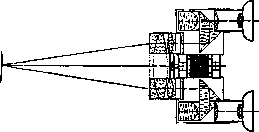
Path of rays in a binocular magnifying glass.
in very severe cases (fall of acuity to 0.1 and even lower). To use such a magnifying glass, an additional lens is placed on each objective, bringing the rays coming from the object to parallelism. The field of view of such magnifiers is generally small and decreases with increasing magnification. To account for the refraction of the observer, the objectives of the magnifier are moved relative to the eyepieces with the help of a screw; one of the eyepieces also has independent movement, which can correct anisometropia. When in use, such a magnifier is mounted on a special stand or worn on the head with a strap holder. A hinge connection of both tubes allows the magnifier to be adjusted to any distance between the eyes. Another type of B. i. are B. microscopes. Normally they consist of two tubes inclined toward each other so that their axes intersect in the plane of the specimen being examined, and each equipped with a separate objective and eyepiece. Each system gives an independent image of the object; both images are combined by the observer's eyes into one common stereoscopic image. Since the microscope gives an inverted image, the stereoscopic effect could not be obtained without straightening both images. This is achieved by including in the path of the rays of each tube a special inverting system of Porro prisms. These prisms can be rotated together with the eyepieces around the axes of both tubes, which, due to the displacement of the eyepieces relative to the axes of the tubes, allows the B. microscope to be adjusted to any distance between the pupils. B. microscope is used for examining the cornea and anterior chamber of the eye with magnifications of approximately up to 100 (corneal microscope). The corneal microscope is also used to determine the depth of the anterior chamber. A stereoscopic effect can be obtained in a microscope with a single tube by using the B. Abbe eyepiece. The effect here is achieved by placing screens in the exit pupils of the eyepieces, blocking one half of the field of view in each, so that the right eye sees the object only in rays inclined to the axis to the right, and the left eye vice versa. This system is applied in the 'eye microscope' of Kepp, used for examining all media of the living eye, from the cornea to the retina. In ophthalmoscopy, B. systems are sometimes also used. For example, in the ophthalmoscope of Gullstrand, stereoscopic vision of the retina can be achieved by using, instead of the ordinary eyepiece, a special binocular one, constructed on the type of B. magnifier. Its use is possible only with a dilated pupil. - Among other B. i., ordinary stereoscopes should be noted, used for viewing specially prepared drawings or photographs in relief. Further development of the stereoscope was achieved in the Pulfrich stereocomparator, used for precise measurement of depths on stereoscopic photographs (used in geodesy and astronomy). - In military affairs, stereoscopes and stereoscopic rangefinders are used. They are systems similar to prism binoculars, but with an increased distance between the axes of the tubes (up to 60 cm in stereoscopes and up to 150 cm, and even more, in rangefinders), which gives an enhanced stereoscopic effect. In stereoscopic rangefinders, special scales in the focal planes of the eyepieces make it possible to determine the distance to the observed objects.
Related articles
Mentioned in
Cite this page
“Binocular Instruments.” Soviet Medical Encyclopedia. English translation of Bolshaya Meditsinskaya Entsiklopediya, 1st ed. (Moscow, 1928–1936), ed. N. A. Semashko. https://sovietmedicalencyclopedia.pages.dev/article/binocular-instruments/