Stereoscope
Historical document, translated for reference. It reflects medical knowledge of the 1920s–30s and is not medical advice.
Summary
This article explains the principles of binocular vision and the stereoscope, a device that creates a three-dimensional image by combining two slightly different views for the left and right eye.
Encyclopedia article (1928–1936)
STEREOSCOPE, IY (from Greek stereos- solid and skopeo- I look). When fixing any drawing on a frontal plane, the images of it on the retinas of the right and left eye will be a copy of each other and within the yellow spot will fall on identical points. The impression received from such a flat object during binocular vision will differ in no way from that during monocular vision. The most valuable property of binocular vision is the property of perceiving and very finely evaluating the depth of space, feeling relief. Vision with one eye is not devoid of this property; the evaluation of depth and relief here is only less perfect and is based on the perspective change in the size of objects, on the shades of illumination and aerial perspective. During binocular vision, due to the difference in the position of the eyes relative to the object being viewed, the right eye covers a larger part of the right side of the object facing it, and the left eye covers a larger part of the left side facing it. Under such conditions, it is clear that the images on the retinas will not be identical, and consequently not all elements constituting the image of the object will fall simultaneously on identical points. The ability to combine these elements located in different planes into a single whole, the ability to evaluate their mutual relations in space constitutes the main advantage of binocular vision.
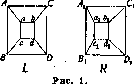
The difference between monocular and binocular vision is clearly manifested when examining two drawings (Fig. 1), from which one (L) gives the image of a truncated pyramid for the left eye and the other (R), as it is drawn for the right eye. By slanting the eyes so that the large squares ABDC and A'B'D'C' coincide, we will see that all corresponding points of both drawings also coincide, and yet the small squares will take a place in front of the large squares, which together with the coinciding edges will give the image of a solid object - a truncated pyramid, with its vertex facing the observer. Comparing these images with each other, it is not difficult to note that the elements constituting them, namely the bases and vertices, are completely identical in both drawings, but their mutual relations are not the same. In Fig. 1 L the small square is shifted to the right; in Fig. 1 R to the left, as a result of which the distances between the corresponding sides of these squares are not the same. The line AB is more distant from A'B' than AC is from A'C', and consequently the centers of the vertices are brought closer together than the centers of the bases. With some skill, it is easily possible to shift the point of fixation behind the plane of these two images, for which it is required to gradually weaken convergence until the visual axes pass through the centers or other corresponding elements of the large or small squares. Suppose that we have weakened convergence so much that the visual axes of both eyes passed through the centers of the small squares, then their images will fall on identical points and will occupy a place in space corresponding to the position of the point of intersection of the visual axes. To merge the large squares, an even smaller convergence is required, which is why the point of intersection of the visual axes passing through their centers will be shifted further, in other words, in the representation of the observer the base of the pyramid will be removed further than the vertex. For the examination of such paired images obtained for the right and left eye, the stereoscope, a device proposed for the first time by Wheatstone (1838) and subsequently improved by Brewster (1843), is convenient. Wheatstone's mirror stereoscope consists of two mirrors A and B, arranged at such an angle that the eyes of the observer look at the reflected images L and R with converging visual axes. From Fig. 2 it is clear that both images L and R merge into one and give a relief picture in KK. In Brewster's stereoscope (Fig. 3) the mirrors are replaced by convex prisms A and B, in front of which stereoscopic pictures L and R are placed, from which the rays, after leaving the lenses, take, as in Wheatstone's stereoscope, a diverging direction. Thanks to this, the eyes of the observer examine with converging axes the plastic image obtained from the merging of L and R in KK. The difference in the pictures constitutes the most important condition for the perception of relief, and the greater this difference (up to a certain limit), the stronger the relief is perceived. This difference is the greater, the closer the object is from the observer, and at equal distances of the object - the greater the distance between the eyes of the observer. According to Helmholtz, the geometric conditions for the perception of relief disappear if, when examining, the visual axes form an angle (convergence) less than 1 minute; if, however, we perceive depth and relief within these limits, then only due to the relations of the size of objects, aerial perspective and shades of illumination. To obtain an impression of solidity from such distant objects, Hardy (1853) and Helmholtz (1857) constructed an apparatus, which received the name of the telestereoscope, by means of which the distance between the eyes of the observer is artificially increased; the eyes are as if moved away from each other to a greater distance, as a result of which the limit of perception of relief is correspondingly removed. The scheme of the telestereoscope is given in Fig. 4. Diverging rays from the object fall on mirrors A and B and, after being reflected from them, are directed into the eyes by means of other mirrors a and b. Thus, the eyes of the observer fix the object as if the normal distance between the pupils 1 was increased to the size 2. The mirrors in telestereoscopes are usually replaced by prisms with total internal reflection.

Related articles
Mentioned in
Cite this page
“Stereoscope.” Soviet Medical Encyclopedia. English translation of Bolshaya Meditsinskaya Entsiklopediya, 1st ed. (Moscow, 1928–1936), ed. N. A. Semashko. https://sovietmedicalencyclopedia.pages.dev/article/stereoscope/