Convergence
Historical document, translated for reference. It reflects medical knowledge of the 1920s–30s and is not medical advice.
Summary
Convergence is the movement of the eyes where both visual lines meet on an object. It is a fusional movement that differs from others by being subject to voluntary control and is measured using metro-angles.
Encyclopedia article (1928–1936)
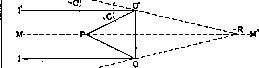
CONVERGENCE (from Latin con- together and vergo- I turn), the movement of the eyes, as a result of which both visual lines converge together on the object that has aroused attention. Convergence belongs to the group of movements with an opposite character, i.e., such movements in which the eyes simultaneously turn in different directions (in convergence, the left eye turns to the right, and the right eye to the left). Movements of this type are also called fusional (fusio-merging), because they promote the merging of sensations received from each eye separately into one inseparable whole. Convergence differs from all other fusional movements in that it is also subject to the will. In addition, convergence is not as absolutely connected with the presence of binocular vision as all other fusional movements are. This is due to the fact that the setting of the visual lines for close distances is closely connected through, probably, a preformed nervous mechanism with the setting of the dioptric apparatus for the same distances. In normal emmetropic eyes, convergence and accommodation produced for close distances are exactly proportional to each other. However, the striving for single binocular vision has a stronger influence on convergence than accommodation. In the interests of single binocular vision, the connection between accommodation and convergence becomes stretchable: within certain limits, it is possible to strengthen or weaken accommodation with unchanged convergence and to change convergence with the same accommodation. This has enormous significance for binocular vision in cases of refractive anomalies and heterophorias. Without the possibility of weakening the connection between accommodation and convergence, the clarity of binocular vision for most people would be completely incompatible with its singularity. As a unit for measuring convergence, the metro-angle is used, as proposed by Nagel, i.e., such an angle which the visual line of each eye describes, parallel to the line of intersection of the horizontal plane with the median plane of the body when inclined to a point on this median line located at a distance of 1 m from the main line (the line connecting the points of rotation of the eyes, the length of which roughly corresponds to the distance between the centers of the pupils). Briefly, the angle of convergence is the angle formed by the visual line with the median line, since the angles BAP1, BAP2, etc., as opposite angles, are equal to the angles AP1C, AP2C, etc. (fig. 1). The absolute magnitude of the metro-angle, i.e., the number of degrees in it, changes in accordance with the change in the length of the main line. The distance within which convergence ensures binocular vision without diplopia (i.e., the distance between the farthest and nearest points of convergence), when expressed in metro-angles, by analogy with accommodation, receives the name of the width of convergence. In normal eyes, the farthest point of convergence coincides with the farthest point of single vision, which with complete relaxation of convergence (visual lines are parallel) lies at an infinite distance and can even be moved to a finite distance behind the eyes (the negative part of convergence-divergence up to 5-6°) (fig. 2). The nearest point of convergence, corresponding to its greatest tension, under normal conditions is located no further than 5 cm from the eyes and thus is closer to them than the nearest point of accommodation. While the nearest point of accommodation with increasing age moves further and further from the eyes, the nearest point of convergence even in old age approximately retains its place. The nearest and farthest points of convergence can be expressed by the strongest converging and diverging prisms, with which a distant object still continues to appear single. The limits within which, at a given degree of accommodation, the connection between accommodation and convergence can be stretched without violating the singularity of binocular vision can also be determined with the help of prisms. In this case, the nearest and farthest points of convergence found are no longer absolute but relative with respect to the given degree of accommodation. The difference between them, expressed in metro-angles, now corresponds to the concept of the relative width of convergence. When determining the relative limits of convergence, the object being fixed must at all times remain not only single but also clear.- In practice, convergence is investigated in such a way that first the subject is asked to fix a very distant object, and then from a distance of about 30 cm, a finger is quickly brought toward the eyes along the median line, and it is observed to what distance the eyes can still follow it. Convergence is considered normal if it is possible up to a distance of 5 cm from the root of the nose and can be maintained at this distance for several seconds with a slight raising and lowering of the finger.- The opposite state to convergence is divergence, in which the visual lines diverge from each other. Divergence entirely depends on the striving for single binocular vision and is not subject to the will at all. The maximum possible divergence is determined by prisms of 8°.
Among deviations from the normal state, insufficiency of convergence should be mentioned. It can be observed in people with signs of weakness and anemia, but otherwise completely healthy. The cause of insufficiency of convergence should be sought in the weakness of its innervation. To eliminate asthenopic phenomena, an attempt is made to improve the general condition of the body, to make accommodation work in full by prescribing full correction to young myopes not only for distance but also for near vision, and to decenter the glasses (from 2.5 to 3.5 mm on each side).- In hysteria, a spasm of convergence may develop. This condition is expressed by a symmetrical turning of both eyes toward the median line ad maximum. At the same time, myosis and spasm of accommodation, increased blinking or even blepharospasm, redness of the conjunctiva of the eyeball, and lacrimation are observed. Less frequently, spasm of convergence occurs in chorea and epilepsy, sometimes in children with inflammation of the conjunctiva and cornea.- Paralysis of convergence is accompanied by complaints of unclear vision and diplopia at close distances with completely normal vision at a distance. In this case, in pure cases, there are no anomalies of either refraction or accommodation. There are also no limitations of mobility. When a finger is brought closer, only one eye follows it, while the other at this time performs only an associated movement with the first outward. The pupillary constriction corresponding to normal convergence does not occur. Most often, paralysis of convergence is of functional origin, therefore it cannot serve as an indication of the localization of the pathological process. But paralysis of convergence is also a fairly bright symptom in lethargic encephalitis as a stem disease. To eliminate diplopia at working distance, diverging prisms are prescribed. If this does not help, then one of the eyes has to be bandaged.- As for the narrowing of the pupil when focusing on close distances, it has not yet been finally clarified whether it is connected with convergence or with accommodation. Behr expresses the thought that all three movements corresponding to focusing on close distances (accommodation, convergence, and narrowing of the pupil) are in themselves quite independent and are only united by an impulse coming from the cerebral cortex into one general movement, having as its ultimate goal the clarity of vision.
Figure 1. Metro-angles. A- point of rotation of the left eye; C- median point of the main line; CD- line of intersection of the horizontal plane with the median plane of the body; AB- visual line, parallel to the median line; α, 2α...-angles which the visual line must describe in order to reach points p1, p2... of the median line. If CP1 is equal to one meter, then α is the metro-angle; when CP2 is equal to 0.5 m, α is equal to two metro-angles, etc. Figure 2. Angle of convergence. O and O'- position of the eyes; OO'- main line; MM'- median line; IO and I'O'- parallel direction of the visual lines; OP and O'P- inclination of the visual lines to the nearest point of convergence P; OX and O'X'- diverging visual lines; P'- imaginary farthest point of convergence; angles POI and PO'I' express maximum convergence (positive convergence + C), angles IOX and I'O'X'- minimum convergence (-C).
Related articles
Mentioned in
Cite this page
“Convergence.” Soviet Medical Encyclopedia. English translation of Bolshaya Meditsinskaya Entsiklopediya, 1st ed. (Moscow, 1928–1936), ed. N. A. Semashko. https://sovietmedicalencyclopedia.pages.dev/article/convergence/