Ophthalmodynamometer
Historical document, translated for reference. It reflects medical knowledge of the 1920s–30s and is not medical advice.
Summary
The ophthalmodynamometer is a device developed by Landolt to measure the maximum degrees of convergence and accommodation in a subject. It utilizes a luminous fixation object, allowing for testing even in individuals with significantly reduced visual acuity.
Encyclopedia article (1928–1936)
OPHTHALMODYNAMOMETER (from the Greek ophthalmos—eye, dynamis—power, and metreo—I measure), a device constructed by Landolt for measuring the highest degrees of convergence (C) and accommodation (A) accessible to a given individual (see figure). It consists of a tin cylinder (C), black on the outside and white on the inside, which can be placed over an ordinary candle (K). On the walls of the cylinder are three types of cutouts covered with frosted glass: a vertical slit half a millimeter wide, a hole in the shape of a point, and a vertical line made of a series of such points.
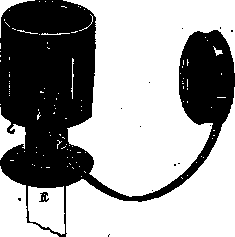
When the candle is lit, all of them stand out sharply against the black wall. Under each figure of cutouts, a hook is attached, to which the end of a tape measure can be hooked. When investigating C and A, two different tapes are used: on one side of each, divisions are marked in centimeters, while on the other side, the tape for measuring C has meter-angles corresponding to the centimeters, and the tape for measuring A has diopters. To investigate C, the slit or a single point is used as a fixation object. The tape is stretched to approximately 70 cm, and the tape measure is placed at the temple of the subject, if possible corresponding to the main line of their eyes (see Convergence). If the subject sees the fixation object binocularly without double vision, the button on the tape measure is pressed, and, while keeping to the midline of the subject's body, one begins to slowly bring the object closer to their eyes. As soon as the subject, despite all their efforts, ceases to see it as a single object, their highest degree of C has been reached. The distance from the subject's eyes to the point from which double vision (crossed) begins is read in centimeters on one side of the tape, and the corresponding value is read in meter-angles on the other. If the subject cannot account for the onset of double vision, they can be assisted by placing a colored glass in front of one of the eyes. But since this glass hinders fusion to a certain extent, it is desirable to repeat the examination once more without the glass.
When investigating A, a vertical line of points is used as the fixation object. Each eye is examined separately. More significant degrees of astigmatism are best corrected beforehand. As soon as the eye's adjustment to the fixation object becomes increasingly insufficient despite all the tension of A as the object approaches, the images of the points begin to be drawn in circles of light diffusion, move closer and closer to each other, and finally merge into one continuous bright strip. The measurement of the distance from this point, from which the images of the points begin to lose the sharpness of their outline, and the determination of the values corresponding to this distance are performed using the tape on which the diopters are marked. The advantage of the ophthalmodynamometer is the luminous fixation object. The latter allows the use of the device even in cases with significant reduction in visual acuity, and changes in its appearance are more easily perceived by the subject. In addition, the ophthalmodynamometer, by stimulating A simultaneously when investigating C, makes it possible to achieve the truly highest degrees of convergence, which is closely linked to A.
Related articles
Cite this page
“Ophthalmodynamometer.” Soviet Medical Encyclopedia. English translation of Bolshaya Meditsinskaya Entsiklopediya, 1st ed. (Moscow, 1928–1936), ed. N. A. Semashko. https://sovietmedicalencyclopedia.pages.dev/article/ophthalmodynamometer/