Rain Gauge
Historical document, translated for reference. It reflects medical knowledge of the 1920s–30s and is not medical advice.
Summary
This 1930s encyclopedia article describes the construction and use of rain gauges for measuring atmospheric precipitation. It details their deployment at meteorological stations and mentions their application in hygiene and sanitation for collecting precipitation to test for airborne pollutants, as well as in sewage system design.
Encyclopedia article (1928–1936)
RAIN GAUGE, an instrument for measuring the amount of atmospheric water falling in the form of rain, snow, hail, etc., onto a specific surface over a certain period of time. At Russian meteorological stations, rain gauges are used (Fig. 1) in the form of a cylindrical zinc vessel with an open upper aperture and a cross-sectional area (reception surface) equal to 500 cm2; a sturdy brass ring is soldered to it. At a certain distance from the bottom, a funnel-shaped partition (b) with openings through which water flows into the lower compartment of the cylinder is inserted into the cylinder. The purpose of this partition is to protect the accumulating water from evaporation and accidental contamination. To pour water out of the rain gauge, there is a small side tube (v) covered with a cap. The instrument is installed in an open place on a sturdy post in such a way that the upper opening of the rain gauge is in a horizontal position and is at a height of 2 meters from the surface of the ground. During wind, air vortices form above the opening of the rain gauge, which hinder the settling of rain, snow, sleet, and even frequently blow the already settled snow out of the rain gauge. To avoid such losses, a funnel-shaped Nifer shield (z) with a wide upper flare, located at the same level as the upper edge of the rain gauge, is fastened around the rain gauge. The water accumulated in the rain gauge is measured by means of a special graduated glass (Fig. 2), each division of which
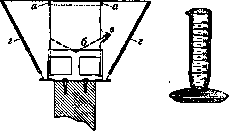
Figure 1.
Figure 2. corresponds to a layer of water in the rain gauge with a height of 0.1 mm. Solid atmospheric precipitation (snow, hail, sleet) is turned into water by thawing, which is then measured. The measurement of the amount of fallen precipitation is usually carried out once a day—at 7 o'clock in the morning. In case of heavy precipitation, as well as in special cases, the measurement is carried out two or more times, depending on the purpose of the study. Rain gauges find application mainly at meteorological stations. In sanitary practice, a rain gauge is sometimes used for collecting atmospheric precipitation in order to examine them for any harmful impurities captured from the air. When designing a combined or separate sewerage system, data obtained by means of a rain gauge over a prolonged period of time make it possible, based on the amount of atmospheric precipitation falling in a given area, to accordingly calculate the dimensions of sewer drainage channels.
Related articles
Mentioned in
Cite this page
“Rain Gauge.” Soviet Medical Encyclopedia. English translation of Bolshaya Meditsinskaya Entsiklopediya, 1st ed. (Moscow, 1928–1936), ed. N. A. Semashko. https://sovietmedicalencyclopedia.pages.dev/article/rain-gauge/