Barlow's Disease
Historical document, translated for reference. It reflects medical knowledge of the 1920s–30s and is not medical advice.
Summary
Barlow's Disease, also known as infantile scurvy, is a condition characterized by hemorrhagic manifestations, bone changes, and specific growth patterns in young children. The article details its history, pathology, and treatment.
Encyclopedia article (1928–1936)
BARLOW'S DISEASE (Sir Thomas Barlow), infantile scurvy. This disease is characterized by manifestations of a "hemorrhagic diathesis," typical bone changes (X-ray), and the general habitus of the child.-History. B. b. was first described in 1691 by Glisson, who regarded it as a complication of rickets with swelling and pain of the joints, bleeding into the gums, etc. In 1859, Moller described the manifestation of Vitamin C deficiency as "acute rickets." In 1893, Barlow, on the basis of characteristic findings in the bones, categorically rejected the connection of this disease with rickets and identified it with adult scurvy; since that time the disease has been called B. b. Heubner and Rauchfuss deny the identity of B. b. with adult scurvy, mainly on the basis of its absence during scurvy epidemics. Some features of the manifestation of B. b. in infancy depend on the peculiarities of the nutrition of small children. Thus, an outbreak of B. b. in the 1890s was caused by the enthusiasm for artificial feeding at that time and prolonged (about an hour) sterilization of milk. The absence of gum ulcers and sometimes bleeding over the teeth in B. b. is observed in some cases also in adult scurvy, which therefore cannot speak against the identification of B. b. with adult scurvy. A whole series of pathologists (Abrikosov, Schmorl, Fraenkel, Aschoff) considers the changes in the bones in B. b. to be a peculiar reaction of the growing organism to the same harmful factor, which in adults causes other changes characteristic of their age. Hart obtained the same picture in both a young and an adult monkey when feeding with appropriate food without vitamin C, thereby proving the complete analogy of the diseases also in the sense of patho-anatomical changes. According to Czefny-Keller, the differences of B. b. from adult scurvy are explained exclusively by age peculiarities of growth and nutrition of small children; the etiology and essence of the changes are the same. Path. anatomy. For B. b. characteristic is the appearance of subperiosteal and bone marrow hemorrhages at the boundary between the diaphysis and epiphysis of the long bones, as well as in the orbit. Microscopically at the boundary of the diaphysis with the epiphysis one finds the transformation of cellular bone marrow into a loose fibrous connective tissue with a small amount of blood vessels and : cells (see figure 1 and separate table). The diseased bone marrow no longer gives off processes into the ossified cartilage, therefore the serrated line at the boundary between the cartilage and the bone becomes straight and gives a characteristic shadow on the X-ray. Osteoblasts disappear, bone struts near the epiphysis disappear, the result of which can be sometimes separation of the diaphysis from the epiphysis, fractures and breaks of bones. Thus, for B. b. characteristic is the transformation of bone marrow near the epiphysis of the long bones into connective tissue, with scanty amount of bone marrow cells and vessels and with loss of osteoblastic function. Subperiosteal hemorrhages are secondary due to the manifestation of hemorrhagic diathesis. The formation of an excess of osteoid tissue, characteristic for rickets, in B. b. is observed rarely. Pathogenesis. Barlow's disease is caused by the absence of antiscorbutic vitamin C in the food, its insufficient introduction or excessive consumption by the organism; thus, B. b. must be referred to avitaminoses. Vitamin C is contained in raw milk and fruit juices (lemon, orange, tomato, etc.) and is destroyed by prolonged boiling and the addition of alkalis. Vincent observed B. b. in feeding: artificial preparations (flour) in 214 children, sterilized cow's milk in 107, condensed cow's milk in 60, pasteurized milk in 20, raw cow's milk in 5, breast milk in 2, breast milk from exhausted starving mothers in 10. Thus, one-sided feeding with patent flour, long (up to 1 hour) sterilized and pasteurized milk, in which vitamin C is absent, is the cause of the occurrence of infantile scurvy.- The infectious theory of B. b. (Rehn, Stark and Soltmann) has almost no adherents. Axel, Hoist and Frohlich succeeded in inducing in guinea pigs changes in the bones, extremely resembling B. b., by prolonged feeding with dried potatoes. The influence of constitution has some significance (Langstein). Children in closed institutions used to often suffer from infantile scurvy. Cases of B. b. in the same family are explained by the absence of fruit juices in the food with artificial feeding (Finkelstein). Acute infections (whooping cough, etc.), as well as vaccination, apparently, can cause an outbreak of latent scurvy. The disease is most often in the winter months, more often in boys than in girls, more in the rich than in the poor, which can partly be explained by the greater spread of artificial feeding among the well-to-do classes. According to Hess's theory, the disease is caused by intensified bacterial activity in the intestine under the influence of vitamin-free food with the formation of toxins and subsequent auto-intoxication; however, this theory is unlikely. Etta considers the cause of B. b. to be a lesion of the endocrine apparatus (goiter and spleen). Path. chemistry (works of Bahrdt and Edelstein) indicates a sharp decrease in Ca and P in the skeleton and musculature of a child dying from B. b. Clinical picture (see figure 2 and 3). The disease proceeds first secretly and is characterized in this hidden period by a stop in weight, loss of appetite, insomnia, pallor of the integuments and mucous membranes, as well as the appearance of diarrhea (dystrophia avitaminosa, praeseorbut). In the further course the disease passes into the second period - of manifest scurvy, when pain appears, and then swelling, most often in the diaphyses of the thighs. Then the whole thigh rapidly swells due to subperiosteal hemorrhages and becomes painful. Other long bones may also be affected, and hemorrhages occur in the orbit and in the ribs near the sternum. Furthermore, due to the separation of the diaphysis from the epiphysis, bone fractures and breaks are observed, as well as a sharp depression of the sternum under the influence of lesions at the boundaries between the bony and cartilaginous parts of the ribs. Characteristic hemorrhages also appear on the mucous membrane of the mouth, nasal, intestinal and renal bleeding. Severe anemia develops with oligochromemia (35% hemoglobin), oligocytosis and poikilocytosis; edema and hemorrhages appear on the skin. The child's emaciation progresses, and he may die from the attachment of acute or chronic infection if appropriate diet is not prescribed. B. b. appears, most often, in the second half of life and can last for months. Even after the disappearance of skin symptoms and improvement of the general condition, changes in the bones remain for a long time, which can be seen on X-rays (postscorbut). Often infantile scurvy is accompanied by fever of irregular type up to 38°.- Differential diagnosis. The presence of hemorrhages on the skin and mucous membranes, erythrocytes in the urine helps to distinguish B. b. from rickets, epiphyseal osteomyelitis, septic arthritis, Parrot's pseudoparalysis, and other similar diseases. X-ray examination of the bones is of great help, which marks the characteristic shadow line at the boundary between the diaphysis and epiphysis of the affected bones and corresponds to the atrophying red bone marrow. Prognosis depends on the severity of the case and treatment. Complication with pneumonia and severe diarrhea worsens the prognosis. Prevention. The most reliable way to prevent B. b. is breast-feeding by a mother receiving sufficient vegetables and raw fruits, boiling milk for no more than 3 minutes, as well as careful, already from three months, appointment of fruit juices.- Treatment consists in the appointment of breast, raw goat or cow milk from a cow or goat tested for TB, with careful observance of cleanliness during milking, in the appointment of fruit juice (tomato, lemon, orange) in an amount from 1 to 10 tablespoons a day, depending on age, severity of the case, endurance of the child, as well as the speed of obtaining effect from treatment. Already after 3-4 weeks one can notice the disappearance of subjective symptoms and improvement of the objective condition of the patient. Diarrhea is not a contraindication to the appointment of raw fruit juices, which in such cases are prescribed more carefully and gradually. The appointment of raw meat juice is also useful.
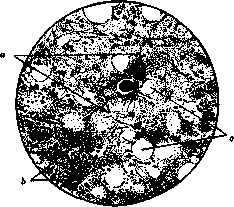
Figure 1. Changes in bone marrow of epiphyses in Barlow's disease: a - atrophying bone marrow, in which bone marrow cells have already disappeared; b - preserved bone marrow cells; c - fat cells.
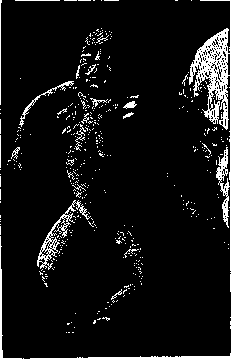
Figure 2.
Figure 3.
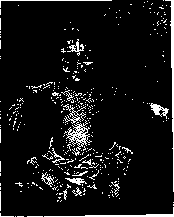
Figure 2.
Figure 3.
Related articles
Mentioned in
Cite this page
“Barlow's Disease.” Soviet Medical Encyclopedia. English translation of Bolshaya Meditsinskaya Entsiklopediya, 1st ed. (Moscow, 1928–1936), ed. N. A. Semashko. https://sovietmedicalencyclopedia.pages.dev/article/barlows-disease/