Barograph
Historical document, translated for reference. It reflects medical knowledge of the 1920s–30s and is not medical advice.
Summary
A barograph is a self-recording barometer that continuously measures atmospheric pressure over time. The article describes both mercury and aneroid barographs, their mechanisms, and applications in meteorology and aviation.
Encyclopedia article (1928–1936)
Barograph (from Greek baros - weight and grapho - I write), a self-recording barometer. Mercury barographs (see Figure 1) are a siphon barometer, the lower limb of which is equipped with a float connected by a block and tackle to a writing pen. The pen draws a continuous curve of barometric pressure on paper divided into days and hours, which is placed on a uniformly rotating drum. The clockwork of the drum is wound for a whole week. Barograph-aneroids (see Fig. 2) are designed after the model of the Vidie aneroid barometer (see Barometer). The metal airless box with flexible corrugated walls changes its volume depending on barometric pressure. A system of levers connects the box to a writing pen, which marks the existing pressure at any given moment on the paper. Barographs are very convenient for continuous observation of the course of atmospheric pressure over long periods of time. They are also used as altimeter-recorders in flights. Aneroid barographs are much more convenient than mercury ones. The firm 'Richard' in Paris makes very good and accurate aneroid barographs.
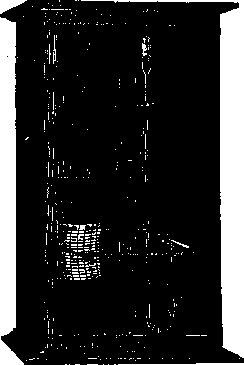
Figure 1. Mercury barograph.
with a writing pen. The pen draws a continuous curve of barometric pressure on paper divided into days and hours, which is placed on a uniformly rotating drum. The clockwork of the drum is wound for a whole week. Barograph-aneroids (see Fig. 2) are designed after the model of the Vidie aneroid barometer (see Barometer). The metal airless box with flexible corrugated walls changes its volume depending on barometric pressure. A system of levers connects the box to a writing pen, which marks the existing pressure at any given moment on the paper. Barographs are very convenient for continuous observation of the course of atmospheric pressure over long periods of time. They are also used as altimeter-recorders in flights. Aneroid barographs are much more convenient than mercury ones. The firm 'Richard' in Paris makes very good and accurate aneroid barographs.
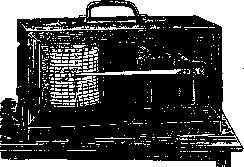
Figure 2. Barograph-aneroid.
Barograph-aneroids (see Fig. 2) are designed after the model of the Vidie aneroid barometer (see Barometer). The metal airless box with flexible corrugated walls changes its volume depending on barometric pressure. A system of levers connects the box to a writing pen, which marks the existing pressure at any given moment on the paper. Barographs are very convenient for continuous observation of the course of atmospheric pressure over long periods of time. They are also used as altimeter-recorders in flights. Aneroid barographs are much more convenient than mercury ones. The firm 'Richard' in Paris makes very good and accurate aneroid barographs.
N. Ignatov.
Related articles
Mentioned in
Cite this page
“Barograph.” Soviet Medical Encyclopedia. English translation of Bolshaya Meditsinskaya Entsiklopediya, 1st ed. (Moscow, 1928–1936), ed. N. A. Semashko. https://sovietmedicalencyclopedia.pages.dev/article/barograph/