Medicinal Plants
Historical document, translated for reference. It reflects medical knowledge of the 1920s–30s and is not medical advice.
Summary
This article provides a historical overview of medicinal plants, their use throughout ancient civilizations, the development of pharmacology, and the transition from wild harvesting to cultivation in Russia and the Soviet Union.
Encyclopedia article (1928–1936)
MEDICINAL PLANTS, plants which are used in the treatment of various diseases. The use of plants for treatment was known to man in the most ancient times. Many plants contain pharmacological substances that act on the animal organism (poisonous, stimulating, sedative, hypnotic, etc.). Knowledge of these properties accumulated empirically over centuries; often extremely false ideas and interpretations were mixed in here. In the history of all peoples there were periods when knowledge of the healing properties of plants and the skill to use them with more or less relative success was a family secret, passed down from elder to elder in the family; later it became the property of priests, shamans, sorcerers, and finally simply folk healers, that is, mostly persons and groups who combined service to the cult with healing (see Folk Medicine). Empirical, materialistic medicine arose earlier than religion on the basis of daily observation of people and animals (accidental vomiting after chewing certain roots suggested the idea of artificially inducing vomiting when necessary by the same method; observations from eating plants that cause digestive disorders, etc.). Religion brought animistic views on the causes of diseases; disease was represented as an individual being (evil spirits, demons), and the method of treatment came down to expelling the evil spirit; this they tried to achieve, for example, by the use of bitter substances, infusions of unpleasant taste, whipping with nettles, and other measures aimed at making the demon leave the patient (Glikman). With the fall in belief in evil spirits, the use of bitter substances, with which they expelled the spirits, was preserved in medicine as empirically acquired knowledge. Each people developed its own methods of treatment, the main source of which was the local flora. Trade relations contributed to the penetration of the most valuable plant medicinal products from foreign countries and thereby increased the variety of medicinal plants. Already in the most ancient times, many of the plants that are used today were used. Ancient Egypt provides much information about medicinal plants and aromatic herbs. There are castor oil plants (images and seeds in tombs 4,000 years before the Christian era), coriander, safflower, henbane; there are indications of the widespread use of opium, wormwood, cloves (Caryophyllus aromaticus L.). 3,000 years before the Christian era, in China, they knew rhubarb, ergot, opium, ginseng, and others.--Indian pharmacy knew many medicinal plants; of those that have retained their medicinal significance, one can mention aconite, cassia, castor oil plant, rhubarb, poppy (opium), Indian hemp (hashish), henbane; coriander and caraway are also found. Hippocrates knew about 200 medicinal plants; Theophrastus, a pupil of Aristotle, in his 'Natural History,' gives a systematic description of a large number of plants, characterizing their medicinal properties (anthelmintic properties of fern, use of marshmallow, dandelion, licorice). Dioscorides (1st century A.D.) describes about 400 species of medicinal plants, including valerian. Among the Arabs, out of 2,600 medicinal substances, 1,400 were of plant origin. The discovery of America enriched medicine with a number of valuable medicinal plants, such as: yellow root, senega, strophanthus, cinchona tree, etc. Paracelsus, who laid the foundation of iatrochemistry, first pointed to the need to look in plants for the substance with which they act. As the study of folk medicine grew, the number of medicinal plants increased. The total number of plants considered medicinal, some authors bring up to 12,000; at present, no more than 200-250 species have medical significance. In the USSR there are about 150 botanical species of medicinal plants. The nomenclature of species of medicinal plant raw materials has changed greatly over time. Along with the exclusion of hundreds and thousands of botanical species that are falling out of use, new species are also introduced and used. Modern medicine has not exhausted and has not studied all the possibilities that the plant world offers; research work of recent years gives many valuable substances isolated from new plants for modern medicine (e.g., harmine from harmala-Peganum harmala L.). Often the original use of a plant was completely different from the present one. Foxglove, for example, is mentioned from the 11th century as an external remedy. In 1804, the German pharmacist Sertürner isolated the first alkaloid (morphine from opium) and thus laid the foundation for a series of works on the study of the nature of active principles in plants; soon after, quinine, strychnine, veratrine, and others were discovered by the French pharmacists Pelletier and Caventou. In 1833, hyoscyamine was isolated from the leaves of henbane, and after it the other alkaloids of the atropine group were described. The years 1817-35 can be characterized as the era of many discoveries in the field of alkaloids, the main core of medicinal principles in plants. From the 1860s, during the unprecedented flourishing of synthetic organic chemistry, interest in medicinal plants fell. It seemed that the laboratory and synthesis should completely displace plants as a source of medicinal substances, however, since 1890, interest in the plant as the primary source of healing substances has again increased, and at present there is an increased interest in the study of new and in-depth research of already known species of medicinal plants. In many cases, it has not yet been possible to isolate in pure form and determine the structure and nature of the active principles; moreover, cases of discrepancy between the physiological action on the organism and the amount of active principles contained in the plant preparation are not uncommon. The quality of foxglove, for example, is determined not by the percentage content of digitoxin, but by units of valor, determined by physiological methods; the physiological action of valerian and belladonna tinctures is not proportional to the amount of essential oil and alkaloids. It is obviously necessary to recognize the complex nature of the action on the organism of the plant as a whole, in contrast to a preparation containing the active principle isolated in pure form. On this basis, in recent years, so-called neogalenic preparations have become widespread, containing a complex of active principles and freed from the ballast of neutral plant mass (seakornin from ergot, convallamar from lily of the valley, digalen and gitalen from foxglove, adonilen from adonis, frangulin from buckthorn, etc.). For a long time, medicinal plants were obtained by collecting wild plants, and their cultivation played a minor role for many centuries. Medicinal plants were partially cultivated by monasteries and pharmacies. It was assumed that a wild-growing plant is richer in active principle than products of cultural origin, which was reflected in the pharmacopoeias of many countries, although individual examples of the opposite phenomenon were known for a long time (e.g., in the cultivation of the cinchona tree, it is possible to significantly increase the content of quinine in the bark compared to the wild-growing, namely-from 3.5% to 6%). A precise verification of this position was undertaken only since the war of 1914, when the sharp increase in demand and decrease in collection everywhere raised the question of expanding the cultivation of medicinal plants. The work of the last 15 years has completely destroyed this view. Under appropriate cultural conditions, the plant not only preserves its physiological action but also significantly increases it. Thus, cultural belladonna, according to the data of experimental stations, contains in the leaves 0.6-0.9% of alkaloids (Lubensk Experimental Station, Ukrainian SSR) and even over 1.0% (Olgin Experimental Station, Moscow), while the highest quality Crimean wild belladonna-0.56%; cultural lily of the valley and foxglove, upon physiological testing, proved to be stronger than wild-growing ones. The study of the biology of medicinal plants and clarification of the conditions of formation and accumulation of active principles have given a basis for this conclusion and have indicated ways to improve the quality of raw materials. Medicinal plants obtained through cultivation have the following advantages over wild-growing ones. 1. The purity of the resulting raw material, whereas collection under conditions of natural growth very often led to mixing with close botanical forms. 2. Uniformity of raw material due to the uniformity of conditions of plant development, simultaneity of collection (the same phase of development), and the same subsequent processing (cleaning, drying, etc.). Greater correspondence to standard norms. 3. The possibility of influencing the quality of raw material and the content of active principles by methods of agrotechnique, selection, etc. 4. The possibility, with precise planning, to ensure the need for raw material and avoid overproduction by regulating the area of cultivation. History of medicinal plants in Russia and the USSR. In ancient times, Novgorod traded with the Khazars in medicines imported by various routes (along the White Sea, from Poland, from Constantinople and the Crimea). Under Vasily Ivanovich, merchants brought musk, camphor, rhubarb, cloves, calamus, almonds, etc. The trade in rhubarb was even monopolized by the treasury under Michael Fedorovich until Catherine II. By the 16th century, a broad trade in medicines had developed in the green and spice rows. -With the emergence of pharmacies, medicines began to be brought by visiting doctors and pharmacists, and the missing ones were purchased from various 'knowledgeable people' and in the green rows. But this proved unprofitable, and the Apothecary Order in Moscow in the early 17th century began to systematically organize the collection of medicinal plants.
For this purpose, a natural berry tax was established. Annually, royal decrees were sent to all corners of the state to the governors with the order 'to gather herbs and flowers and roots, which are suitable for medicinal purposes.' Special heralds traveled through the villages and 'with cries for many days' called upon 'people of all ranks in the uyezds and settlements' to gather plants. For this purpose, special officials, pomiasy, or herbalists, who apparently possessed knowledge in pharmacognosy and supervised the gathering, were under the authority of the Apothecary Order. The decrees prescribed that along with gathering already known herbs, 'all people should be asked who knows medicinal herbs that would be useful for diseases as medicine for people.' The berry tax was a heavy burden on the population. The collected products were sent to Moscow 'with special couriers and escorts.' Sometimes the apothecary convoy was escorted by marksmen. Nevertheless, the products spoiled and were lost along the way, and the government was forced to replace the natural tax with a monetary one. But the monetary collection also caused resistance, complaints, and endless petitions for the cancellation of arrears. All collections, threats, and compulsion proved futile, and the tax had to be abolished. The necessary products began to be purchased for money, and many plants began to be intensively cultivated in special vegetable gardens. Under Alexis Mikhailovich, there were over 150 fruit gardens in Moscow and its vicinity. In some of them, medicinal plants were cultivated. L. F. Zmeev lists the gardens that had medicinal significance: the Kremlin garden, of Ivan III across the Moscow River opposite the Kremlin (1495), at the Kremlin wall at the mouth of the Neglinnaya River, behind the Myasnitsky Gates, in the Izmailovo village, behind Sukharev Tower (now the Botanical Garden), the Kudrinsky (later the Widows' House) and under the German settlement. Among other things, 'God's tree, carduus with benedictus, simple and curly mint, herniaria, star, thyme, aquaticum, atriplex, burdock flower, red poppy, lion's tooth root, satyri-onis, phoenicolo root, rutin' and many others were cultivated in the gardens. At the gardens, there was also a large staff of gardeners, alchemists, furnace tenders, and watchmen. In 1678, the position of 'distiller' was established. In addition to the cultivation of medicinal plants, there were large pharmaceutical laboratories at these gardens, where essential oils were manufactured, raw products were processed, and tinctures, ointments, syrups, and other medicinal forms were prepared. These laboratories were called 'coctoriums.' In St. Petersburg, the apothecary garden was established in 1717 on an island, which therefore still bears the name 'Apothecary.' The garden improved over time and is now the Main Botanical Garden. Pharmacy, and with it the cultivation of medicinal plants, received significant development during the era of Peter the Great, who also touched upon the issues of providing medicinal means, having primarily in mind the needs of the army. State pharmacies were established in various cities and apothecary gardens or vegetable gardens were established near them (in Lubny in 1730); at the same time, such pharmacies concentrated around them the gathering of wild medicinal plants, conducting it in a semi-compulsory manner, i.e., with the mandatory participation of the population for small payment for work. The gathering of medicinal plants gradually took on the character of a trade. The trade especially took on broad dimensions in Lubny, where the free pharmacy of Dely (from 1809) conducted extensive trade in herbs and began the export trade in medicinal raw materials. In accordance with the requirements of the external market, medicinal-technical, and not exclusively medicinal plants (licorice root, linden flowers, calamus root, club moss, elderberry flowers, cornflower flowers, etc.) were exported. In 1913, the gathering of wild technical and medicinal plants was determined at 30,932 tons; of these, 29,097 tons were exported (according to incomplete customs statistics data) for 2,907,582 rubles (average for 1911-13 - 22,219 tons worth 2,390,353 rubles; according to more accurate materials of the People's Commissariat of Trade, the amount of pre-war export of all medicinal raw materials is determined at 3,748,000 rubles); of this amount of exported medicinal raw materials, 65% falls on licorice root; if santonin and wormwood are also excluded, the share of all exported medicinal plants (including medicinal-technical) remains in 1911 - 1,952 tons worth 1,052,577 rubles, in 1912 - 780 tons for 806,786 rubles, in 1913 - 760 tons for 852,383 rubles. Export trade became the main purpose of all collected raw materials, domestic needs were in last place, and the supply of pharmacies went mainly with imported products and imported raw materials. Often our own raw materials were imported back into Russia in a somewhat processed form. The war of 1914-17, the blockade, and the acute medicinal famine raised the task of freeing the country from external dependence in the matter of supplying medicinal plants. The complete cessation of foreign trade caused almost a cessation in the gathering (resp. trade) of medicinal plants, after which the revival of the trade went initially only along the line of strictly medicinal needs, and only with the restoration of foreign trade, medicinal-technical plants again reached somewhat more than half of all collected medicinal raw materials. Until 1914, the cultivation of medicinal plants was in its infancy, did not set industrial tasks, and had the character of individual initiatives of research, and more often of an amateur nature; only the cultivation of anise and coriander in the Voronezh province (about 3,200 hectares with a factory for processing seeds), fennel in the Podolsk province, and mint in the Poltava province (about 800 hectares) stood out, but all these plants went for flavorings and perfumery. Only from 1915 did the cultivation of medicinal plants begin to develop. In 1920, the question of replacing imported plants with domestic ones was raised, and by 1928 in the USSR many plants were already successfully cultivated (foxglove, belladonna, lobelia, gentian, rhubarb, golden seal, castor bean, thyme, etc.).
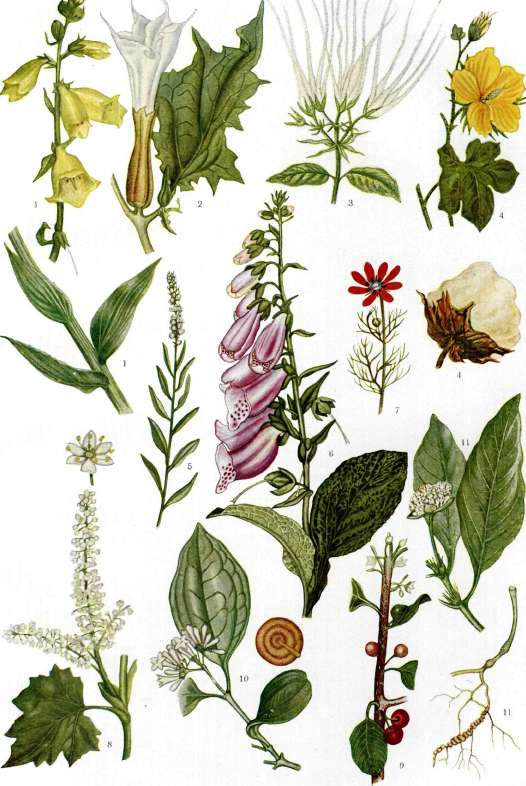
1-foxglove, large-flowered; 2-datura; 3-strophanthus; 4-cotton plant; 5-senega; 6-foxglove; 7-autumn adonis (Adonis aestivalis); 8-rhubarb; 9-buckthorn; 10-vomiting nut; 11-ipecacuanha.
To the article Medicinal plants.
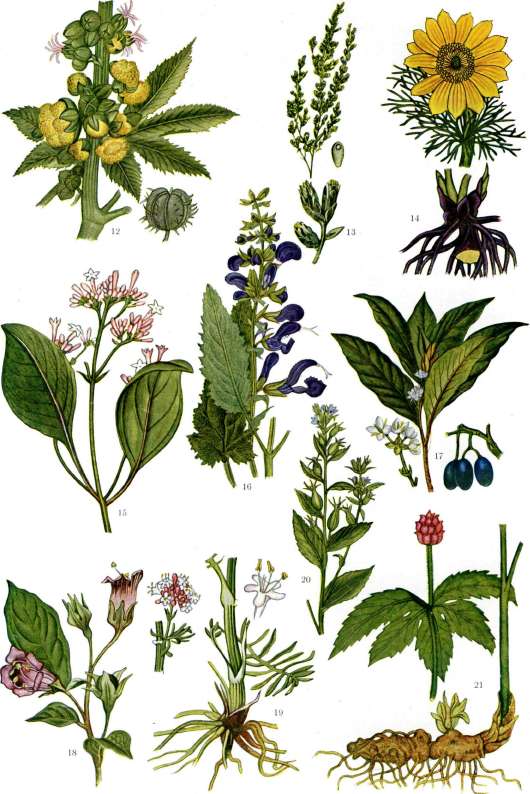
12-castor bean; 13-wormwood, centaurium; 14-spring adonis (Adonis vernalis); 15-chinchona tree; 16-sage; 17-camphor laurel; 18-belladonna; 19-valerian; 20-lobelia; 21-hydrastis.
To the article Medicinal plants. 6 50 2&i and hi ^ё1 Plant Name Calamus (Acorus calamus L.) Althaea (Althaea officinalis L.) Anise (Pimpinella anisum L.) Arnica (Arnica montana L.) Lignum vitae (Guajacum officinale L., Guajacum sanctum L.) Meadow saffron (Colchicum autumnale L.) Henbane (Hyoscyamus niger L.) Belladonna (Atropa belladonna L.) Birch (Betula alba L., Betula verrucosa Ehrh.) Motherwort (Thymus serpyllum L.) Freshwater sponge (Spongilla lacustris Carter, spongilla fluviatilis Lieberk.) Monkshood (Aconitum napellus L.) Lingonberry (Vaccinium vitis-idaea L.) Elder (Sambucus nigra L.) Used Part Rhizome Root Fruits (seeds) Herb, flower Shavings of wood Seeds Leaves, sometimes roots Buds Entire plant (herb) Entire sponge Tubers Leaves Flowers, berries Region and collection calendar USSR, BSSR End of August-October USSR, RSFSR, North Caucasus, Dagestan, Central Black Earth Region September-October, March-April Region of cultivation and area in hectares Collection 1930 tons rubles July Transcaucasian SSR, Crimea August Central Black Earth Region, Ukraine, Volga region, North Caucasus, Middle and Lower Volga region June-July North Caucasus, Crimea June-July Ukraine, North region March-April Ukraine, Central Black Earth Region, Lower Volga June-July USSR, RSFSR July Ural, Kirgizia July-August BSSR, RSFSR (north and east) June Ukraine, Central Black Earth Region, Dagestan-June, Ukraine-August (unrefined) (refined) Middle Volga region, Central Black Earth Region, Central Black Earth Region, Middle Volga region BSSR (experimental culture) 0.3 0.05 Ukraine, Middle and Lower Volga, North Caucasus, Moscow region 25 (wild-growing) 50 cultivated -...... .....-- 31,000 2,400 Note Essential oil is used in the perfume industry. Exported Exported Domestic demand is not satisfied. Development for essential oil. Exported Imported. Annual requirement is 0.3 tons worth 165 rubles. Exported Exported May have significance in the perfume-cosmetic industry. Exported Essential oil is used in the perfume industry May have significance for the perfume-cosmetic industry. Exported Domestic demand constitutes 2% of collections. Exported 1C A a Plant Name Valeriana (Valeriana officinalis L.) Hydrastis (golden seal, yellowroot) (Hydrastis canadensis L.) Hamamelis (Hamamelis virginiana) Gentian (Gentiana lutea L.)
Mustard (Brassica nigra L., Sinapis nigra L.) Pomegranate (Punica granatum L.) Walnut (Juglans regia) Herniaria (Herniaria glabra L.) Elecampane (Inula helenium L.) Sweet Clover (Melilotus officinalis Desr.) Oak (Quercus pedunculata Ehrh., Quercus sessiliflora Smith) Turkish Galls (Gallae turcicae) Thorn Apple (Datura stramonium L.) Oregano (Origanum vulgare L.) Roots and rhizome Rhizome Leaves Root Trunk bark Leaves USSR, BSSR, ZSFSR, RSFSR, CChO, Middle and Lower Volga region, North Caucasus, Dagestan, Nizhegorod region August-September Herb Root Herb (tops with inflorescences) USSR, BSSR, CChO, etc. Moscow region 1 (experimental culture) ZSFSR Spring North Caucasus, USSR May USSR, Kazakhstan May-June North Caucasus August-September USSR, RSFSR July Bark of young USSR, RSFSR trees or April-May branches Galls on young branches and cuttings Leaves, seeds Flowering tops (mixture of leaves and flowers) Moscow region 1 (experimental culture) USSR, CChO, Lower Volga region North Caucasus, Dagestan, Kazakhstan, CChO, USSR June-July USSR, CChO June-July 270 180 '195,000 130,000 Note Exported Imported. Requirement 18 tons per year. Cost-260,000 rubles. Culture experiments successful Imported. Requirement 1.7 tons. Cost 1,360 rubles. Imported. Requirement 12 tons per year. Cost-6,600 rubles. Experiments have established the possibility of culture in the USSR. Development of culture in Moscow region. Besides medicinal value (mustard plasters) in the food industry (fatty oil and seasoning). Medical requirement 25 t 225 17 47,000 2,040 Exported Exported Used in the tobacco industry. In medicine, application is insignificant. Used mainly in the leather industry. Imported. For tannin production. Requirement 428 tons per year, cost-260,000 rubles. Besides satisfying domestic needs, large quantities are exported Used for obtaining essential oil (perfumery). Exported ^58 £ and Plant Names Angelica (Angelica officinalis Hoffm., syn. Ang. archangelica L.) Buckthorn (cathartic) (Rhamnus cathartica L.) St. John's Wort (Hypericum perforatum L.) Wild Strawberry (Fragaria vesca L.) Centaury (Erythraea centaurium Pers.) Heartsease (Viola tricolor L. var. arvensis Murr.) Ipecac (Uragoga ipecacuanha Baillon) Iris (Iris florentina L., Iris germanica L., Iris pallida Lam.) Viburnum (Viburnum opulus L.) Kava-kava (Macropiper methysticum) Cascara (Croton eluteria L.) Galangal (Alpinia officinarum Hance) Castor Bean (Ricinus communis L.) Coca (Erythroxylon coca) Used part of plant Roots Berbs Herb during flowering Berbs Herb during flowering Collection region and calendar Culture region and area in hectares Collection 1930 tons rubles USSR, BSSR August-September Herb during flowering Root Rhizome USSR, CChO, BSSR August USSR, CChO June-July Ural, BSSR, North Region, Western region June-July USSR, North Caucasus Kazakhstan August USSR June-August Bark Bark Rhizome Seeds Leaves USSR Spring USSR, North Caucasus Crimea 8.3 Note Minor use in pharmacy, food industry and perfumery. Culture is insignificant.

0.2
Crimea, North Caucasus, USSR (south), Kirgizia, Kazakhstan, Lower Volga region 140,000 140 thousand 0.25 Used partly in the food industry (tinctures on vodka) Besides medicine, used in the food industry Exported Exported Imported Application insignificant-0.25 t. Development of culture (North Caucasus; Crimea) due to the needs of the perfumery industry 23,800 THOUSAND Besides medicine, used as a food product ________(berries)________ Imported Imported Imported Oil obtained from castor bean, besides medicine, is used in very small quantities in technology and aviation. Exported Imported Kola (Cola vera Schum. syn. Sterculia acuminata) Condurango (Marsdenia condrango Reich.) Indian Hemp (Cannabis sativa L., var. indica) Plant name Used part of plant Nuts Collection region and calendar Culture region and area in hectares Cinnamon (Cinnamomum cassia Bl.) Mullein (Verbascum phlomoides L., Verb. thapsiforme Schrad.) Koto (Coto) Helichrysum (Helichrysum arenarium Moench. (L.)) Nettle (Urtica dioica L.) Buckthorn (Rhamnus frangula L.) American Buckthorn (Rhamnus purshiana D. C.) Ephedra (Ephedra vulgaris Rich.) Bark Resin Bark Flowers Bark Herb Leaves USSR, CChO, North Caucasus, Dagestan June-July USSR, CChO June-July North Caucasus, TSSR, CChO, Western region, Moscow region, Middle and Lower Volga, Leningrad region, Ural, Nizhegorod region, USSR, BSSR June-July Bark North Caucasus, TSSR, CChO, Western region, Moscow region, Middle and Lower Volga, Leningrad region, Ural, Nizhegorod region, USSR, BSSR June-July Bark Turmeric (Curcuma longa L.) Laurel (Laurus nobilis L.) Bark Herb Rhizome Berbs Culture experiments begun Collection 1930 0.1 USSR, BSSR, Western region, Leningrad region, Ivanovo region, Moscow region, Tatar ASSR March-April Ural, Middle and Lower Volga, Siberia, Kazakhstan July Black Sea coast of the Caucasus September Culture experiments in Abkhazia were successful rubles 0.1 0.2 Note Imported Imported Imported Imported Domestic requirement over 3 t. Exported Imported. Minor use, mainly in folk medicine Domestic requirement over 16 t. Exported in large quantities Exported in large quantities Imported. Recently successfully replaced by the preparation neogalenin "frangulin" (from brittle buckthorn) Used in folk medicine. Exported. Used for preparing tincture, "turmeric paper". Imported
| a '£ == и Ko. & o £ D Plant Name Lily of the Valley (Convallaria majalis L.) Lycopodium (Lycopodium clavatum L., Lycopodium complanatum L.) Linden (Tilia parvifolia Ehrh.) Used part " "
Region | Region and calendar
culture part plant ,
c6q
!
Lobelia (Lobelia inflata L.) Flax (Linum usitatissimum L.) Raspberry (Rubus Idaeus L.) Mallow (Althaea rosea f. nigra Cav.) Mandrake (Scopolia carniolica Jaqu.) Marjoram (Origanum majorana L.) Mother and stepmother (Tussilago farfara L.) Flowers, leaves, roots Spores Flowers Grass Seeds Berries Flowers Roots Grass with flowering shoots Leaves, flowers Western region, Central Black Earth region, Middle and Lower Volga region, Ukrainian SSR, Byelorussian SSR May, Ivanovo region, Western, Leningrad and Moscow regions, North, Nizhny Novgorod region, Ural, Byelorussian SSR, July Ukrainian SSR, RSFSR (Ural, North Caucasus, Lower and Middle Volga region, Nizhny Novgorod region, Central Black Earth region, Tatar ASSR, Moscow region, Western region), Byelorussian SSR, ZSFSR June-July Ural, Nizhny Novgorod region, North region, Leningrad region, Western region, Moscow region, Ivanovo region, Byelorussian SSR, ZSFSR and Kazakhstan, Tatar ASSR June-July North Caucasus, Abkhazia May Ukrainian SSR, Western region. Leningrad region, Moscow region, Central Black Earth region North region, Dagestan, North Caucasus April-May-June Moscow region, Byelorussian SSR, Western region, Moscow region, Leningrad region, Ukrainian SSR 2.4 million tons collected in 1930 rubles 85 2 Ukrainian SSR, Byelorussian SSR, North Caucasus Ukrainian SSR, Crimea, North Caucasus 48 12 12,750 250 Note 7,200 12,000 Used in pharmaceutical industry in large quantities for the preparation of 'convalen'. Exported Internal demand 55 t. Exported Widely used in folk medicine (5-6 t). Exported in very large quantities as technical raw material for winemaking Until recently (1929) imported, now successfully cultivated in Moscow region. Widely cultivated as a fiber and oil crop. In pharmacy for poultices. Internal demand up to 25 t Internal demand up to 90 t. Exported Application insignificant in folk medicine, large-in technology as a dye. Exported mainly as technical Used for obtaining atropine. Export possible, but not yet systematically organized More as a spice. Exported. Internal demand about 10 m Exported ^ И, ==: o Plant name Makhorka (Nicotiana russica) Melissa (Melissa officinalis L.) Juniper berries (Juniperus communis L.) Muira-puama (Muira-puama) Soap root (Saponaria officinalis L., Gypsophila paniculata L., Acanthophylum sp. sp.) Used part of the plant Whole plant (above-ground part) Leaves Berries Root Peppermint (Mentha piperita L.) Foxglove (Digitalis purpurea L., Dig. ambigua Murr.) Marigold (Calendula officinalis L.) Opium poppy (Papaver somniferum L.) Dandelion [Taraxacum officinale L. (Vig.)] Fern (male roots) (Aspidium Filix mas Sw.) Shepherd's purse (Capsella bursa pastoris L.) Leaves Leaves Flowers Milky juice (opium) with 10% morphine. Dry fruit bodies Root Rhizome Grass Byelorussian SSR, North region, Ivanovo region, Nizhny Novgorod region, Leningrad region, Moscow region August-October Region of cultivation and area in hectares Collection 1930 rubles Note Ukrainian SSR, Kazakhstan Ukrainian SSR, Central Black Earth region 250 thousand Ukrainian SSR, Uzbek SSR, Tadzhik SSR Spring or autumn Ural June-July Ukrainian SSR, Byelorussian SSR, Kazakhstan, Dagestan, Central Black Earth region, Middle and Lower Volga region August-September North region, Leningrad region, ZSFSR Spring and autumn May-June Ukrainian SSR, North Caucasus, Central Black Earth region Ukrainian SSR, Byelorussian SSR, Central Black Earth region, North Caucasus, Moscow region Kirghizia, Kazakhstan, Middle Volga (culture experiments) 0.15 250 200 2.5 2,750 30,000 24,000 Pharmaceutical demand 3,500 t. Cost 1,300,000 rub. Exported nicotine obtained from the plant Also used in perfumery. Imported Insignificant in pharmacy (45 t) and mainly technical and food (halva). Exported in very large quantities Used mainly for obtaining essential oil. Internal consumption up to 80 t. Exported mainly in the form of essential oil and in large quantities in the form of leaves. Main significance is perfumery and food Exported. Until 1914 imported Opium exported Small in pharmacy, mainly in food industry (chicory). Exported in significant quantity. Internal demand is small. Culture begun Plant name Water pepper (Polygonum hydropiper L.) Pod pepper (Capsicum annuum L.) [Used part of the plant Grass Peony (Paeonia officinalis L.) Sunflower (Helianthus annuus L.) Wormwood (Artemisia absinthium L.) Fruits Petals Flowers Orange (Citrus aurantium L.) Ratanhia (Krameria triandra Ruiz et Pav.) Rhubarb (Rheum palmatum L., var. tanguticum Max.) Rose (Rosa gallica L., Rosa damascena Mill., Rosa trigin-tipetala Dieck.) Rosemary (Rosmarinus officinalis) Chamomile (Matricaria chamomilla L., Matricaria suaveolens Pasch.) Roman chamomile (Anthemis nobilis L.) Sabadilla (Schoenocaulon officinale Asa Gray, syn. Sabadilla officinarum Brandt) Grass (tops of stems) Bark and fruits Root Rhizome Flowers Leaves Flowers Seeds Region and collection calendar Ukrainian SSR, ZSFSR, Central Black Earth region, Western region June Region of cultivation and area in hectares Collection 1930 tons ! rubles May-June July Central Black Earth region, Middle and Lower Volga region, Ukrainian SSR, May-June-July Ukrainian SSR, Kazakhstan Moscow region May-June-July Ukrainian SSR, North Caucasus, Astrakhan 0.4 Central Black Earth region, Ukrainian SSR, North Caucasus, 11.-Volga k. 3.6 million 6.5 1.2 Moscow region, Byelorussian SSR Crimea, North Caucasus 0.1 Crimea, North Caucasus, Abkhazia 100 (wild) 225 cult. Ukrainian SSR, Byelorussian SSR, Central Black Earth region, Moscow region, Middle Volga region Ukrainian SSR, Central Black Earth region, Moscow region in Note 36,000 162,000 Widely distributed as a garden crop Main purpose of culture - oil (edible) In significant quantities for obtaining essential oil (perfumery and food industry). Exported Imported. Culture experiments gave positive results Imported Imported until recent years; now experimentally established that its culture is possible in USSR Extremely insignificant application in pharmacy. Great value represents rose essential oil for perfumery, partially used in food industry. Culture is carried out on an experimental basis. Essential oil is used in perfumery industry. In pharmacy (internal demand up to 115 t). Exported Imported !£Ё1 Plant name Sassafras (Sassafras officin.) Senega (Polygala senega L.) Senna (Cassia angustifolia Vahl., Cassia acutifolia Del.) Licorice (Glycyrrhiza glabra L., var. glandulifera Reg.) Pine (Pinus silvestris L.) Ergot (on rye) (Claviceps purpurea Tulasne) Used part of the plant Root Leaves Root Kazakhstan, Dagestan, ZSFSR, Turkmenistan Spring-autumn-winter Buds North region, Leningrad region, Ukrainian SSR March-April Sclerotia (ergot) Nizhny Novgorod region, Ivanovo region, Ural, Moscow region, Leningrad region, North region, Tatar ASSR, Middle-Volga region, Western region, Ural, Byelorussian SSR July-August Seeds Grass Ukrainian SSR, Crimea, North Caucasus Fruits Nizhny Novgorod region, Tatar ASSR, Central Black Earth region, Middle-Volga region, Kazakhstan, Byelorussian SSR Central Black Earth region, Ukrainian SSR, Byelorussian SSR, Tatar. August ASSR, Moscow region 2,100 Leaves North region, Leningrad region, Byelorussian SSR, Ukrainian SSR June Buds Ukrainian SSR March-April Leaves Ukrainian SSR, Byelorussian SSR May-June Leaves, flowers Ukrainian SSR June-July Fruits Ukrainian SSR, North Caucasus Collection 1930 tons rubles 0.05 12.5 83.3 800 (cleaned) 16,160 (uncleaned) 2,100 cult. 415 (wild) 132,000 969,600 Note Imported Imported Imported Internal consumption 40 t cleaned. Exported in very large quantities as technical plant Internal demand 7 t. Exported Exported Imported Culture is developing, as essential oil has growing demand in perfumery Internal demand 17 t. Exported Internal pharmaceutical demand 35 t. In recent years used as technical (tannin). Also used in perfumery industry. Internal consumption 10 t, Exported Also used for obtaining essential oil (perfumery industry). Exported Plant name Field horsetail (Equisetum arvense L.) Hop (Humulus lupulus L.) Cinchona tree (Cinchona succirubra Pav.) Hellebore (Veratrum album L.) Bident (Bidens tripartitus L.) Bilberry (Vaccinium myrtillus L.) Adonis (Adonis vernalis L.) Strychnine tree (Strychnos nux vomica L.) Wormwood (Artemisia cina Berg.) Sage (Salvia officinalis L.) Eucalyptus (Eucalyptus globulus) Orchis (salep) (Orchis morio L., Orchis militaris Huds., Orchis mascula L., Platanthera bifolia Rchb.) Used part of the plant Stems with leaves Flowers Bark Rhizome Leaves Berries Stems with flowers and leaves Nuts Seeds Leaves Leaves Tubers Region and collection calendar Ukrainian SSR June-July Ural Autumn Ukrainian SSR, North Caucasus Central Black Earth region, Western region June-July Byelorussian SSR, Ukrainian SSR, North region, Leningrad, Western, Moscow and Ivanovo regions, Ural, Nizhny Novgorod region, Kazakhstan, ZSFSR August-September Ukrainian SSR, Ural, North Caucasus, Central Black Earth region, Middle-Volga region, Bashkir ASSR, Kazakhstan April-May Kazakhstan July-August Region of Collection Culture
1930: and area; Note in hectares tons ! rubles Ukrainian SSR, Byelorussian SSR 1.000 0,5 12.5 Abkhazia July-August Spring Ukrainian SSR, Central Black Earth Region, Lower Volga 6.7 ,1.943 Internal medical need 0.4 t. Main need in brewing. Exported In pharmaceutical affairs. Imported Internal need 0.08 m
Internal need about 10 t. Exported Internal need 117 t. Used mainly in the food industry and as a coloring agent for wines etc. Exported Exported Imported Used mainly for obtaining santonin. Exported. USSR is the monopoly producer of santonin Internal need 100 t. Exported Internal need 0.4 t. Exported in small quantities The success in resolving this issue, which for decades had put the country in a position of dependence on the foreign market, was facilitated by the elimination of private trade, the introduction of planning principles and state monopoly in the processes of procurement, processing and trade in medicinal plants.--The scientific and practical resolution of issues of cultivation and study of M. p. is united in the system of the V. I. Lenin Academy of Agricultural Sciences and is carried out by a network of special experimental stations of the Union for the cultivation of M. p., such as Lubenskaya, Mogilevskaya, North Caucasus (Maykop) and Olgin (Moscow), and agricultural stations with departments of M. p. (Saratov, Nikitsky Garden, Abkhazian), as well as the Scientific Chemical-Pharmaceutical Institute and the Institute of Plant Growing. The main tasks of experimental work: study of cultivation techniques, selection, determination of cultivation areas, acclimatization of foreign plants, clarification of conditions for accumulation of active principles and practical assistance in organizing industrial crops. In addition, extensive acclimatization experiments in our humid subtropical regions (Sukhumi, Lankaran) aim to implement the industrial cultivation of cinchona tree, American buckthorn, aloe, coca, senna, koso and others; in the Central Asian republics, the cultivation of asafetida (Ammonium Copticum), from which thymol is obtained, is successfully developing. The practical result of the work begun is that a number of plants, which were imported into Russia before 1914, are now cultivated in the USSR on such a scale that it creates the possibility (after satisfying domestic needs) to export them (belladonna, foxglove) abroad. Of 126 names of M. p. needed for pharmacies and the pharmaceutical industry, 89 species are collected or cultivated within the Union. The need for 1929/30 is approximately 4,152 tons worth 4,393,000 rubles, and imports for 1929/30 - 715 tons worth 1,100,000 rubles. Already by 1931, the planned area under M. p. cultivation exceeds 14,000 hectares; to this should be added the areas of special state farms over 4,000 hectares, and this does not include grain-ether-oil plants with predominant technical significance (mint, anise, coriander, caraway, with an area of up to 44,500 hectares). As for the procurement of wild M. plants, by 1930 their quantity exceeded the pre-war norm (27,200 t in 1930 compared to 24,000 t in 1911-13). The total value of the wild raw material being procured has sharply increased [5,200,000 rubles compared to 2,800,000 rubles (average for 1911-13)]. Thanks to the increased procurement of more valuable species and the introduction of new ones (belladonna, mandrake etc.), as well as due to the improvement in the quality of raw materials, the USSR's export has been enriched with a number of new export items; some of these until recent years were items imported to us (belladonna, foxglove, even valerian and others from opium products, atropine etc.). All work on the procurement of M. p. by gathering and cultivation is carried out by a single organization-All-Union Association 'Lektekhsyr'e'; scientific research work on medicinal plants is concentrated in the research Chemical-Pharmaceutical Institute of the Supreme Economic Council.
Related articles
Mentioned in
Cite this page
“Medicinal Plants.” Soviet Medical Encyclopedia. English translation of Bolshaya Meditsinskaya Entsiklopediya, 1st ed. (Moscow, 1928–1936), ed. N. A. Semashko. https://sovietmedicalencyclopedia.pages.dev/article/medicinal-plants/