Primula
Historical document, translated for reference. It reflects medical knowledge of the 1920s–30s and is not medical advice.
Summary
Primula is a perennial herbaceous plant of the Primulaceae family, formerly used in folk medicine for colds, coughs, and as a diaphoretic. Modern research identified glycosides in its root, and it was used as an expectorant during wartime when imports were limited.
Encyclopedia article (1928–1936)
PRIMULA, Primula officinalis Jacq., baranchiki, bukvitsa belaya, pervotsvet lekarstvennyy (see illustration), perennial herbaceous plant, family Primulaceae, distributed throughout Europe and Asia except for the northernmost parts. Found in meadows, hills, and forests among shrubs. The flowers of P., formerly used in folk medicine as a tea for colds and coughs and as a diaphoretic, have in recent times been completely abandoned. Used in folk medicine in the form of infusions of flowers and roots for calming pain in joint rheumatism and as a hypnotic. In 1920, Goris and Vishnyak isolated glycosides primverin and primulaverin from the root of P., which however did not find independent application. During the imperialist war, when it became necessary to replace imported ipecac and senega, the root of P. was proposed to be used as an expectorant. The action was partly based on the content of saponin-like substances in the root. Used in the form of an infusion 1.0-2.0-100.0 water, a tablespoonful every 2 hours. A number of preparations were released: tussipect - ammonium salt of P. saponins; primulat - liquid extract of P. and sweet violet; primulin - mixture of P. saponins with 20% sodium benzoate and 1.5% anise oil. Lit.: Gaisbsck F., Die Radix Primulae als Expektorans und Diuretikum, Klin. Wschr., 1924, p. 474-479; Joachimowitz R., Die Radix Primulae, ein neues Expektorans, Wien. klin. Wschr., 1920, p. 606-611.
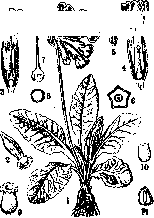
Primula officinalis: 1- flowering plant; 2- flower; 3 and 4- ovary in longitudinal section; 6- stamen; 5- cross section of flower; 7- pistil; 8- cross section of ovary; 9- opened fruit; 10- ovule; 11- seed in longitudinal section.
infusions of flowers and roots for calming pain in joint rheumatism and as a hypnotic. In 1920, Goris and Vishnyak isolated glycosides primverin and primulaverin from the root of P., which however did not find independent application. During the imperialist war, when it became necessary to replace imported ipecac and senega, the root of P. was proposed to be used as an expectorant. The action was partly based on the content of saponin-like substances in the root. Used in the form of an infusion 1.0-2.0-100.0 water, a tablespoonful every 2 hours. A number of preparations were released: tussipect - ammonium salt of P. saponins; primulat - liquid extract of P. and sweet violet; primulin - mixture of P. saponins with 20% sodium benzoate and 1.5% anise oil. Lit.: Gaisbsck F., Die Radix Primulae als Expektorans und Diuretikum, Klin. Wschr., 1924, p. 474-479; Joachimowitz R., Die Radix Primulae, ein neues Expektorans, Wien. klin. Wschr., 1920, p. 606-611.
infusions of flowers and roots for calming pain in joint rheumatism and as a hypnotic. In 1920, Goris and Vishnyak isolated glycosides primverin and primulaverin from the root of P., which however did not find independent application. During the imperialist war, when it became necessary to replace imported ipecac and senega, the root of P. was proposed to be used as an expectorant. The action was partly based on the content of saponin-like substances in the root. Used in the form of an infusion 1.0-2.0-100.0 water, a tablespoonful every 2 hours. A number of preparations were released: tussipect - ammonium salt of P. saponins; primulat - liquid extract of P. and sweet violet; primulin - mixture of P. saponins with 20% sodium benzoate and 1.5% anise oil. Lit.: Gaisbsck F., Die Radix Primulae als Expektorans und Diuretikum, Klin. Wschr., 1924, p. 474-479; Joachimowitz R., Die Radix Primulae, ein neues Expektorans, Wien. klin. Wschr., 1920, p. 606-611.
infusions of flowers and roots for calming pain in joint rheumatism and as a hypnotic. In 1920, Goris and Vishnyak isolated glycosides primverin and primulaverin from the root of P., which however did not find independent application. During the imperialist war, when it became necessary to replace imported ipecac and senega, the root of P. was proposed to be used as an expectorant. The action was partly based on the content of saponin-like substances in the root. Used in the form of an infusion 1.0-2.0-100.0 water, a tablespoonful every 2 hours. A number of preparations were released: tussipect - ammonium salt of P. saponins; primulat - liquid extract of P. and sweet violet; primulin - mixture of P. saponins with 20% sodium benzoate and 1.5% anise oil. Lit.: Gaisbsck F., Die Radix Primulae als Expektorans und Diuretikum, Klin. Wschr., 1924, p. 474-479; Joachimowitz R., Die Radix Primulae, ein neues Expektorans, Wien. klin. Wschr., 1920, p. 606-611.
Related articles
Cite this page
“Primula.” Soviet Medical Encyclopedia. English translation of Bolshaya Meditsinskaya Entsiklopediya, 1st ed. (Moscow, 1928–1936), ed. N. A. Semashko. https://sovietmedicalencyclopedia.pages.dev/article/primula/