Wild Tansy
Historical document, translated for reference. It reflects medical knowledge of the 1920s–30s and is not medical advice.
Summary
Wild Tansy is a perennial herbaceous plant found throughout the USSR, used in medicine against intestinal parasites but rarely due to potential poisoning risks. It contains essential oil and tannetin and can cause central nervous system effects in large doses.
Encyclopedia article (1928–1936)
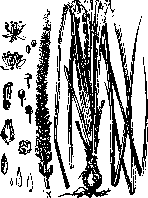
Wild Tansy, Tanacetum vulgare L., a perennial herbaceous plant of the composite family, found abundantly as a weed on field boundaries, along roads, and in ditches throughout the USSR. The plant's stem is straight, reaching 1-1.3 m in height; the leaves are oblong, pinnately dissected with pinnately lobed segments and serrated notches; the flower heads are hemispherical below and flat disc-shaped above, 6-8 mm in diameter; the flowers are bright yellow; the fruit is a five-angled achene. In medicine, the flowers, leaves, or herb are used, containing essential oil (0.1-0.2%) and the bitter substance tannetin, against ascarids and pinworms, but rarely due to possible poisonings; it is used in the form of infusions in enemas. When used in large doses (6-20 g as an abortifacient), it can cause convulsions and paralysis of the central nervous system. The essential oil, used for the same purposes, is even more poisonous and therefore requires special caution. Wild Tansy is more commonly used in veterinary medicine. In folk medicine, it is widely used against worms, headache, jaundice, to stop menstruation, and as an anti-cholera remedy.
Related articles
Mentioned in
Cite this page
“Wild Tansy.” Soviet Medical Encyclopedia. English translation of Bolshaya Meditsinskaya Entsiklopediya, 1st ed. (Moscow, 1928–1936), ed. N. A. Semashko. https://sovietmedicalencyclopedia.pages.dev/article/wild-tansy/