Rhubarb
Historical document, translated for reference. It reflects medical knowledge of the 1920s–30s and is not medical advice.
Summary
Rhubarb is a perennial herbaceous plant with large root leaves, native to southern Mongolia, Tibet, and China. It contains anthraglycosides and tannoglycosides that give it laxative properties, with applications in both adult and pediatric medicine.
Encyclopedia article (1928–1936)
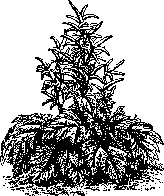
RHUBARB (Ph. VII), Rheum palmatum L. var. tanguticum MaximoVIcz, family Polygonaceae. A perennial herbaceous plant with very large root leaves. Grows wild in southern Mongolia, Tibet, and China (see Medicinal Plants). Cultivated in Germany; in the USSR, cultivation has been introduced but does not yet have industrial importance. Rheum officinale Baill. (see illustration) gives an inferior variety of R. Collection takes place in autumn; roots are discarded, rhizomes are cleaned and cut into pieces. According to the German Pharmacopoeia (1926), roots are also used. Commercial R. consists of pieces of various shapes; their surface is uniformly yellow, with a marbled fracture; on a white background are scattered numerous orange points and lines (medullary rays containing orange-colored anthraglycosides), sometimes forming characteristic figures of 'stars' (leaf bundles in cross-section) typical of true R rhizome. The odor of R is distinctive, the taste is bitter and astringent; R colors saliva yellow (anthraglycosides); it crunches on the teeth due to the abundance of large calcium oxalate crystals. R can be stored for years without losing its potency, but it spoils in damp rooms, easily absorbing moisture and becoming moldy. R contains two groups of substances that determine its medicinal properties: anthraglycosides and tannoglycosides. Anthraglycosides are found in both bound and free states; upon cleavage they give aglycones; rheum-emodin [C14H402(CH3)(OH)3 - methyltrioxyanthraquinone], identical with frangula-emodin (see Buckthorn), chrysophanic acid [(OH)(CH3)-CO C6H2C6H3OH, methyldioxyanthraquinone], rhein [C14H702(CH3)(OH)4-tetraoxymethylanthraquinone] and a number of other similar compounds. These are orange-colored substances, easily soluble in water, even more so in alkalis, and less soluble in alcohol. Tannoglycosides are less soluble in water and alkalis, but well soluble in alcohol. For identification of R, Bornträger's qualitative reaction is used (see Buckthorn). For quantitative determination of anthraglycosides, various chemical methods have been proposed. The biological action of R is tested on white mice. R belongs to the group of plant laxatives that act on the large intestines similarly to buckthorn, senna, and Alexandrian leaf. In large doses, R causes liquid stools, in medium doses a papaceous consistency, and in small doses it weakens peristalsis and is therefore used against diarrhea in children. If the dose of R is significant (0.8-1.0 or more), then in humans the effect of anthraglycosides, both free and perhaps even more of those not isolated in pure form and close to cathartic acid, is first and foremost strongly manifested. The action of R, as containing anthracene derivatives, is due to the excitation of the main muscle layers of the large intestines; anthracene group substances exert only a weak effect in the small intestines, probably due to the absence here of corresponding conditions for their dissolution. It is noted that for the laxative effect of rhubarb, the presence of bile in the intestine is a necessary condition. With large doses of R, or with sufficiently rapid evacuation of its contents from the intestine, the rhubarb tannin substances usually do not have time to exert their astringent effect; but sometimes the laxative effect of R is followed by constipation, which is associated with the strong influence of tannoglycosides. Emodin, chrysophanic acid, as well as amorphous and still insufficiently studied chemically, components of R—haporetin, phoretin, and erythroretin—have antiseptic properties, due to which the therapeutic value of R significantly increases compared to other laxatives that lack antiseptic properties. Large doses of R, while having a laxative effect, can cause pain and colic in the intestines, especially if the medicine is taken on an empty stomach. Medium doses of R (0.1-0.2 per dose) cause a papaceous stool (laxative effect) as a result of the mild irritating action of anthraglycosides on the intestine, moderated by the influence of tannoglycosides or rhubarb tannin substances, which manifest their effect in these cases due to the longer duration of R's stay in the intestines. If R is given in small doses (0.05-0.1), then the rhubarb tannin substances, with their astringent effect, cause the cessation of diarrhea, in which the components of R belonging to the anthracene series play a significant role, acting antiseptically. When taking R, due to the excreted anthraquinone derivatives, urine, feces, sweat, and milk turn yellow, which turns red under the influence of alkalis. Rhubarb is prescribed in powders, pills, and infusion in doses of 0.8-2.0 as a laxative and in doses of 0.1-0.2 as a regulator of intestinal function. Preparations: Pulvis Magnesiae cum Rheo (Ph. VII), children's powder, consists in addition to R of magnesium carbonate salt, which neutralizes acids and has a laxative effect, and sugar with dill essential oil, which has carminative properties. Prescribed to children on the tip of a knife to a teaspoonful, depending on age and indications. Extractum Rhei (Ph. VII), dry rhubarb extract; prescribed internally in pills of 0.1-0.3 as a tonic; in doses of 0.5-1.0 as a laxative. Extractum Rhei compositum (Ph. VII), compound rhubarb extract, in pills of 0.1-0.3 as a tonic; in doses of 0.5-1.0 as a strong laxative. Sirupus Rhei (Ph. VII), rhubarb syrup, taken by teaspoonful as a gentle laxative for children. Tinctura Rhei aquosa (Ph. VII), aqueous tincture of R, used as a laxative by the tablespoonful. Tinctura Rhei amara spiritusa (Ph. VII), bitter alcoholic tincture of R, used in ½-1 teaspoonful 2-3 times a day ½ hour before meals as a stomachic.
_*г^-!
in water and in alkalis, but well soluble in alcohol. For identification of R, Bornträger's qualitative reaction is used (see Buckthorn). For quantitative determination of anthraglycosides, various chemical methods have been proposed. The biological action of R is tested on white mice. R belongs to the group of plant laxatives that act on the large intestines similarly to buckthorn, senna, and Alexandrian leaf. In large doses, R causes liquid stools, in medium doses a papaceous consistency, and in small doses it weakens peristalsis and is therefore used against diarrhea in children. If the dose of R is significant (0.8-1.0 or more), then in humans the effect of anthraglycosides, both free and perhaps even more of those not isolated in pure form and close to cathartic acid, is first and foremost strongly manifested. The action of R, as containing anthracene derivatives, is due to the excitation of the main muscle layers of the large intestines; anthracene group substances exert only a weak effect in the small intestines, probably due to the absence here of corresponding conditions for their dissolution. It is noted that for the laxative effect of rhubarb, the presence of bile in the intestine is a necessary condition. With large doses of R, or with sufficiently rapid evacuation of its contents from the intestine, the rhubarb tannin substances usually do not have time to exert their astringent effect; but sometimes the laxative effect of R is followed by constipation, which is associated with the strong influence of tannoglycosides. Emodin, chrysophanic acid, as well as amorphous and still insufficiently studied chemically, components of R—haporetin, phoretin, and erythroretin—have antiseptic properties, due to which the therapeutic value of R significantly increases compared to other laxatives that lack antiseptic properties. Large doses of R, while having a laxative effect, can cause pain and colic in the intestines, especially if the medicine is taken on an empty stomach. Medium doses of R (0.1-0.2 per dose) cause a papaceous stool (laxative effect) as a result of the mild irritating action of anthraglycosides on the intestine, moderated by the influence of tannoglycosides or rhubarb tannin substances, which manifest their effect in these cases due to the longer duration of R's stay in the intestines. If R is given in small doses (0.05-0.1), then the rhubarb tannin substances, with their astringent effect, cause the cessation of diarrhea, in which the components of R belonging to the anthracene series play a significant role, acting antiseptically. When taking R, due to the excreted anthraquinone derivatives, urine, feces, sweat, and milk turn yellow, which turns red under the influence of alkalis. Rhubarb is prescribed in powders, pills, and infusion in doses of 0.8-2.0 as a laxative and in doses of 0.1-0.2 as a regulator of intestinal function. Preparations: Pulvis Magnesiae cum Rheo (Ph. VII), children's powder, consists in addition to R of magnesium carbonate salt, which neutralizes acids and has a laxative effect, and sugar with dill essential oil, which has carminative properties. Prescribed to children on the tip of a knife to a teaspoonful, depending on age and indications. Extractum Rhei (Ph. VII), dry rhubarb extract; prescribed internally in pills of 0.1-0.3 as a tonic; in doses of 0.5-1.0 as a laxative. Extractum Rhei compositum (Ph. VII), compound rhubarb extract, in pills of 0.1-0.3 as a tonic; in doses of 0.5-1.0 as a strong laxative. Sirupus Rhei (Ph. VII), rhubarb syrup, taken by teaspoonful as a gentle laxative for children. Tinctura Rhei aquosa (Ph. VII), aqueous tincture of R, used as a laxative by the tablespoonful. Tinctura Rhei amara spiritusa (Ph. VII), bitter alcoholic tincture of R, used in ½-1 teaspoonful 2-3 times a day ½ hour before meals as a stomachic.
____
Related articles
Mentioned in
Cite this page
“Rhubarb.” Soviet Medical Encyclopedia. English translation of Bolshaya Meditsinskaya Entsiklopediya, 1st ed. (Moscow, 1928–1936), ed. N. A. Semashko. https://sovietmedicalencyclopedia.pages.dev/article/rhubarb/