Alexandrian Leaf
Historical document, translated for reference. It reflects medical knowledge of the 1920s–30s and is not medical advice.
Summary
Alexandrian Leaf, or Folium Sennae, consists of the dried leaflets of two Cassia species used historically as a laxative. The article details its active anthraquinone constituents, physiological effects primarily on the large intestine, and various traditional pharmaceutical preparations such as infusions, powders, and compound elixirs.
Encyclopedia article (1928–1936)
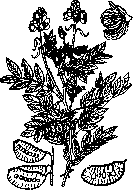
ALEXANDRIAN LEAF, Folium Sennae (State Pharmacopoeia VII), dried leaflets of the compound paripinnate leaf of two species of Cassia (family Caesalpiniaceae): Cassia acutifolia Delile—Alexandrian senna (middle Nile), and Cassia angustifolia Vahl—Indian or Tinnevelly senna (shores of the Red Sea and Hindustan). Alexandrian leaf, used as a laxative, acts mainly on the large intestines, increasing the normally slow peristalsis of the colon; the movements of the stomach and small intestines are not noticeably changed. The active principles—anthraquinone derivatives (cathartic acid, chrysophanic acid, and emodin)—are found in the Alexandrian leaf both in a free state and in the form of glucosides. Preparations: 1) Fol. S. spiritu extractum, leaves treated with 90° alcohol to remove resin, which is blamed for a side effect expressed as abdominal pain; 2) Inf. Sennae—an infusion prepared by hot or cold methods (5.0:50.0); dose: 1–3 tablespoons; 3) Inf. S. compositum, Vienna drink—an infusion of Alexandrian leaf with Rochelle salt, honey, and alcohol; dose: 1–2 tablespoons; 4) Inf. S. salinum—an infusion of Alexandrian leaf with sodium sulfate and honey; 5) Electuarium e S.—laxative electuary—Alexandrian leaf with sugar syrup and tamarind pulp; dose for children: teaspoons; 6) Pulvis Liquiritiae compositus—compound liquorice powder—a mixture of Alexandrian leaf, liquorice root, dill seed, sulfur, and sugar; dose: teaspoons; 7) Species laxantes St. Germain—St. Germain laxative tea—a mixture of Alexandrian leaf extracted with alcohol, dill and anise seeds, elderflowers, and Rochelle salt; infusion: 1–2 teaspoons per cup of water (for a single dose); 8) sennatin, Sennatin, a liquid containing all the active principles of the Alexandrian leaf, administered via subcutaneous and intramuscular injections of 1–2 cubic centimeters (Credé, Drews).
extracted with alcohol, dill and anise seeds, elderflowers, and Rochelle salt; infusion: 1–2 teaspoons per cup of water (for a single dose); 8) sennatin, Sennatin, a liquid containing all the active principles of the Alexandrian leaf, administered via subcutaneous and intramuscular injections of 1–2 cubic centimeters (Credé, Drews).
Related articles
Mentioned in
Cite this page
“Alexandrian Leaf.” Soviet Medical Encyclopedia. English translation of Bolshaya Meditsinskaya Entsiklopediya, 1st ed. (Moscow, 1928–1936), ed. N. A. Semashko. https://sovietmedicalencyclopedia.pages.dev/article/alexandrian-leaf/