Amoeboid Movements
Historical document, translated for reference. It reflects medical knowledge of the 1920s–30s and is not medical advice.
Summary
This article describes amoeboid movement as a form of locomotion in certain protozoa and wandering cells, such as leukocytes, characterized by the formation of pseudopodia. It discusses the physical and chemical mechanisms behind these movements, including surface tension, intracellular osmotic pressure, and the influence of environmental factors like temperature and pH.
Encyclopedia article (1928–1936)
Amoeboid movements, movements by means of pseudopodia (false feet), characteristic of certain protozoan animals (Protozoa) and wandering amoeboid cells of the blood and connective tissue (leukocytes, amoebocytes), are expressed in the formation of protoplasmic protrusions of variable shape (pseudopodia) on the surface of the protozoan body or the motile cell, which serve for locomotion and for capturing food. Amoeboid movements can arise at any place on the surface of the protozoan body or wandering cell without relation to their axis; they can also arise simultaneously in different places on the body and occur in different directions (see figure). Amoeboid movements, and consequently pseudopodia, are closely connected with intracellular currents of protoplasm. The external manifestations of amoeboid movements, i.e., the shape of the pseudopodia, are very diverse: in rhizopods, depending on the properties of the outer layer of the body, pseudopodia can be finger-shaped (lobopodia), radiant (actinopodia), thread-like (filopodia), and reticulate; they can be long or short, etc. (see figure 1 in the article Amoebae).
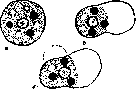
Formation of pseudopodia in an amoeba: a—Entamoeba histolytica at rest; b and c—two successive moments of pseudopodia formation.
The character of amoeboid movement can be fluid or rolling, slow or rapid. In the normal state, protoplasm has a semi-liquid consistency. As a result, during the formation of pseudopodia, amoeboid movements obey the laws of surface forces acting at the boundary of two immiscible liquids. Possessing a higher surface tension than water, the protoplasmic body tends to take the shape of a sphere, but upon a decrease in surface tension in any place, when an excess of intracellular osmotic pressure arises, a protrusion of protoplasm—a pseudopodium—is formed in that place. The correctness of this interpretation of the mechanism of amoeboid movements is to a significant degree confirmed by the "amoeba model" created by Bütschli. According to his method, a drop of olive oil, ground with potash, is placed in glycerin. Due to the partial saponification of the oil drop, local changes in its surface tension occur, and the drop begins to produce the most diverse amoeboid movements. At the same time, the same circular, i.e., fountain-like, movements of the liquid are observed inside it, which are often observed during the movement of living protoplasm. Besides surface tension, the mechanism of amoeboid movements is undoubtedly connected with other processes that influence the change in the aggregate state of the protoplasm and lead to a change in the viscosity of its surface layer. The main cause of all these changes is, in all probability, related to phenomena of metabolism (assimilation and dissimilation) in the cell, since these processes can result in a decrease or increase in the number of molecular complexes; depending on this, both surface tension and intracellular pressure can change. However, like other physical-chemical phenomena, amoeboid movements also depend on temperature, on the active reaction of the medium [determined by the so-called hydrogen ion concentration index (pH)], on the content of oxygen and carbon dioxide, and on the salt composition of the surrounding environment, which influence the viscosity of the protoplasm. Depending on the salt composition of the medium, amoeboid movements can manifest in the form of positive or negative chemotaxis (see). G. Epstein.
Related articles
Mentioned in
Cite this page
“Amoeboid Movements.” Soviet Medical Encyclopedia. English translation of Bolshaya Meditsinskaya Entsiklopediya, 1st ed. (Moscow, 1928–1936), ed. N. A. Semashko. https://sovietmedicalencyclopedia.pages.dev/article/amoeboid-movements/