Cavernous
Historical document, translated for reference. It reflects medical knowledge of the 1920s–30s and is not medical advice.
Summary
This article defines the anatomical term 'cavernous' and describes the structure and function of the cavernous bodies of the penis, urethra, and glans, as well as the cavernous sinus of the brain.
Encyclopedia article (1928–1936)
CAVERNOUS, cavernosus (from Latin caverna—cave), cavernous, an anatomical term applied to organs in which there are wide cavities or lacunae filled with blood. The corpora cavernosa, cavernous bodies of the external genital and urinary organs—the penis, urethra, glans of the penis and clitoris—possess the ability to swell, increase in volume, and harden (erection) as a result of intensified blood filling. This is achieved by the presence of a dense membrane, a large number of blood lacunae or caves in the main mass of the cavernous body, and a special structure and arrangement of arteries and veins. The cavernous bodies of the penis have a very dense fibrous membrane, tunica albuginea (on average 1 mm thick), with a small amount of elastic fibers, bundles of which form the outer longitudinal and inner transverse layers. In the septum (septum) longitudinal bundles are absent, and between the inner ones remain slits establishing communication between the two cavernous bodies. The main mass has a spongy structure and is built from trabeculae, between which are communicating cavities of irregular shape (areolae, cavernae) filled with blood (Fig. 1). The trabeculae consist of fibrous connective tissue with elastic fibers and a large number of bundles of smooth muscle tissue; they are lined with endothelium on their surface. Blood vessels in general have the appearance of narrow, communicating spaces, wider in the central part than in the peripheral part; at the moment of erection they expand extremely, pushing apart and stretching the trabeculae (Fig. 2). Views on the nature of the cavernae diverge: some authors consider them dilated veins (Kolliker, Ebner); others, emphasizing the arterial nature of the blood flowing through them, call them arteriovenous anastomoses (Braus); French authors (Nicolas, Retterer), based on embryological data, assert that they are enormously dilated capillaries. The arteries of the cavernous bodies are strongly tortuous (a. helicinae); part of them breaks up on the surface into a capillary network that passes into the cavernae; another part penetrates inside and opens directly into the cavernae (Langer), thickening at the free end. On the inner wall of the small arteries there are cushion-like thickenings of longitudinal smooth muscles located between the layers of the internal elastic membrane; in the resting state of the organ they reduce the inflow of blood. The veins draining blood take their origin for the most part directly from the central cavernae; therefore, during erection their lumen is compressed, which increases the blood filling of the tissue.
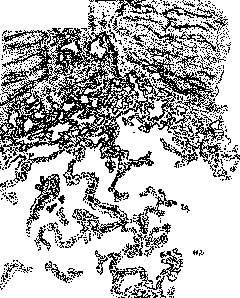
Fig. 1. Corpus cavernosum penis, cross-section; collapsed state. (According to Braus.)
The cavernous body of the urethra differs by a thinner membrane, with a greater content of elastic fibers and the presence of smooth muscles in it; the cavernae are in general narrower, and the trabeculae, on the contrary, are wider and contain fewer muscles. A direct transition of arteries into the cavernae is not observed.
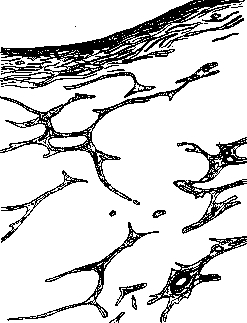
Fig. 2. Corpus cavernosum penis; artificial erection obtained by injection of gelatin. (According to Braus.)
The cavernous body of the glans has a special character: it is devoid of a membrane and represents a collection of wide, tortuous veins, between which is connective tissue with elastic networks, without smooth muscles.
Sinus cavernosus, cavernous sinus, paired venous sinus of the base of the brain, located on the sides of the sella turcica and entering into the composition of the circulus venosus Ridleyi (sinus circularis Ridleyi); its cavity is pierced by the carotid artery and is penetrated by trabeculae of connective tissue, communicating its cavernous character. The term 'cavernous' is also applied to some types of angioma. V. Karpov.
Related articles
Mentioned in
Cite this page
“Cavernous.” Soviet Medical Encyclopedia. English translation of Bolshaya Meditsinskaya Entsiklopediya, 1st ed. (Moscow, 1928–1936), ed. N. A. Semashko. https://sovietmedicalencyclopedia.pages.dev/article/cavernous/