Angioma
Historical document, translated for reference. It reflects medical knowledge of the 1920s–30s and is not medical advice.
Summary
Angioma refers to a vascular tumor, typically benign and slow-growing, classified as hemangiomas (blood vessel tumors) or lymphangiomas (lymph vessel tumors). These tumors can develop from abnormal vascular development, pre-existing vessel dilation, or as true tumors, with various types including arterial, capillary, and cavernous angiomas.
Encyclopedia article (1928–1936)
ANGIOMA (from Greek angeion-vessel), a vascular tumor. A distinction is made between hemangiomas and lymphangiomas, depending on which vessels constitute the tumor mass; under the term A., hemangiomas are usually meant, i.e., tumors from blood vessels. In their main mass, A. are products of the faulty development of the vascular system of a given area (so-called hamartomas, see); for example, vascular warts (naevus vasculosus), birthmarks (often familial) belong here. Part of A. arises by dilation of pre-existing vessels due to changed relationships with surrounding tissues, e.g., in focal atrophy of an organ's parenchyma (liver), in connection with vasomotor disorders, etc.; senile skin angiomas, hemorrhoidal nodes also belong here. Such dilation of pre-existing small vessels is also designated as telangiectases. A. also arise on the basis of organizational and inflammatory processes, e.g., in organized thrombi, granulation tissue. Finally, part of A. represents true tumors-angioblastomas. A. belong to benign tumors with slow growth; their size is usually small, form is round or irregular, color is dark red; on mucous membranes A. often have the appearance of polyps.

Types of A. are distinguished: 1. Arterial, when the vessels of the tumor resemble arteries or arterioles in their structure; if arteries already macroscopically resemble a characteristic plexus, sinuously twisting, then one speaks of aneurisma cirsoideum, A. arteriosum racemosum or A. plexiforme (Rankenangiom); A. of this last kind are observed on the face, head coverings or in the brain, where they can lead to fatal hemorrhages. Arterial A. can change their tension and size under the influence, e.g., of changes in innervation, hence the term tumor erectilis (see also Arterioma).
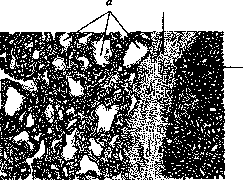
2. A. capillary (A. simplex), consisting of a dense interlacing of capillaries, which usually have a particularly succulent endothelium and narrow lumen (these A. are also called hypertrophic; see figure 1). 3. A. cavernous, i.e., built according to the type of cavernous tissue, resembling, e.g., cavernous tissue of the penis; vessel walls are thin, lumens are wide, often irregular (see figure 2); this type of A. is sometimes incorrectly genetically connected with veins; the starting point here is capillaries.
The location of A. is very diverse; more often on the face, head skin, mucous membranes, liver, especially in old subjects. Sometimes A. (especially cavernous) are multiple, located in dozens on the coverings, mucous membranes and in all internal organs-the so-called angiomas, with various complications observed in connection with the peculiarities of localization, size of the tumor, e.g., cases of intestinal intussusception with multiple angioma polyps of it, hemorrhages into the brain, etc. In individual cases, A. are combined with hypertrophy of surrounding tissues (telangiectatic elephantiasis). Metastasizing A. have been described. Treatment of A.: removal by excision or cauterization; injection of alcohol around the periphery of A. (thrombosis of vessels). Sometimes A. spontaneously thrombose and organize (e.g., in the liver).
Related articles
Mentioned in
- Aneurysm
- Angiectasia
- Arteriectasia
- Arterioma
- Artery
- Botryomycosis
- Brain (551 General diagnostics of brain diseases)
- Capillaries
- Cauterization
- Electropuncture
- Erythrocytoma
- Glioma
- Hamartoma, Hamartia, Hamartoblastoma
- Hutchinson
- Intussusception (a1159)
- Naevus
- Perithelioma
- Phlebectasia
- Retinal Angiomatosis
- Telangiectasia
Cite this page
“Angioma.” Soviet Medical Encyclopedia. English translation of Bolshaya Meditsinskaya Entsiklopediya, 1st ed. (Moscow, 1928–1936), ed. N. A. Semashko. https://sovietmedicalencyclopedia.pages.dev/article/angioma/